Moroccan Darija (Casablancan Koiné): A Historical Approach

Written by Afsheen Sharifzadeh, a graduate of Tufts University focusing on Iran and the Caucasus. The goal of this article is to explore the origins of Moroccan Darija through the lens of local sedentary and Bedouin dialects, and to examine historic contacts with autochthonous Berber languages and foreign languages such as Spanish and Persian.

The main courtyard and its reflection pool, Ibn Youssef madrasa and mosque complex, Marrakesh, Morocco (c. 1564 A.D)

Background

Northwest Africa (the “Maghreb”, from Arabic المغرب الاقصى al-maġrib al-aqṣa “the farthest West”; and, more recently, Berber: ⵜⴰⵎⴰⵣⵖⴰ Tamazɣa “Land of the Imazighen [Berbers]”) experienced two waves of Arabization separated in time by nearly five centuries. Following a classification made by Ibn Khaldūn, the first wave was composed of mainly urban soldiers while the second wave brought thousands of nomadic Arabian families to the region. The number of Arabophones who arrived in both cases must have been relatively small compared to the indigenous Berber- (and, formerly, Latin-) speaking populations, and whilst many Berbers shifted to the language of their new conquerors over the centuries, this process has failed to result in the adoption of an exclusively Arab identity. 

Arabic vernaculars in Morocco, Algeria and Tunisia are referred to locally as Darija (lit. “vernacular language”), while the literary Arabic standard used in education, broadcast and administration is called ʕarabiyya fuṣḥa (lit. “eloquent Arabic”). Darija varieties may in turn be divided into sedentary (pre-Hilali, or مديني mdīni lit. “urban”, or حضري ħadˤari “settled”) and Bedouin (Hilali or عروبي ʕarūbi, lit. “Arabian”) dialects. However, these descriptors technically refer to the medieval “Middle Eastern” vernaculars from which they descend rather than the lifestyles of their current speakers. While there is largely direct lineage between the progenitor Middle Eastern urban dialects and Moroccan urban dialects, in some cases, they do not correspond. For example, the Jebli Arabic dialect spoken in the northwestern rim of the Atlas mountains represents a “sedentary” (Pre-Hilali) dialect adopted by Berber mountaineers along the trade routes between Fes and Tangier, which therefore links it with the old urban dialects of North Africa. Moreover, Moroccan Darija, which originated in 20th century Casablanca and is now the lingua franca of the country, is of Bedouin provenance (discussed below).

To further complicate the linguistic landscape in Morocco, sedentary and Bedouin Arabic varieties have interacted individually with neighboring Berber languages for over a millennium. The sedentary (Pre-Hilali) Arabic dialects, representing the first layer of Arabization, are the most innovative and bear the strongest morphosyntactic traces of these contacts. In contrast, Bedouin dialects by and large were influenced by Berber phonetic and semantic interferences. Another distinguishing feature of the sedentary Arabic varieties is the presence of Spanish lexica, transferred by Andalusian Muslim and Jewish refugees who were expelled from Spain during the reconquista and settled in North African cities, while the Bedouin dialects obviously escaped these influences.

Moroccan Darija, which can be used interchangeably with “Casablancan Koine”, arose recently as a product of rapid urbanization around Casablanca in the 20th century. The dialect is of Bedouin provenance, owing to the origin of most Casablancans, but it features a strong admixture of Pre-Hilali elements brought by old urban elites who migrated from Fes, Rabat, Salé, Meknès and other northern cities. It thus represents a conglomeration of diverse contact-induced changes and koineization brought about by recent demic diffusions rather than the modern iteration of any singular historically attested dialect. Although it is now the mother language of a plurality of Moroccans, there still exists a significant degree of variation within Koine speakers, owing to its rather recent genesis and the varied regional origins of its speakers. At times, such as in the case of Fessis, Koine speakers have purposefully transferred certain features of their ancestral lects (e.g. Fessi use of non-trilled [ɹ], emphasized occlusive laryngeal  [ʔˤ] or [q] in lieu of Bedouin [g], and gender-neutralized second person pronoun انتينا intīna in the perfective and imperfective aspects) due to historic sociolinguistic associations between these features and urbane refinement and, thereby, prestige.

Painted wood or Tazouaqt (Arabic: تزواقت, from Berber ⵜⴰⵣⵡⵡⴰⵇⵜ) at the entrance to the mausoleum of Moulay Idriss II in Fez, Morocco (c. 1440 A.D., almost completely replaced in the 18th century by Moulay Ismail in a style typical of the Alaouites )

Sedentary (pre-Hilalian) Arabic dialects:

The first wave of Arabs arrived armed on horseback, apparently without their families, in the 7th century AD. This band was composed of mixed urban Arabians (presumably Meccans) and “Middle Eastern” Muslim converts–soldiers hailing from Syria, Mesopotamia, Persia, Egypt and elsewhere–who introduced complex Perso-Arabian Islamic material culture and sedentary Arabic varieties to Roman Africa, the two Mauretaniæ and Hispania. In 670 A.D., the city of Kairouane (from Middle Persian 𐭪𐭠𐭫𐭥𐭠𐭭 kārawān “military column; caravan”) was established as a headquarters for the Muslims’ expansionist ambitions in the region, wherefrom they “plunged into the heart of the country, traversed the wilderness in which his successors erected the splendid capitals of Fes and…[Marrakesh], and at length penetrated to the verge of the Atlantic and the great desert” (Edward Gibbon).

It appears that the newcomers, apparently numbering only in the few thousands, exchanged extensively with their Berber-speaking neighbors, who must have greatly outnumbered them. In the culinary sphere, they were introduced to local foods (Berber ⵙⴻⴽⵙⵓ seksu → Arabic كسكسو ksksu “couscous”) and in return, they transferred tastes from the orient (particularly Persian cuisine, discussed below). However, owing to the very fact of their small numbers, apparently not enough correct Arabic input was available to language learners, which resulted in significant interference from Berber in the learning process. For example, it has been suggested that the agentive “m” prefix arose due to overgeneralization of a corresponding Berber agentic prefix (ⴰⵎ am-) with a broader scope of use in the first stages of language learning (e.g. مزيان mzyān “good” from زين zayn; including exceptional cases that are actually derived from Berber roots; e.g. Shilha ⴰⵎⵥⵍⵓⴹ amẓluḍ “poor” → مزلط məzluṭ “poor”). The extension of the “fəʕʕal” class of nouns–an unproductive form limited only to occupations in Classical Arabic (e.g. نجار nəjjār “carpenter”)– was probably an attempt by Berber bilinguals to use what they thought was the correct Arabic participial form (e.g. Darija خواف xəwwāf “”fearful”). 

This wave was followed by a period of intense Islamization of the “pagan” autochthones, whilst per Quranic prescriptions the ahl al-ḏh̲imma (Iberian Christians and Jews, Berber Jews) were largely left alone. For centuries thereafter, Arabs and Berbers lived in uneasy communion with each other–the latter frequently serving as clients to the former–until various Berber-led rebellions toppled the Umayyad Caliphate by the middle of the 8th century. Arabic vernaculars remained essentially confined to the cities which the Arabs inhabited, whereas in the countryside, Berber languages remained the means of inter-community communications until present times. In the 9th century after the foundation of Fes, the capital of the Idrisids, Arabic became more prestigious with thousands of refugees from Andalusia and Kairouane arriving in that city and founding great mosques and madrasas (al-Andalusiyyin “Andalusians” and al-Qarawiyyin lit. “Kairouanians” mosques, c. 859 A.D.). In a sociolinguistic sense, this influx meant there was suddenly enough native Arabic input available to learners, as well as a social motivation to speak “pure” Arabic, which favored the eradication of salient Berber transferrences. It probably served to reverse the process of creolization in urban dialects which had been underway before this period. However, the few exceptional items which survived were probably too frequent by that time to be leveled by prescriptive Arabic influences (e.g. مزيان mzyān “good”; جوج juj “two”; imperative اجي aji “come!” through elimination of irregular تعال taʕāl “come).

The urban Arabic dialects in Morocco which descend from the first wave of Arabization include those of Fes, Salé, Rabat, Meknès, Marrakesh, Tétouane, Chefchaouen, Tangier, Ouazzane, Taza, as well as the Jebli dialects in the Rif region. Across modern political borders, the dialects of most old cities in the Maghreb (Tlemcen, Constantine, Tunis, Kairouane, Oran, Tripoli etc.) are included in this group. Although a minority dialect, Fessi is today considered a prestige dialect in Morocco inasmuch as it is associated with the landed aristocracy that has mostly migrated to Casablanca within the last century, drawn by the numerous French language schools there. The core vocabulary of the urban Arabic varieties in the Maghreb often corresponds to urban dialects further east, such as in the case of Fessi Arabic, vis-à-vis Casablancan Koine which is of Bedouin provenance:

EnglishMoroccan DarijaFessi ArabicDamascene Arabic
“He did”dārɛamalʕamal
“I liked”bġitḥabbitabbeyt
“heart”gəlbʔalb*ʔalb
“What’s your name?”ašnu smītekšnu ʔesmekšu ʔesmek
“Listen!”nnitsmaʕismaʕ
“Good”mzyānmli, mzyānmni
“Here! (take this!)”hākkhūdkhud
*Classical Arabic qalb with /q/ is also used

Pre-Hilali dialects like Fessi and, through influence, Casablanca Koine, make the most use of analytic morphology such as the analytic genitive instead of the constructed genitive which is used in ʕarūbi lects. A few salient Pre-Hilali morphologic innovations are listed below:

  1. In Koine, the constructed genitive is no longer productive and is used only in certain relatively frozen constructions, having been replaced by dyāl or d(e.g. L-malek d’l-mghrib “The King of Morocco”).
    1. Some ʕarūbi glosses with the constructed genitive are preferred in Koine (akhūti “my brothers”) in contrast to the more innovative Pre-Hilali forms used in the northern city dialects (khāwa dyāli “ibid.”)
  2. Analytic elatives using ktar “more” have replaced the Classical Arabic afʕal construction : bnīn ktar “tastier” instead of *abnan
  3. Indefinite singular nouns employ a gender neutralized prefix واحد ال wad l- in lieu of a gendered suffix (this development parallels the Medieval Baghdadi prefix فد fad “a” from فرد fard)
  4. An analytic dual construction emerged which has supplanted the inherited dual case. It uses the word جوج juj “two” (from Classical Arabic زوج zawj “pair; couple” > Greek ζεῦγος zeûgos “yoke” via Aramaic ܙܘܓܐ zawgā). 
  5. The feminine singular designation for inanimate plurals in Classical Arabic was replaced by masculine gender and plural number: bināyāt zuwīnīn “beautiful buildings”.
EnglishMoroccan DarijaModern Standard Arabic
“Beautiful things”Shiwāyej zuwīnīnAshyāʔ jamila
“Many things”Bzzāf dyāl wāyejAshyāʔ kaīra 
“Tasty, tastier”Bnīn, bnīn ktarLaḏīḏ, alaḏḏ
“One man”Waḥd r-rajelRajul wāḥed
“Two women”juj d’l-ʕiyālātimraʔatān
“Our house is more beautiful than their house”D-dār dyālna zuwīna ktar mn d-dār dyālhumBaytuna ajmal min baytihim

As in other dialects, new native formulations arose, albeit with little concordance with the eastern Arabic idioms: باش bāš “in order to”, from بِأَيِّ شَيْء‎ (biʾayyi šayʾ, “with what thing”);

لاباس labās “well, good” from Arabic لَا بَأْسَ‎ (lā baʾsa), the verbal noun of بَؤُسَ‎ baʾusa “damage, calamity”; كاين kāyin “there exists” (from كائن kā’en “existing”; cf. Medieval Baghdadi Arabic اكو aku from يكون yakūn). Some further innovations include:

  1. Use of ka- or the variant ta- for progressive tense; e.g. ka-nktəb “I write”, ta-tbġini “You love me”
  2. The future tense is constructed using ġādi or simply ġa- (cf. Classical Arabic ġadan “tomorrow”)
  3. First person marker with n- and first person plural use of prefix n- + suffix -u; e.g. nmši “I go”, nmšiu “We go”
  4. Use of feminine 2nd person perfect verb endings (-i) (note: Pre-Hilali dialects use an immutable pronoun intīna with the masculine 2nd person perfect verb ending)
EnglishMoroccan DarijaMuslim Baghdadi ArabicDamascene Arabic
“I just came to tell you that I love you very much”Ġīr jīt bāš ngullək ka-nbġīk bzzāf (variant ta-nbġīk)Bas ijeet ʕalamud agullak innu āni aebbek hwāye Bas ijet ʕashān aʔullak innī baḥebbak ktīr
“There is or there isn’t”Kāyen wla ma kāyenšAku lo mākuFī aw mā fī
“I will dance too”Ḥta ana ġādi nšaĀni ham ra arguṣAna ra arʔuṣ kamān
“Because”Ḥet, ḥetāš liʔanleʔannu
“We wanted to sleep there”Kenna nbġīu nnəʕʕsu təmmākČinna nrīd ənnām əhnākeKān biddna nnām hunīk
“If you were a true Moroccan, you shouldn’t have sold your country to foreigners”Kūn kenti maḡribi quḥḥ, kūn ma bʕtiš l-blād dyālek lgwarLo činit maghrebi ḥaqiqi, ma chān baʕet blādek lil faranj Iza kent maghrebi aʔiʔi, ma kān beʕt baladak lil faranj

On the Persian Elements in Morocco

Old urban dialects, such as that of Fes, have imbued Moroccan Darija with words of early imperial Islamic origin which recall the Orient, including: بالزاف bzzāf “very; a lot” (from Classical Arabic بالجزاف bil jazāf, itself from Persian گزاف gazāf “exaggerated, excessive”) and ڭاوري gāwri (from Persian گاور gâvor “Zoroastrian from Mesopotamia”; later adopted by the Muslims meaning “infidel”), كفتة kafta (from Persian كوفته kūfte, كوفتن kūftan “to beat, grind, shatter”), شوربة shurba “soup” (from Persian شوربا šurbâ “a kind of stew”, lit. “salty/sour stew”); مݣانة magāna “clock, watch” from Persian پنگان pengān “water clock” (cf. Tunisian Arabic منڨالة mungāla), شرجم،سرجب sarjam/sharjab “window”  from Persian چارچوب čârčub “frame”; note Libyan Arabic  روشن‎ rōšan, “window” from Persian روزن rowzan‎ “crevice, hole”); بزطام bizṭām (cf. Algerian Arabic تزدام tezdām) from Persian جزدان jozdān “wallet”; سطوان siṭwān “tiled courtyard surrounded by peristyle within the house” (from Persian ستون sotun “column”); خرشوف xarshūf “artichoke” (from Middle Persian 𐭤𐭠𐭫𐭰𐭥𐭯 *xār-čōp, lit. “thorny stick”), خمم xemmem “to think” (irregular variant with -m final of Classical Arabic خمن xammana “to guess, suspect”, maybe ultimately an assimilated root from Persian گمان gumān “supposition; speculation”). Urban dialects like that of Salé have preserved other Abbasid archaisms, such as مارستان māristān “hospital”, from Persian بيمارستان bimārestān

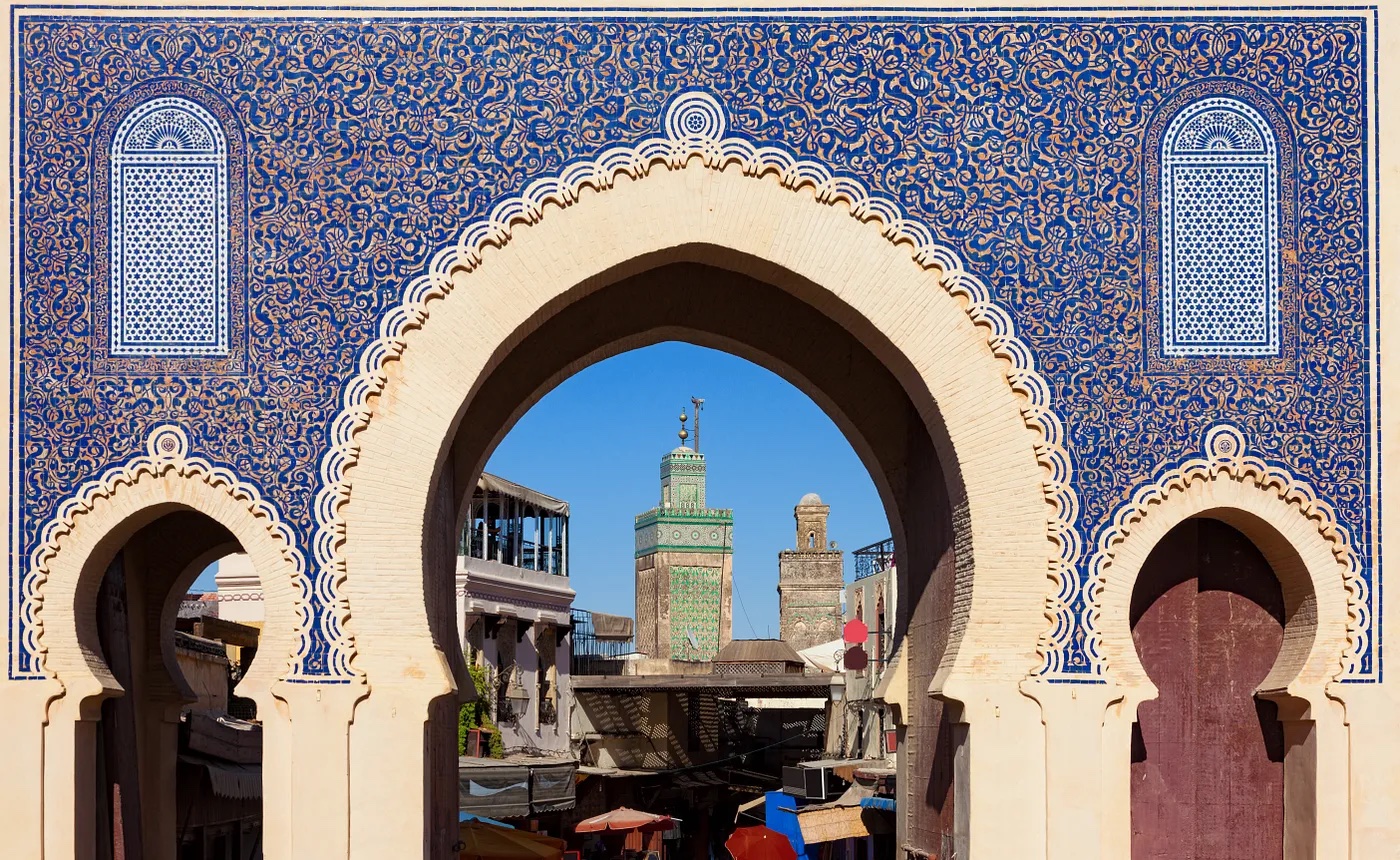
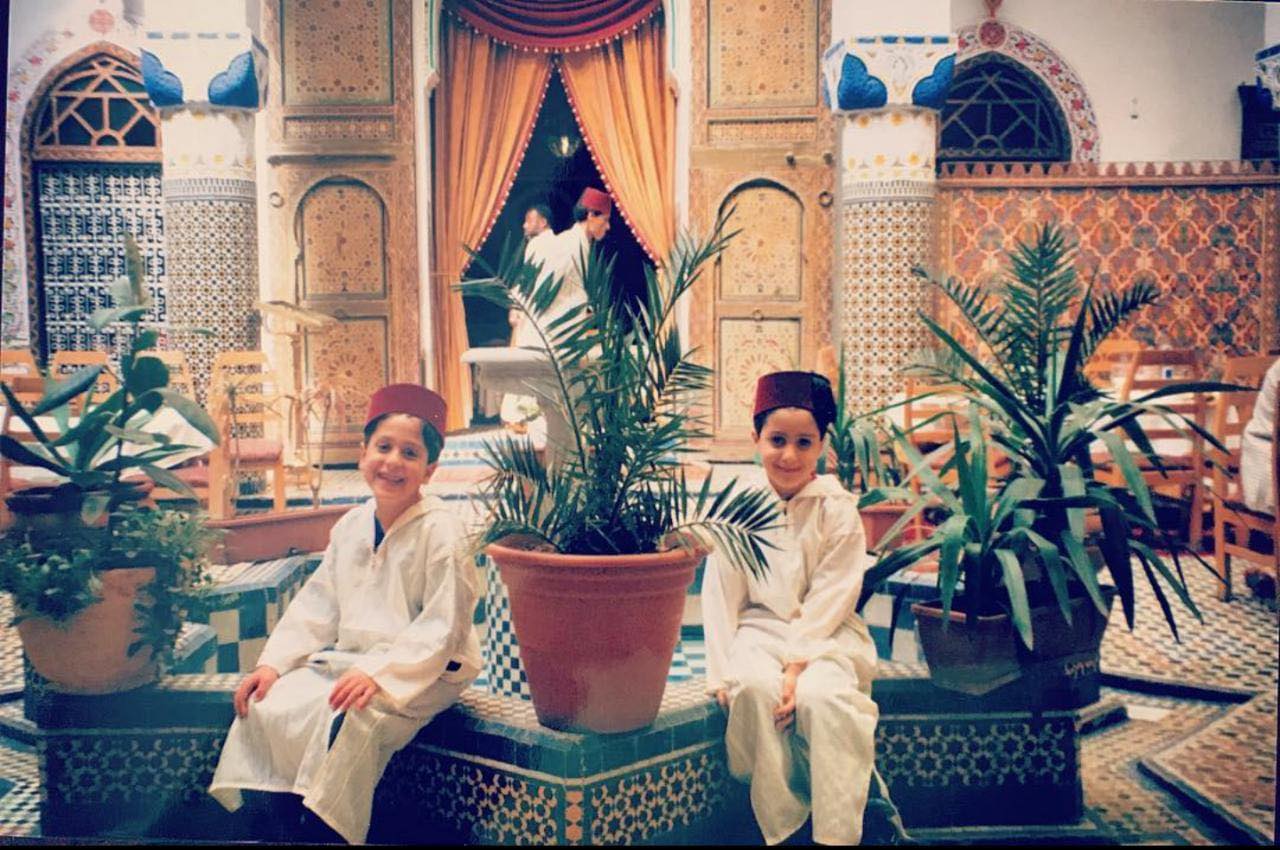
(1) A Moroccan man clad in traditional striped jeleba fills a bottle of water at Fontaine Nejjarine, Fes, Morocco (c. 18th century) (2) Horseshoe arches with polychrome glazed tiles decorate the Bab Bou Jeloud (built by the French in 1913), with a view of the Bou Inania minaret and old medina, Fes, Morocco (3) Polychrome glazed tiles with geometric motifs, resembling those in Persian architecture, at Dar el Bacha museum, Marrakesh, Morocco (4) The author (right) and his brother in Fes, Morocco (c. 1998)

The presence of Iranian loans at first seems unbewildering given the many hundreds of Persian words that entered the Arabic language–either directly or via Aramaic– following the Islamic conquest of the Sassanid Persian Empire. Persian, Greek, and Aramaic represent the largest loaner languages to Classical Arabic, although frequently only the latter two are emphasized. Persians played a seminal role in the standardization of Arabic as a literary medium and pioneered the academic study of the language; indeed the Arab historiographer Ibn Khaldūn could barely restrain himself from singing the praises of Persian grammarians, physicians, astronomers, mathematicians and other scholars in developing what has frequently been referred to as “Arabian” or “Islamic” science. These lexemes are unique however in that many are unattested in the Arabic vernaculars further east, and this taken in conjunction with the material and onomastic evidence detailed below suggests the presence of a small but influential Iranian element in early Islamic North Africa.

In light of the drastic shortage of historical records on these migrations, the presence of Persian names among intellectuals and dynasts of the Islamic period in North Africa lends credence to that idea. Apparently their descendants founded two dynasties in the Maghreb–the Rustamids (Bānū-Bādūsyān, 777-909 A.D), founded by ‘Abd al-Raḥmān ibn Rustam, were Persian Ibāḍī imāms whose capital Tahert in modern-day Algeria was famed as ‘Iraq al-Maghrib “Mesopotamia of the West”, or Balkh al-Maghrib “Bactria of the West”, perhaps owing in part to the Iranian character of the city. A century later, the Khurāsānid dynasty (Bānū-Khurāsān, 1059-1148 A.D.) founded by ‘Abd al-Ḥaqq ibn ‘Abd al-‘Aziz ibn Khurāsān, ruled an independent principality in modern-day Tunisia. Persian immigrants or those with Iranian nisbahs further appear in Andalusia (Ziryāb, al-Shushtari), detailed below. 
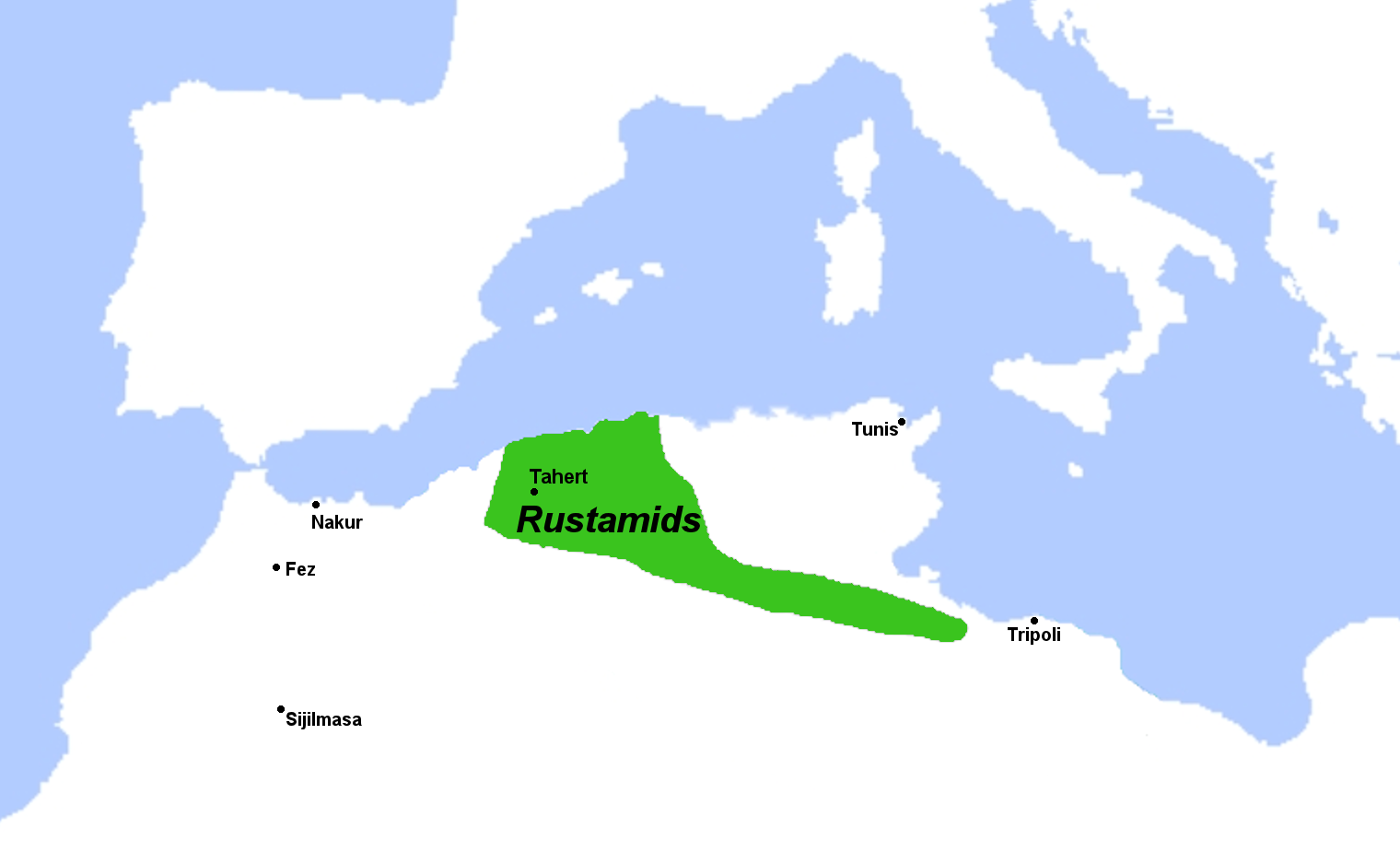
A Persian Kharijite Ibāḍī imām, Abd al-Raḥmān ibn Rustam, and his descendants ruled the Rustamid (Bānū-Bādūsyān) dynasty in the Maghreb (777-909 A.D). Its capital, Tahert, became a Kharijite stronghold famed as ‘Iraq al-Maghrib “Mesopotamia of the West”, or Balkh al-Maghrib “Bactria of the West”, perhaps owing the Iranian character of the city and some of its inhabitants. A century after its fall, another Iranian dynasty, the Khurāsānids (1059-1148 A.D), came to power in northern Tunisia

It is notable that west of Baghdād (from Middle Persian 𐭡𐭢𐭣𐭲‎ (bgdt /bag-dād/, “given by god”; compare Russian given name Богда́н Bogdan “ibid.”), nowhere in the medieval Islamic world did Iranian forms gain as much currency as in the Maghreb. Perhaps this owed in part to the nature of urbanity in Anatolia, Egypt, Palestine and Greater Syria, where for centuries the materials of Greco-Roman civilization reigned supreme among a Romanized Christian citizenry. Indeed Roman churches and other buildings in these regions were frequently dismantled by the Muslims for reusable materials or repurposed into mosques by the simple addition of a mihrab and minaret (e.g. the Umayyad Mosque of Damascus which was formerly the Basilica of Saint John the Baptist (Greek: βασιλική του Αγίου Ιοάννή του Βαπτιστή Vasilikí tou Agíou Ioánni tou Vaptistí). Islamic architectural forms in these regions employed nearly identical building materials (limestone ashlar) and ornamentation schemes (marble veneer decorations, Greek order columns) to the forms that preceded them, which were Roman in character. 

The Maghreb was instead relatively virgin land for the Muslim immigrants, who founded a significant number of new cities which they cohabited with Berbers. These new spaces engendered the transmission and local innovation of Persislamic architectural vocabulary, fashions and culinary stylings. For example, the adoption of the Persian garden form (Arabic: رياد riād; Persian: چهار باغ chahār bāgh) was most marked in the Maghreb, and it became a prominent feature in Moorish palaces in Spain (such as Madinat al-Zaḥrā, the Aljafería, and the Alhambra). In the 9th century, Persians had discovered the manufacture of colored tiles with metallic pigments through the use of tin oxide glaze, which spawned a renaissance of majollica tile production in the Iranian world that apparently also reached the Maghreb. The technology and inspiration behind zellīj tiles in the Maghreb is, thus, undoubtedly Persian, rather than the untenable idea that Roman mosaics which are composed of tesserae and depict human and animal forms somehow circuitously inspired Maghrebi Islamic zellīj. The latter hypothesis is further problematic in that it forces us to accept the unlikely scenario that Persian and Maghrebi tilework, with their strikingly similar compositions and designs, developed twice around the same time and independently of each other. Why this art would not have developed in Syria, Palestine or Egypt, where Roman and Byzantine mosaics existed in great volume, is another perplexing question.

Evidence of Persian craftsmen and architects exporting their crafts abounds in the Arab world; for example, the glazed tiles on several Cairene buildings, including the bulbous stone minarets of the mosque of Nāṣer Moḥammad in the citadel (1318-35 A.D.), indicate that craftsmen from Tabrīz operated a workshop in Cairo in the 1330s and 1340s. Double-shelled, ribbed domes ending in muqarnas corbels (stalactites) with high, calligraphy-ornamented drums are Persian features to be see on the Mausoleum of al-Ṣultaniyya in Cairo, and which are later encountered in Timurid Samarqand. The characteristic Persian four-ayvān plan was first introduced to Mamlūk Egypt in madrasas, though it was rarely, if ever, used in mosques there, but is frequently encountered in the Maghreb. Morever muqarnas vaults, a prominent Persian feature in Maghrebi architecture, were only seldom commissioned in Syria and Egypt, but took strong hold further west where they are carved into stucco. Since in Morocco many buildings were constructed using baked earth or bricks–much like in Persia–geometric ornamentation schemes using glazed tiles or carved plaster or stucco resembling those in Iran could be applied to buildings. This contrasts with the situation in Egypt, Anatolia and Syria, where limestone ashlar buildings with marble veneer decorations predominated. Thus, Persian elements appeared frequently in Maghrebi architecture, probably as a result of the presence in North Africa of individuals with firsthand experience of Persian architecture.

A Persian-style arched ayvān with muqarnas vaulting and polychrome glazed tiles, Bou Inania Madrasa, Fes, Morocco (1350-55 A.D.). Elements of Persian architecture and ornamentation form a foundation for Maghrebi Islamic forms.

Moroccan culinary tradition attributes the widespread use of nuts like almonds and cashews, dried fruits such as raisins, prunes, dates and apricots, pickled lemons (حامض مصير ḥamudh mṣir) and saffron to Persian influence. Indeed, both cuisines are characterized by an idiosyncratic sweet, savory and sour palette, in contrast to the cuisines of their immediate neighbors. Moreover, it is known that Muslims introduced saffron from Persia to North Africa in the 10th century. This, too, points to a tunneling of early Persian forms across Romanized territories to the Maghreb, perhaps through the milieu of few but influential Iranians among the Muslims.
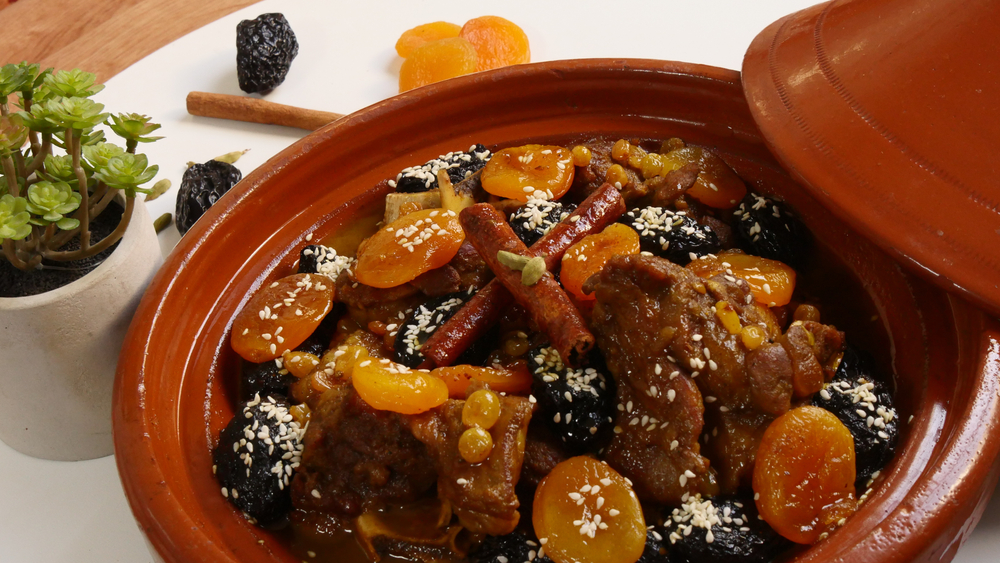
A variation of Moroccan ṭājin barquq w meshmāsh with mutton, prunes, apricots, raisins, sesames, cinnamon and pistachios. Maghrebi cuisine shares an idiosyncratic sweet, savory and sour palette with Persian cuisine, probably reflecting the introduction of Persian ingredients and flavors by the Muslims.

Andalusian Influence

In the 15th century, the aforementioned old Maghrebian cities (particularly Tangier, Fes and Rabat, and more broadly Constantine, Tlemcen, Kairouane, Tunis, Tripoli and Bizerte) saw a massive influx of Muslims and Jews who had been expelled from Islamic Spain (Arabic: الاندلسيين “Andalusians”; Spanish: moriscos “Moors”) and migrated “back” to the Maghreb where they settled among their distant dialectal cousins. This “second urbanite wave” further contributed to the evolution of urban dialects, but not the ʕarūbi (Bedouin) dialects which were spoken in the countryside. Andalusian families, still distinguished by their surnames–Jorio, Fenjiro, Chkalante, Guedira, Gharnaṭa, Qorṭoubi, Andalousi, Prado, Vergas, Lavra–brought features of Spanish and Andalusian Arabic to the local vernaculars. The ​​طرب أندلسي ṭarab ʾandalusī (and by extension غرناطي gharnāṭi in Tlemcen, from the Arabic name for Granada) is attributed to a certain Ziryāb, a freed Persian slave-turned-courtier and musical pioneer who introduced Persian instruments and musical modes to Muslim Spain. The Andalusian repertoire, with its foundations in classical Persian and Spanish music, is thus distinguished from ʕarūbi (what has been termed shaʕbi “folk”), Gnāwa and Berber folk music, which employ different instruments, formats and modes. The Gnāwa repertoire in particular, which features the guembri lute and the call-and-response format of vocal performance, links it with the musical systems of the Songhay in Timbuktu, Gao and Djenné.  

A number of old Iberian Romance words entered the Fessi dialect, the legacy of large numbers of Andalusian Muslim and Jewish refugees who migrated to Maghrebian cities after their expulsion from Islamic Spain, some of which have been adopted in Casablancan Koine. These include سيمانة simāna “week” from Spanish semana; Fessi كوشينة kušina “kitchen” from Spanish cocina (doublet with darija كوزينة kuzina, probably a later borrowing during the Spanish protectorate); اشكولة iškuila “school”; from Spanish escuela; قرة qirra from Spanish guerra “war”; فورنو furnu “oven” from Spanish forno; شلية šelya “chair” from Spanish silla; طابلة ṭabla “table” from Spanish tabla; فيشطة fishṭa “party”, from Spanish fiesta; كريلو grīllu “cockroach” from Spanish grillo “cricket”; قميجة qamija “shirt”, from Spanish camisa; بسطيلة basṭila from Spanish pastilla “puff pastry with various fillings”; فابور fābor “free [of charge]; a favor” from Spanish favor; rwina from Spanish ruina “mess, wreck”, qīmrūn “shrimp” from Spanish camarón. Cities like Salé in which Andalusian immigrants settled saw propagation of Spanish words even their core vocabulary, which have not been transferred into Koine owing their salient foreign nature:

EnglishSalawi Arabic (Salé)Spanish
“Good”buinubueno
“Wrong”falo falso
“Luck”as-suirtisuerte 
“Alone”ulusolo

Some Andalusian Jews in Morocco retained their Spanish vernaculars (Ladino and Ḥaketía) until their exodus to Israel in the mid 20th century. 

Bedouin (Hilalian) or ʕarūbi Dialects: the Basis of Moroccan Darija

The second wave of Arabic speakers were Bedouins of the Banu Maʕqil  Banu Hilal, Banu Sulaym and Bani Ḥassan tribes who migrated en masse in the 11th and 12th centuries from the Najd region of Arabia to the Magrheb, where they took home in the arid plains and hautes-plateaux. The impetus for this forced migration was the Fatimid Caliphate’s desire to confine the unruly Bedouins in the south of their dominion. As the Bedouins were unaccustomed to urbanity, the Banu Hilal settled in areas where they continued their nomadic lifestyle, and this wave brought significantly greater linguistic arabization and spread of nomadism in areas where agriculture had previously dominated. Camps (1983) estimates the number of Bedouins to have been relatively small; only around 80,000 at the outset, and their migration extended over two centuries and not all of them settled in Morocco. Local Berbers (most likely belonging to the Masmuda confederacy and thus speaking a language related to Shilha, given the Bedouins’ settlement in the lowlying plains between Souss and Rabat), who shared a similar lifestyle of pastoralism, were quickly assimilated to the language of the incomers.  The nature of their contact was such that over time, Arabs adopted the modified Arabic language of their Berber neighbors and started to speak it amongst themselves. Moreover, everyone in the community adopted the Berbers’ speech and spoke it to the children. With the establishment of Casablanca, ʕarūbi migrant workers and their dialects–rather than the old sedentary dialects such as Fessis–became the basis of Moroccan Darija. The modern Moroccan Darija is therefore a dialect of Bedouin provenance with an admixture of local sedentary features.  
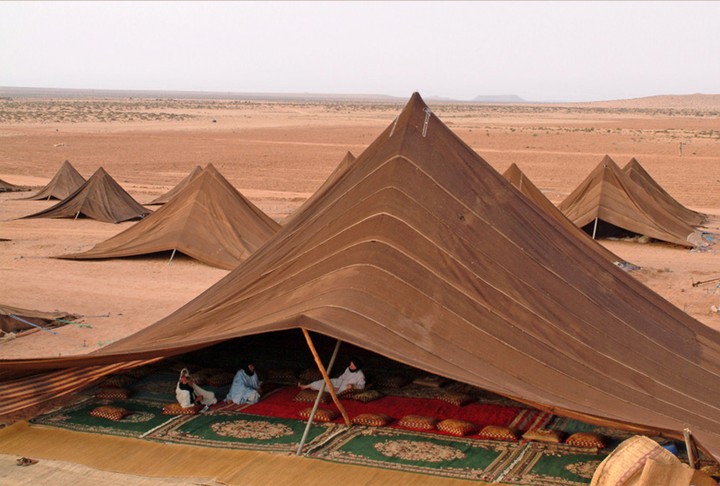
A Bedouin camp in the desert near Merzouga, Morocco

In contrast to the sedentary dialects which use the local innovation ka- or ta-, ʕarūbi dialects particularly in northeastern Morocco and Algeria developed a progressive aspect marker and by extension copula -را rā (lit. “he saw”), probably from Najdi ترا tarā “to be seen” : e.g. ni nkteb = “I am writing” (lit. “He saw me writing”); rāk mn wjda “you are from Oujda”. Some comparisons between Moroccan Darija and Najdi Arabic are made below:

EnglishMoroccan Darija (Oujda)Najdi Arabic
“Youth, young generation”drāridhrāri
Interrogative particle wəšweš
“What my heart wanted (f.)”Lli bġaha gəlbiIlli bġaha galbi
“Take this”hākhā
“She is going”Rāha tmšiTarāha temši

With regard to Berber elements in ʕarūbi (Bedouin) dialects, examples of both metatypy and phonological restructuring exist, which is possible in extended and complex contact situations. The Arabization process presumably started with the Arabs’ neighbors, and then these Arabized Berbers served as intermediaries to their next neighbors, etc.  A few examples of Berber metatypy in ʕarūbi are listed below:

  1. The Berber feminine/diminutive circumfix ta….t used mainly with nouns of occupations in Moroccan Darija (e.g. bənnay “mason” –> tabənnayət “profession of masonry”) but also for abstract noun derivations, e.g. dərri “child” –> tadərrit “childhood”
  2. The Berber genitive marker n “of”, though limited to some kinship terms like bb°a n Sufiān “father of Soufiane”

On Berber (Amazigh) influences in Darija

Berber (endonym: ⵜⴰⵎⴰⵣⵉⵖⵜ tamazīɣt; Ar. الامازيغية al-amazīġīyya; الشلحة aššilḥa) is a distinct language family belonging to the Afro-Asiatic phylum. Blench (2018) notes that Berber is considerably different from other Afroasiatic branches, and indeed its genetic relation to Arabic–of equal magnitude to its relation with Ancient Egyptian and Cushitic–is vanishingly remote. Proto-Berber probably split from a common ancestor with the other known Afro-Asiatic branches between ~10,000-9,000 years before present, and then this group underwent a putative linguistic bottleneck as recently as ~3,000 years ago, which apparently eradicated the internal diversity of the family and left a contracted number of idioms from which all of the modern Berber languages descend. Proto-Berber then appears to have spread across a vast area from the western banks of the Nile river to the Atlantic coast of North Africa. Today, an estimated 30-40% of Moroccans, 20-30% of Algerians, 5-10% of Libyans and 1% of Tunisians use a Berber language as a mother tongue, but these numbers would have been higher only a century ago. 
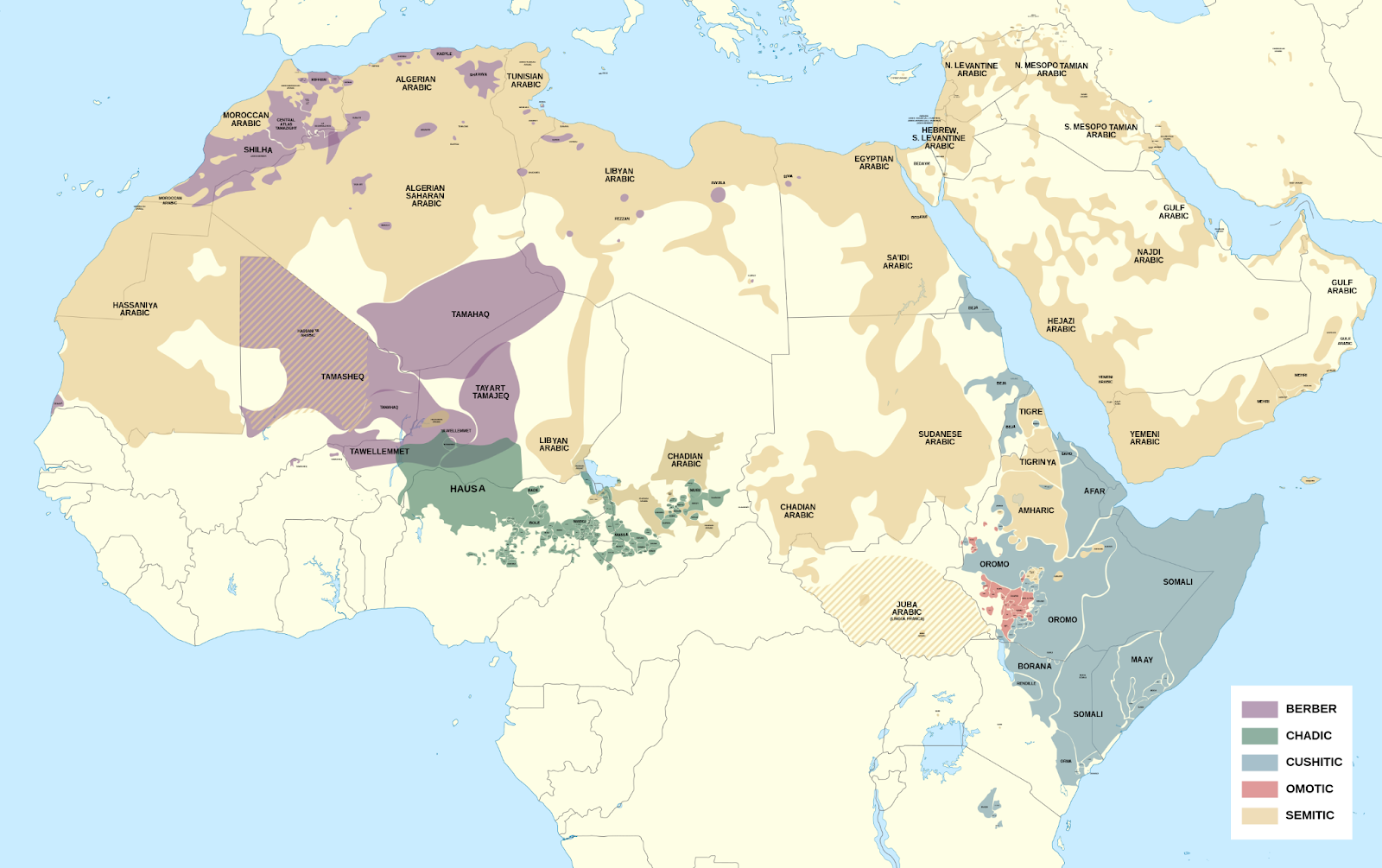
A map showing the modern distribution of languages belonging to the Afro-Asiatic macrofamily. Berber languages (purple) were indigenous languages to Northwest Africa prior to the arrival of Arabic. Today, an estimated 30-40% of Moroccans, 20-30% of Algerians, 5-10% of Libyans and 1% of Tunisians use a Berber language as a mother tongue.

The region was visited from an early date by seafaring Phoenician merchants from the Eastern Mediterranean (but, apparently, few Greeks), who established important port colonies (e.g. Shilha ⴰⴳⴰⴷⵉⵔ Agadir, from Phoenician 𐤂𐤃𐤓‎ gādīr “wall;compound”, cognate with Arabic جدار jidār “wall”; Rusadir from Phoenician 𐤓‬𐤔𐤀𐤃𐤓‬ rushādir “powerful). These immigrants later established the Carthaginian empire and perpetuated Punic language and culture, eventually subjugating the Romanized para-Berber kingdom of Numidia. The presence of Punic borrowings in Proto-Berber points to the diversification of modern Berber language varieties subsequent to the fall of Carthage in 146 B.C.; only Guanche and Zenaga lack Punic loanwords. Berberophones along the Mediterranean coast later became subjects of the Roman Empire under administrative divisions of Tripolitania, Africa, Mauretania Caesariensis and Mauretania Tingitana, but commercial and cultural exchanges between Romans and Berbers along the Līmes Mauretaniæ persisted for centuries through the Byzantine period. 

During this age of contact, Roman innovations including the ox-plough, camel (Kabyle: ⴰⵍⵖⵯⵎ a-lɣəm via metathesis from Latin camēlus or Coptic ϭⲁⲙⲟⲩⲗ (camoul)?), and orchard management were adopted by Berber communities. Latin loanwords in Berber include, notably, ⴰⴼⵓⵍⵍⵓⵙ afullus “chicken” (from Latin pullus); ⴰⵙⵏⵓⵙ asnus “donkey” (from Latin asinus), ⵓⵔⵜⵉ urti “garden” (from Latin hortus); ⵜⴰⵖⴰⵡⵙⴰ taɣawsa “thing” (from Latin causa “reason/case; motive”); ⴰⵏⵖⴰⵍⵓⵙ anɣalus “angel, spiritual entity” (from Latin angelus); ⵉⴳⴻⵔ iger “cultivated field” (from Latin ager); ⵜⴰⴼⴰⵙⴽⴰ tafaska “feast/religious celebration” (from Latin pascha “Easter; Passover”); ⴰⴼⴰⵍⴽⵓ afalku “bearded vulture” (from Latin falcō “falcon”), ⵜⴰⴼⴻⵙⵏⴰⵅⵜ tafesnaxt “carrot” (from Latin pastinaca “parnsip, stingray”), ⵢⴻⵏⵏⴰⵢⴻⵔ yennayer “January; first month of the Berber New Year” (from Latin ianuarius), inter alia.

(Top) Ruins of the Basilica of Volubilis; (Bottom left) Roman mosaics at Volubilis; (Bottom right) Storks nesting atop Corinthian-order columns at Volubilis, Morocco

Berber is the substrate language for the Arabic varieties spoken in the Maghreb. Nonetheless, it has left few lexical borrowings in Arabic varieties, with the most notable exception of toponyms. The overwhelming majority of place names in Morocco are of Berber origin, e.g. ⴰⵎⵓⵔ ⵏ ⴰⴽⵓⵛ amur n akush “Land of God”, whence Marrakesh and Morocco; ⵉⵎⵉ ⵏ ⵜⴰⵏⵓⵜ imi n tanout  “mouth of a small well”, ⵉⴼⵔⴰⵏ ifran “caves”; ⴰⵎⴽⵏⴰⵙ amknas whence Meknes “the Miknasa Zenata Berber tribe”; ⵜⵉⵟⵟⴰⵡⴰⵏ tiṭṭawan “springs” (with the Ghomara Berber feminine plural suffix ⴰⵏ –an) whence Tetouane; ⵜⵉⵏⴳⵉ tingi “marsh”, whence Tangier; ⵡⵔ ⴰⵣⵣⴰⵣⴰⵜ ur azzazat “without clamor; silent” whence Ouarzatate, etc.

Other ancient local words may include ݣناوة gnāwa “Sub-Saharan Africans and their musical repertoire in Morocco; a caste of largely endogamous black Africans living among both Arabophones and Berberophones”, probably from a Shilha gloss ⴰⴳⵏⴰⵡ agnaw “deaf-mute” (pl. ⵉⴳⵏⴰⵡⵏ ignawen) and later “black people” (semantic development resembles Arabic عجم ‘ajam “confusing or unclear way of speaking” → “Persians”). This word is probably also the origin of “Guinea” and perhaps “Djenné”.

A speaker of the Senhaja d’Srair Berber language, spoken in the Ketama commune of Al Hoceïma Province, in the central part of the Rif mountains. Despite its geographic proximity to and influence from the neighboring Riffian Berber language, Senhaja Berber together with nearby Ghomara belong to the Atlas group, linking them to the Shilha and Central Atlas Tamazight languages further south.

In the domestic and culinary spheres, there exist a few important loanwords: كسكسو ksksu “couscous” from Berber ⵙⴻⴽⵙⵓ seksu; ساروت sārūt “key”, from Central Atlas Berber ⵜⴰⵙⴰⵔⵓⵜ tasarut; and صيفط ṣīfṭ “to send” (cf. Kabyle ⵙⵙⵉⴼⴻⴹ ssifeḍ). Some local flora and fauna have also retained their Berber names: زايس zāyis “octopus” from Berber ⴰⵣⴰⵢⵣ azayz; مشّ mušš “cat” (cf. Central Atlas Tamazight ⴰⵎⵓⵛⵛ amušš); لالة Lalla “lady; respected woman”, (related to Central Atlas Berber ⴰⵍⴰⵍⵍⵓ alallu “dignity”, from ⵜⵉⵍⴻⵍⵍⵉ tilelli “freedom”); دشار dšār from ⴷⵛⴰⵔ dšar “region”; شلاغم šlāḡem “mustache” from Berber ⴰⵛⵍⵖⵓⵎ ašlɣum

It is possible that the use of feminine gender language names in Darija is Berber substrate: الريفية al-rifiyya “Riffian language”, cf. ⵜⴰⵔⵉⴼⵉⵜ Tarifit “Riffian language”. Additionally, Moroccan Darija exhibits a preference for broken plurals, particularly for ethnonyms or nationalities endemic to the region. By contrast, geographically distant peoples use the regular jarr plurals: مغاربة mġārba  “Moroccans” (cf. Modern Standard Arabic مغربيين maġrebiyiin “Moroccans”) , تونسة twansa “Tunisians”, فواسة fwāsa “Fessis”, ريافة riyāfa “Riffians”, شلوح šluḥ “Shilha Berbers”, سواسة swāsa “people from the Souss region; frequently used synonymously with Shilha Berbers”, جبالة jbāla “Jbelis”, but مصريين maṣriyiin “Egyptians”, عراقيين erāqiyiin “Iraqis”, etc. It is interesting that Berber too uses complex and apophonic broken plural formations, like other Afro-Asiatic branches: ⴰⵎⵖⵔⵉⴱⵉ amɣribi → ⵉⵎⵖⵔⴰⴱⵉⵢⵏ imɣrabiyen “Moroccans”; ⴰⵛⵍⵃⵉ ašllḥi → ⵉⵛⵍⵃⵉⵢⵏ išlḥiyen “Shilha Berbers”, ⴰⴳⵍⵍⵉⴷ agllid “king” → ⵉⴳⵍⴷⴰⵏ igldan “kings”; ⵜⴰⴳⵍⴷⵉⵜ tagldit kingdom → ⵜⵉⴳⵍⴷⵉⵏ tigldin “kingdoms”. 

The Iranian Presence in Classical Arabic and Medieval Islamic Learning

Written by Afsheen Sharifzadeh, a graduate of Tufts University focusing on Iran and the Caucasus. This article surveys the Iranian presence in pre-Islamic Arabia and the medieval Islamic world and addresses Classical Arabic loans in Modern Persian. It features an exclusive English-language appendix of 200 Middle Iranian loans into Classical Arabic and their etymologies, compiled by the author.

house_of_wisdom_big
A library in present-day Baghdad with the Persian four-ayvān courtyard scheme, named after Bayt al-ikma; courtyard view, Abbasid-era portion.

On the Prevalence of Classical Arabic Loanwords in Modern Persian

Whereas pre-Islamic Iranian languages are virtually free of Semitic vocabulary, Aramaic, Syriac, Hebrew, and Arabic have borrowed a remarkable number lexical items from Iranian (as did late Babylonian, Achaemenid Elamite, Old Armenian, and Georgian). Historical linguists have afforded the majority of these languages comprehensive pedigrees of Iranian borrowings, but regrettably few authors have paid attention to the Iranian loans in the Arabic language and literature, and in doing so, have neglected a rich narrative of cultural contact whereby Persian and Byzantine antecedents formed the creative backbone of early Islamic material and visual culture.

1024px-Sassanian_Empire_621_A.D
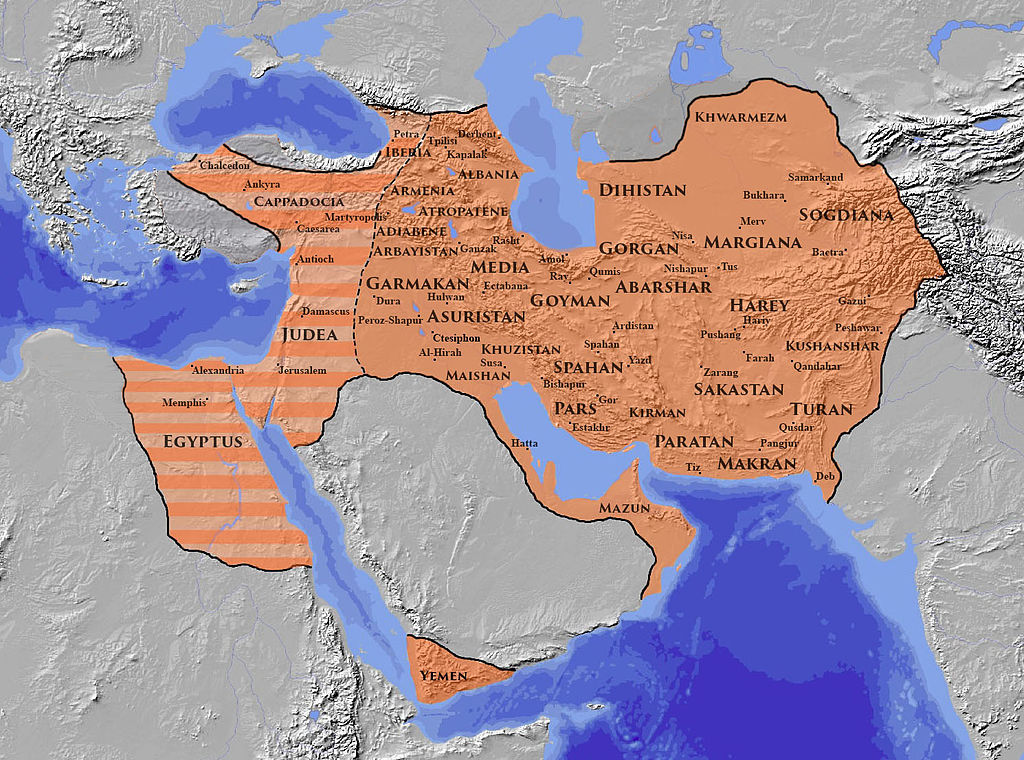
The Sassanid Empire (224 A.D.-651 A.D.) was the last Zoroastrian Iranian polity before the arrival of Islam. Sassanian and Byzantine antecedents formed the creative backbone of early Islamic material and visual culture. 

It is no mystery that following the conquest and Islamization of Sassanid Persia throughout the 7th and 8th centuries A.D., Iranian languages were shot through, even to the most far-flung dialects, with Arabic loanwords. Yet Arabic never attained currency as a lingua franca in the Iranian world. Instead, knowledge of the Classical Arabic language throughout the Islamic period was limited to educated city-dwelling Muslim circles, and it was from this stratum of society that Classical Arabic lexica were gradually and purposefully incorporated—often undergoing abstract semantic shifts—into “erudite speech”, which became the basis of New Persian literature, scholarship, and poetry. These Iranian religious figures, literati, linguists, poets, historians, mathematicians, chemists, alchemists, astronomers, physicians, geographers, musicians, and philosophers became preeminent contributors to the canonization of the Arabic language and its transformation from a regional nomadic tongue into a universal vehicle of both doctrinal and secular learning. Acculturation was taking place along the same vector– whereby medieval Islamic architecture, horticulture, cuisine, attire, court culture, political offices, etc. were systematically appropriated from earlier Persian and Byzantine models.

USSR 198355294463
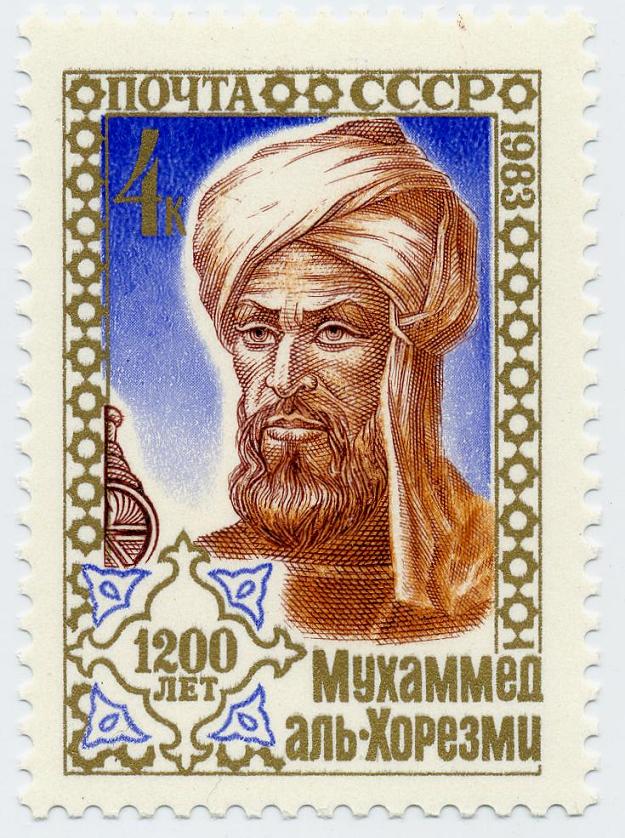
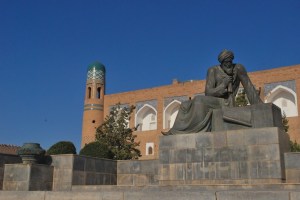
Al-Khwārizmi was an Iranian mathematician, astronomer, and geographer during the Abbasid Caliphate. The English word “algorithm” is his namesake, and the word “algebra” derives from al-jabr, an operation he used to solve quadratic equations. Here he is pictured on a postal stamp issued by the USSR in 1983 (left) and immortalized in statue form at Khiva, Uzbekistan (right).

Knowledge of Classical Arabic was essential and indispensable for religious worship, and the correct reading of the Qur’an was impossible without it. But in the first century of Islamic ascendancy, the Arabs did not produce anything of literary value. If any poetry was composed, it was on the old pagan models and celebrated the poets’ amatory adventures, in stereotyped fashion, rather than the victories of Islam. As Reinhart Dozy notes:

Mais la conversion la plus importante de toute fut celles des Perses. Ce sont eux, et non les Arabes qui ont donné de la fermeté et de la force à l’Islamisme, et en même temps, c’est de leur sein que sont sorties les sectes les plus remarquables. (Dozy, L’Islamisme, p. 156)

It follows that the first grammar of the Arabic language, al-Kitāb (الكتاب), was written by the Persian author Sībūyeh (سيبويه; Arabic: Sībawayh) in the 8th century AD. Many of his Iranian contemporaries with masterful command of Arabic, including Ibn al-Muqaffa’, translated thousands of Indian, Greek, Syriac, and Persian literary works from Middle Persian into Classical Arabic. The epicenter of these intellectual activities was Bayt al-Ḥikma (بيت الحكمة; literally “House of Wisdom”) in Baghdad, which was the Abbasid Caliph al-Ma’mun’s appropriation of the Sassanid Persian Academy of Gundishāpur, the world’s first center of both religious and secular higher-learning. The Caliph had the contents of Gundishāpur and its world-renowned hospital transported en masse to Bayt al-Ḥikma, which was staffed by graduates of the Academy of Gundishāpur and wherein the methods of the older Persian academy were to be emulated. The Bukhtishu-Gundishāpuri family were Nestorian physicians from this university in Persia who served at the Abbasid court through the 7th, 8th, and 9th centuries, spanning six generations. The Caliph al-Mansur’s new capital and crown jewel, Baghdad (“God-Given” in Middle Persian), was no exception to this trend; the city had been modeled on the quintessential Sassanid round city plan (such as at Firuzābād) by a Persian architect and planner, Mashallah ibn Athari, and the astrologically-auspicious location for the imperial city had been chosen by none other than Nawbakht, a Zoroastrian priest. The Abbasid and Fatimid bourgeoisie were patrons of Persian garments, etiquette, court culture, and cuisine, and relied heavily on Persian viziers such as the Barmakid family (برمكيان) to oversee crucial matters pertaining to finance and state administration. As such, they adopted the Sassanid postal system and bureaucratic system (ديوان diwān).

c7 c2alhambra
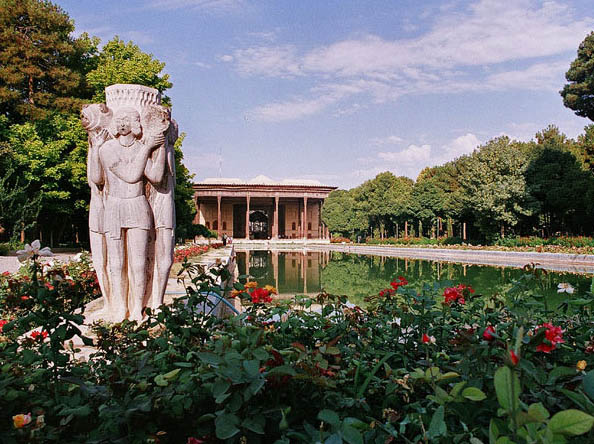
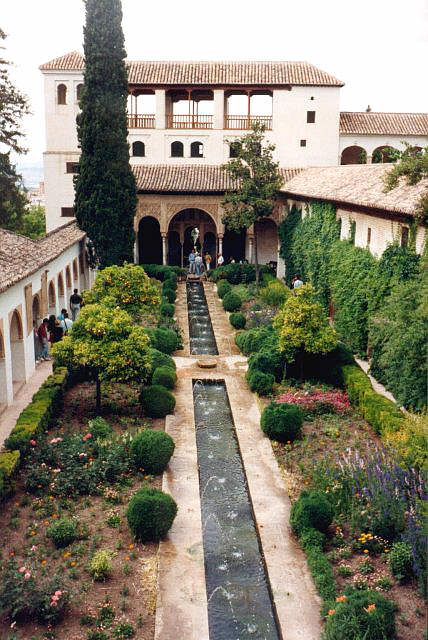
Persian gardens (top) have influenced the design of gardens from Andalusia to India and beyond. The gardens of the Alhambra show the influence of Persian Garden philosophy and style in a Moorish Palace scale, from the era of Al-Andalus in Spain (bottom). 

Persian influence increased at the Court of the Caliphs, and reached its zenith under al-Ḥādi, Harun al-Rashid, and al-Ma’mun. Most of the ministers of the last were Persians or of Iranian extraction. Afshīn Kheydār b. Kāvūs, the all-powerful favorite of the Caliph al-Mu’tasim and a scion of the Buddhist princes of Osrushana in modern-day Uzbekistan, was appointed Abbasid Supreme General and Governor of Sindh, Jebāl, Libya, Armenia and Azerbaijan. In Baghdad, Persian fashions continued to enjoy an increasing ascendancy, and the old Persian festivals of Nowruz and Mihrigān (origin of the modern Arabic مهرجان mahrajān “festival, celebration”) were celebrated. Persian raiment was the official court dress, and the tall black conical Persian hats (qalansuwa) were already prescribed as official by the second Abbasid caliph in 770 A.D. At the court, the customs of Sassanians were imitated and garments decorated with golden inscription were introduced which it was the exclusive privilege of the ruler to bestow.

The Islamic Golden Age reached its peak during the 10th and 11th centuries, during which Persia was the main theater of academic activity, eclipsing al-Andalus (Muslim Spain) in volume and significance. Persian scholars and polymaths in various fields produced their masterpieces in Arabic—an Arabic whose lexicon they had made applicable to their respective fields in pioneer ways and for which they had popularized new phraseology, word forms, and grammatical structures through the dissemination of their works. Among the most prominent of these individuals were al-Khwārizmi, Abu Sinā (Avicenna), al-Tusi, al-Biruni, Omar Khayyām, al-Haitham, al-Shirāzi, and Nāer Khusraw. Ironically, one can imagine that a rather pure, literary Classical Arabic vernacular was probably in use among Iranian scholarly circles in Khorāsān and Khwārezm (a historic Iranian region roughly corresponding to modern day Uzbekistan and Turkmenistan) during the Abbasid period, while the vernaculars spoken in major Arab-inhabited urban centers around the realm such as Baghdad, Damascus, and Cordoba were of colloquial provenance and were undergoing gradual deviation from Classical pronunciation, grammar and lexicon under the influence of regional linguistic factors. These colloquial transformations are reflected in contemporary literary productions such as 13th century manuscripts of “1001 Nights” (Arabic: الف ليلة و ليلة Alf Leyla wa Leyla, based on an earlier Persian work Hazār Afsāna, literally “1000 Myths”) recovered from Syria and Egypt.

scheherazade
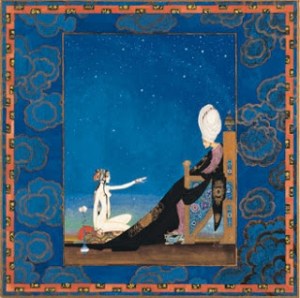
The story of “1001 Nights”, also popularized under an orientalist misnomer “Arabian Nights”, is a series of adapted stories based on a mythical Persian king Shahryār and a storyteller Shahrzādeh. The core characters and structural framework of the Arabic language version are inextricably akin to an earlier Persian work, Hazār Afsāna, with the addition of a few Arabic given names, Abbasid-era stories and motifs such as the Jinn.

This trend did not escape the observation of the 14th century Arab historiographer, Ibn Khaldun, who elaborately explains the primacy of Iranian culture and learning in the nascent Islamic world:

It is a remarkable fact that with few exceptions, most Muslim scholars…in the intellectual sciences have been non-Arabs. Thus the founders of grammar were Sibawayh and after him, al-Farisi and Az-Zajjaj. All of them were of Persian descent…they invented rules of (Arabic) grammar…great jurists were Persians… only the Persians engaged in the task of preserving knowledge and writing systematic scholarly works. Thus the truth of the statement of the Prophet becomes apparent, ‘If learning were suspended in the highest parts of heaven, the Persians would attain it…The intellectual sciences were also the preserve of the Persians, left alone by the Arabs, who did not cultivate them…as was the case with all crafts…This situation continued in the cities as long as the Persians and Persian countries, Iraq, Khorasan and Transoxiana (modern Central Asia), retained their sedentary culture. [Translated by F. Rosenthal (III, pp. 311-15, 271-4 [Arabic]; Frye, R.N. (1977). Golden Age of Persia, London: Weidenfeld & Nicolson, p.91)].

taj-mahal-1
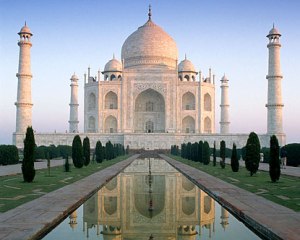
Mughal India, like the Ottoman Empire and the Timurid Empire, was a Persianate society (a society that is either based on, or strongly influenced by the Persian language, culture, literature, art, and/or identity.). Emperor Shāh Jahān (literally “King of the World” in Persian), commissioned a Persian architect from Badakshān named Ustād Ahmad Lāhauri to construct the Tāj Mahal (“Crown Place” in Persian) for his Persian wife and lover, Mumtāz Mahal (née Arjumand Banu Begum.) The Taj Mahal is one of the largest Persian Garden interpretations in the world.

It was via this initially exclusive medium of scholarly and artistic expression promulgated by Muslim Iranian intelligentsia that Middle Persian transformed into New Persian in the urban centers of Khorāsān, Khwārezm and Transoxiana throughout the early Islamic period. Many Middle Persian words were rendered archaic and thence obsolete in favor of abstract Classical Arabic loanwords–a feature that was characteristic of the speech of the Muslim Persian city-dwelling elite. A modified Arabic orthography was applied to this transforming tongue in place of the Pahlavi scripts used to record Middle Persian. This new form of the Persian language became a prestige dialect throughout the Iranian world, spreading from Central Asia throughout the Iranian plateau, and would later enjoy widespread patronage and even official currency in the royal courts of the Ottomans, the Timurids, and the Mughals in India. What are modern-day Turkey and the Indian subcontinent even became important centers of Persian literary and poetic production. In Persianate societies, Arabic words were indirectly transmitted via Persian influence into languages such as Urdu, Turkish, Uzbek, Azerbaijani, Kurdish, Turkmen, Pashto, Uyghur, as evidenced by the retention of Persian phonological modifications to Classical Arabic pronunciation in these languages. Sarti Uzbek (but not Khorezmian or Kipchak Uzbek) even lost vowel harmony—a rudimentary feature of Turkic phonology—as a result of Persian substratum and bilingualism.

But this was by no means the first golden age for the Persian language—pre-Islamic Iranian languages likewise exerted a remarkably pervasive influence on neighboring tongues under the aegis of Iranian suzerains and civilized elite in those territories. Classical Armenian contained an impressive sixty percent of its general vocabulary derived from Iranian languages, and most Aramaic languages had been heavily Persified by the time of the Islamic conquest—even serving as media of transmission for Iranian borrowings into Arabic.

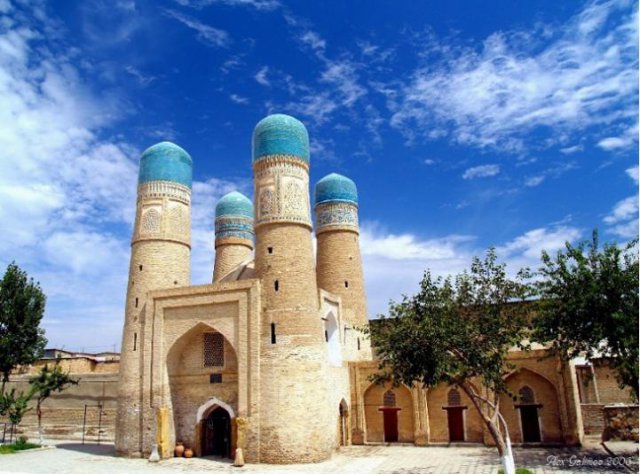
486e2d09a6dApaxT 631fc995ad Khanaka (Sufi monastery) of Nadir Divan-Beghi {1620}, Bukhara09-Bukhara-2013raw1640b registan-v-samarkandeshahi-zinda-samarkand022_Klub_puteshestviy_Pavla_Aksenova_Uzbekistan_Samarkand_Registan_Medrese_Sherdor_Foto_efesenko_-_Depositphotos-1024x623
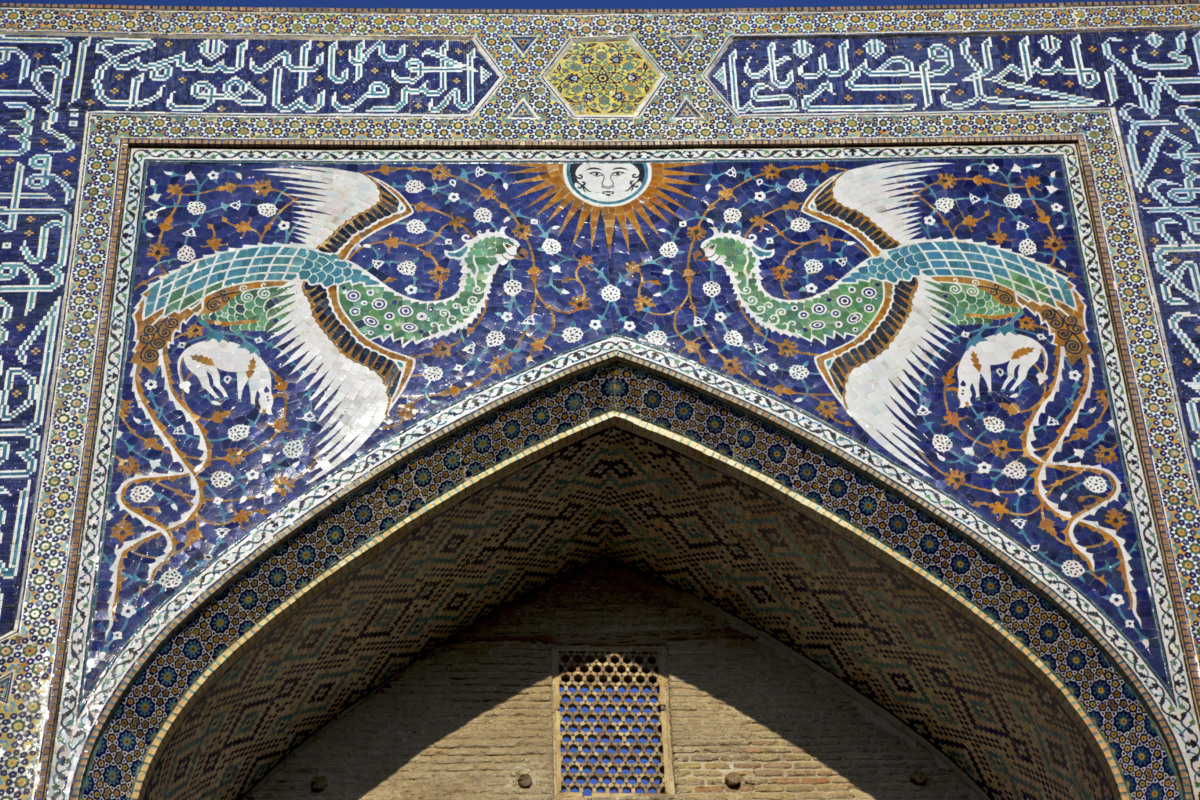
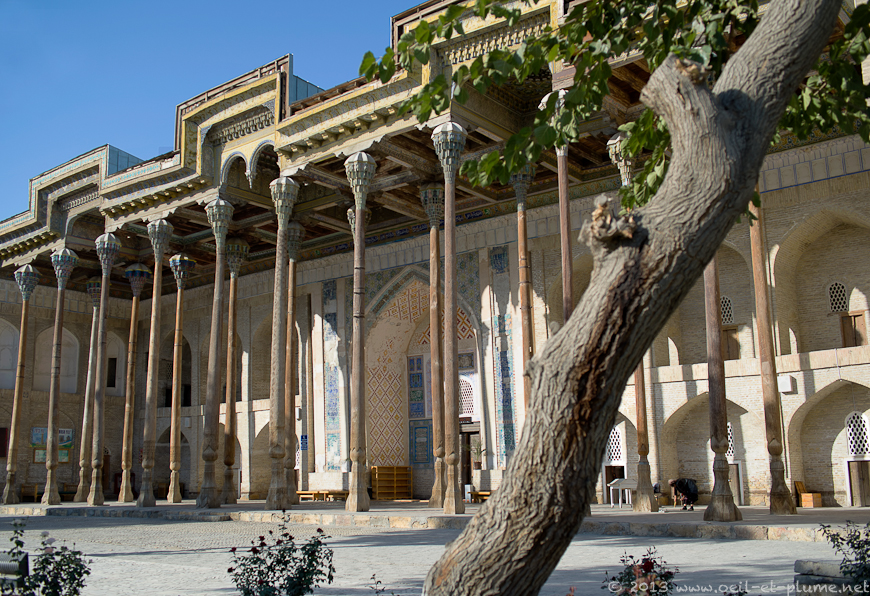
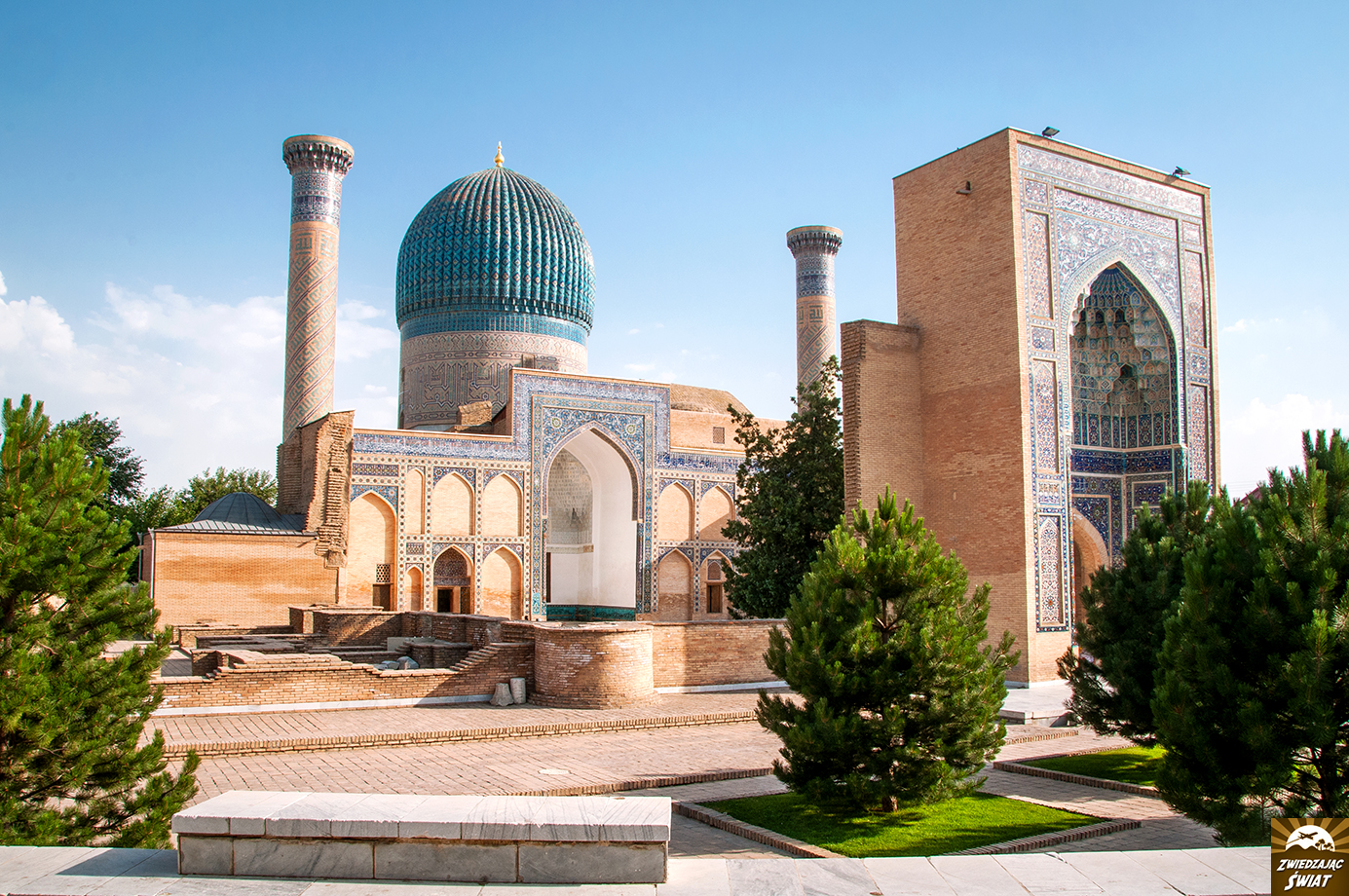
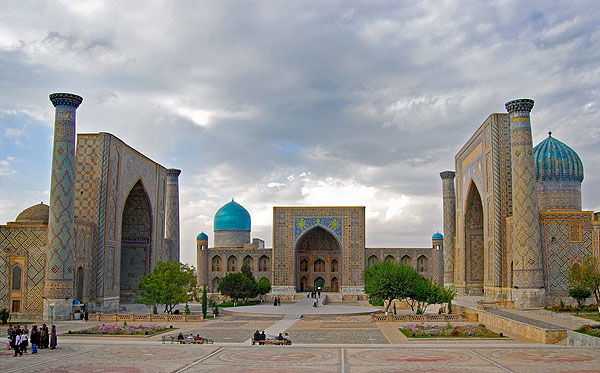
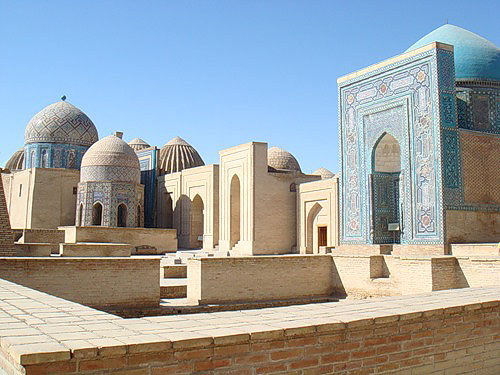
[From top, left-right: 1. Chahār Minār, Bukhara  2. Bukhara, view of old city and wall  3. Nādir Divan-Begi Khānaqāh, a Sufi monastery featuring depictions of Simurgh from Ferdowsi’s Shāhnāmeh on its pishtaq, Bukhara  4. Bālā-Hauz, Bukhara  5. Gūr-i Amīr, Tamerlane’s mausoleum, Samarqand  6. Rēgistān square, Samarqand  7. Shāh-i Zinda, Samarqand  8. Shērdār Madrasa at Rēgistān, Samarqand]
Bukhara and Samarqand are still natively Persian-speaking (Tajik) cities in modern-day Uzbekistan; the former traditionally boasted a sizable Persophone Jewish element as well that has since relocated to Israel. The structures depicted are architectural heirlooms to the region’s robust Persianate past and former economic prosperity under the Samanid, Ghaznavid, and later Timurid empires. From a philological standpoint, we can imagine that it was in urban centers like these that incoming Turcophone groups interacted with the autochthonous settled Persian-speaking populations in Transoxiana, in turn giving rise to the modern Uzbek yoke, and wherein the Uzbek language (Sart dialect; progenitor of the modern literary language) gradually lost features typical of Turkic—notably the vowels /ü/, /ö/ and vowel harmony—and adopted thousands of Persian words and phrases. (*note the Khorezmian Uzbek language is of Oghuz provenance but features a heavy admixture of Uyghur-Uzbek elements; the Kipchak Uzbek language is closely related to Kazakh. Both of these languages are vowel-harmonized and feature relatively fewer Persianisms in their lexicon and morphology) 

Thus the prevalence of Classical Arabic loanwords in New Persian is largely the fruit of a medieval scholarly tendency among Iranian intelligentsia who composed their works in Classical Arabic to then incorporate Arabic words and phrases into their speech, perhaps in an attempt to “enrich” the non-Islamic Middle Persian tongue and thereby emphasize their elevated stratum in society (city-dwelling, educated Muslim families) on the basis of their prestigious vernacular. Iranian scholars and polymaths also played a pivotal role in the standardization and diffusion of Classical Arabic, and Persians, Greeks and Syriacs served as cultural brokers in the Abbasid court. 

Persian Islamic Scholars Composed All Six of the Major Sunni Hadith Collections (al-Kutub as-Sittah

During the 9th century, all of the six canonical collections of the Sunni ḥadith, venerated by Sunni Muslims as al-Kutub as-Sittah (الكتب الستة) and second in importance only to the Quran, were composed by Persian authors. Their names and places of origin are listed below:

1. Sahih Bukhari, collected by Imam Bukhari (d. 256 AH, 870 CE), born in Bukhārā
2. Sahih Muslim, collected by Muslim b. al-Hajjaj (d. 261 AH, 875 CE), born in Nishāpur, Khorāsān
3. Sunan al-Sughra, collected by al-Nasa’i (d. 303 AH, 915 CE), born in Nisā, Khorāsān
4. Sunan Abu Dawood, collected by Abu Dawood (d. 275 AH, 888 CE), born in Sistān
5. Jami al-Tirmidhi, collected by al-Tirmidhi (d. 279 AH, 892 CE), born in Termez, Khorāsān
6. Either:
Sunan ibn Majah, collected by Ibn Majah (d. 273 AH, 887 CE), born in Qazvīn
Sunan ad-Dārimī , collected by Imam Al-Darimi (181H–255H), born in Samarqand

List of Middle Iranian Loanwords in Classical Arabic (Compiled by the Afsheen Sharifzadeh)

Ahmad Amin writes “at a glance one can see that the Arabs in every point or every way they turned or for every necessity of life were obliged to use Persian words. Besides the words themselves they adopted the phrase-making ideas and expressions used by the Persians in explaining various matters or in defining things.”

Hundreds of Iranian words and terms began to enter into Arabic language, sometimes via an Aramaic milieu, and were Arabicized (تعريب ta’rīb) in eccentric ways according to the phonetic and morphological system of that language. Verb derivatives were even formed from Iranian nouns according to the Arabic patterns (اوزان awzān). It follows that Iranian lexical borrowings in Classical Arabic (معربات mu’arrabāt) pertained to all domains of civilized society, including botany, culinary matters, administration, architecture, minerals, philosophy, zoology, musical instruments, and items of luxury and power adopted from Sassanian Persia. The following are some notable and readily-recognizable Eastern Iranian/Parthian, Middle Persian (MP) loans, and Early New Persian (NP) that remain in Modern Standard Arabic (اللغة العربية الفصحى) as well as most dialects, although borrowings in Classical Arabic and Mesopotamian/Gulf dialects are more varied and numerous.

LIST


abad- eternity (MP: a-pād “without foot, endless”)

‘abqari- genius, highest perfection, unsurpassed (MP: abargar “superior, highest”)

adab– literature; courtesy, civility (constructed from MP: dab)

‘anbar- ambergris (MP: hambar)

anbār– warehouse, depot (MP: hambār)

argīla– waterpipe (NP: nārgīl “coconut”)

‘askar, ‘askari- army, military (constructed from MP: lashkar)

‘ar, ‘aar, mu’aar– perfume, perfumist (constructed from MP: atr)

azraq, zarqā’- yellow (constructed from MP: zargōn “golden”)

Baghdād (MP: baga+data “Given by God”)

bahlawān- clown, gymnast (MP: pahlawān “champion”)

bakht- luck (from MP: bakht)

banafsaj- purple, violet (MP: wanafshag, NP: banafsha)

bandar– port, harbor (MP: bandar)

baqshish- tip, gratuity (MP: bakhshish “gratuity”)

bāriz, baraza– prominent; to elevate (constructed from MP, Parthian: borz “high; elevate”)

barīd– post, mailing (constructed from MP: burida-dum “a docked mule appointed for the conveyance of messengers”)

barnāmaj- program (MP: abarnāmag)

bas- (coll.) but, enough, stop (NP: bas)

bashkīr– hand towel (MP: pēshgir)

bathinjān- eggplant (MP: bādengān)

ba duck (MP: bat)

bayān- statement, report, accouncement (MP: payām)

baydaq– a footman [in chess] (constructed from MP: payādag, NP: piyāda)

bulbul- bird (MP: bulbul)

bulūr- crystal (MP: bolur)

bunduq– hazelnut (MP: pondik)

bunj- anaesthetic (MP: pōng)

burj– tower (MP: burg)

burwāz- frame (MP: parwast “enclosure”)

bustān- garden (MP: bostān)

bāmiya- okra (MP: bamiya)

bārija- battleship, flagship (MP: bārūja “flower pot”< “a deep-hulled vessel”)

bāzār– market (Parthian: wahāchār, MP: wāzār, NP: bāzār)

būsa- kiss (MP: bōs)

dabīr, dabbara- manager; to oversee, plot (constructed from MP: dipīr)

daftar- notebook, office (MP: dabtar)

darb- gate (MP: darpân “gatekeeper”, Arabic reflex of this term)

darwīsh- ascetic, particularly Sufi (MP: dreyosh “one who lives in holy indigence”)

dashin, yadshin– dedicate (constructed from MP: dashn “gift”)

dumbek– drum (MP: tumbag)

dukkān– shop (MP: dukan)

dulāb– wheel (MP: dol-ab “water wheel [machine]”)

dunyā- world (MP: dunya)

dustūr- constitution (MP: dastwar, NP: dastūr)

dīn, diāna, tadayyun- religion, piety (constructed from MP: dēn> OP: daēna)

dīnār– unit of currency (MP: denār)

dīwān- high governmental body, council (MP: dēwān “archive”)

falak- orb, sphere (MP: parak “the star Canopus, brightest star”)

Fārsī, Bilād al-Furus– Persian, Persia (MP: Pārsīg)

fattash, taftīsh, mufattish- inspect (constructed from MP: pitakhsh “viceroy”>p-t-kh-sh>f-t-sh)

fayj– courier (MP: payg, NP: payk)

fayrūz- turquoise (MP: pērōzag, NP: firuza)

fihris, fahrasa- index, register (constructed from MP: pahrist)

finjān- cup (MP: pengân)

firdaws- paradise (MP: pardēs)

fifia- alfalfa (MP: ispist)

fustuq- pistacchio (MP: pistag)

fīl- elephant (MP: pil)

filfil– pepper (MP: pelpel)

fūlādh– steel (MP: polad)

a- towel (MP: pusha)

handasa, muhandis- engineer (constructed from MP: [h]andāzag “measure, quantity”, NP: andāza)

hawā’- air, atmosphere (MP: havā> OP: hvayāv “good current”)

haykal- framework, outline (MP: paykar)

Hind- India (Persian name for Sindh, product of h>s Iranian/Indo-Aryan isogloss)

hindām– symmetry (MP: [h]andām “symmetry, arrangment”)

ibrīq- jug (MP: abrēk)

īwān- a chamber or vault, often at the exterior entrance of a building (MP: aywān)

jāmūs– buffalo (MP: gāwmēsh)

janzīr– chain (MP: zanjīr)

ja, jaās- gypsum; plasterer (MP: gach)

jawhar- essence, substance (constructed from MP: gōhr)

jawhara, jawahir- jewel (constructed from MP: gōhr)

jawz- walnut (MP: gōz)

jazar– carrot (MP: gazar; descendents Larestani: gazrak, Armenian: gazar))

jund, jundīyya, tajannud, tajnīd- army, military service, enlistment (constructed from MP: gund “army”)

jāsūs, tajassus- spy, espionage (constructed from MP: goshash>g-sh-sh>j-s-s, “hearer, listener”)

julnār- pomegranate blossom (MP: gulnār)

jūrāb- socks (NP: jawrāb)

ka’ak– a type of pastry (MP: kāk)

kabāb, kubba- roasted meat on skewers (MP: kabāb)

kahrabā’- electricity (MP: kāhrubā, “yellow amber”)

kamān, kamānja- a musical instrument (MP: kamān “bow”, kamāncha “little bow”)

kānūn- campfire, furnace (MP: kānun)

kanz- treasure (MP: ganj>OP: ganza)

khām- raw [materials], ore (MP: khām “raw, crude”)

khandaq- moat, pit (MP: kandag)

khanjar- dagger (MP: khōngar)

kharj, kharrāj– tribute, duty, work (constructed from MP: harg)

khiār- cucumber (MP: khyār)

khurda- scraps, fragments (MP: khurdag)

khammana, takhmin- guess, speculate, value (constructed from MP: gumān g-m-n > kh-m-n)

khān- shelter, rest stop (MP: khān “house”)

khashin, khushūna- rough, harsh; severity (constructed from MP: khashen)

khazīna, makhzan- treasury (constructed from MP: ganjēna g-j-n > kh-z-n)

kīmīā’– chemistry (MP: kimiā)

kīs- bag (MP: kisag)

kisra- idol (from MP: Kasra, Khosrow)

kūz- vase, storage vessel (MP: kōz)

laymūn: lemon (MP: lēmōg)

lāzaward: lapis lazuli (MP: lajward)

lubiya- bean (MP: lobiya)

mahara, muhr- stamp, seal (MP: muhr)

mahrajān- festival (MP: Mihrigân, Zoroastrian autumnal equinox celebration)

al-Māristān– premier hospital complex of Abbasid-era Baghdad (from MP: wēmāristān; NP: bimārestān)

marj – field (Parthian: marg, MP: marv)

marjān- pearl, coral (MP: margān)

mās– diamond (MP: almās)

masaka, massaka, amsaka, tamassak– adhere, stick, cling, take hold (constructed from MP: mashk “musk”)

mask– musk (MP: mashk)

mawz– banana (MP: mōz)

maydān- city square, field (MP: mēdān)

mezza– taste, starter (MP: mizag, NP: mazza)

mihrāb- niche in the wall of mosque indicating the qibla or direction of Mecca (MP: Mihrāba “Mithraeum”)

miswāk– toothpick, toothbrush (constructed from MP: sawāk, from MP sūdan “to rub, scrape”)

muzarkash, zarkash- colorful, decorated (constructed from MP: zarkesh “gilded”)

nabāt- sugar crystals, “sugar candy” (MP: nabat)

nabīdh– wine (MP: nabēd)

nadhar, intidhār, munādhir, mandhūr– to look, watch, wait (constructed from MP: negar, negaristan)

nafoil, petroleum (MP: naft)

namr- cushion, pillow (Parthian: namr “meek”, NP: narm)

naqsh, munāqasha, niqqāsh, naqqāshi, manqūsh- painter, artist (constructed from MP: nakhsh)

narjis- narcissus flower (MP: nargis)

nasrīn- sweetbriar flower (MP: nasrēn)

nishān- badge (MP: nishan)

numūdhaj- exemplary (MP: namudag)

nākhudhā- ship captain (MP: nāv-khudā)

nāranj: orange, clementine (MP: narang)

nāy: reed flute (MP: nay)

nīlūfar: nenuphar, lotus, water lily (MP: nilōpal)

qabr- grave, coffin (MP: gabr “hollow, cavity”)

qafa– cage (MP: kafas)

qahramān- champion (MP: kār-framān, “manager, overseer”)

qas’a- serving pot (MP: kāsa)

Qazwīn- Caspian (MP: Kasbīn)

qirmiz– crimson, scarlet (MP: kermest)

qubba- vault, dome, cupola (MP: gunbad)

qumbula- bomb (MP: kumpula)

raālead, tin (constructed from MP: arziz > Parth: archich)

rizq, razaqa, istarzaqa, rezzāq- daily wage, sustenance; to bestow or endow (constructed from MP: rōzig, Parthian: rōchik “daily bread”)

aidala, aidaliyya– pharmacy (constructed from MP: chandal “sandalwood”)

aqr- hawk (MP: chark)

alīb- cross (MP: chalipa)

andal- sandals, sandalwood (MP: chandal “sandalwood”)

andūq– chest, crate; treasurer’s office (MP: sandūk)

anj– harp (MP: chang)

sarādiq- pavillion, canopy (MP: srādag)

sardāb- basement (MP: sardāba)

sarīr- throne, bed (MP: sarir)

sawsan– lily (MP: sōsan)

shakush- hammer (MP: chakuch)

shāhīn- falcon (MP: shāhēn)

shatranj- chess (MP: chatrang)

shā’ib, shā’ibа, ashīb – grizzly (constructed from MP: āshub)

shāwīsh– sergeant (MP: chāwush “seargent, herald; the leader of a caravan”)

shāy- tea (MP: chāy)

shibbith– dill (MP: sheved)

shīsha- waterpipe (NP: shīshag “bottle, flask”)

siāl, sayl, musīl– flowing, runny (constructed from MP: sayl, i.e. saylāb)

sifir- zero (MP: zifr)

simsār, samsara- middleman, broker (MP: samsar)

sirāj- lamp, light (MP: chirāgh)

sirā– path, way, custom (MP: srat, “street”)

sirdāb- tunnel, cellar (MP: sardāb)

sirwāl- pants, trousers (MP: shalwār)

sufra- dining table (MP: supra)

sukkar- sugar (MP: shakar)

Aīn- China (MP Chin, name for China, from the Qin dynasty)

sādej- plain, simple (MP: sādag)

sīkh- skewer (MP: sikh)

īnīyya- tray (MP: chini, in reference to imported chinaware from the East)

sīra: juice (MP: shirag)

abaq- plate, dish (MP: tābag “frying pan”)

ābūr- line, queue (MP: tabur)

arāz- type, brand (MP: taraz)

arbūsha– a type of hat, “red fez” hat (NP: sar “head” + pūsh “wear”)

takht, takhta- platform, bench (MP: takht “throne”)

tanbal- lazy (MP: tanparvar)

tannūr- oven (MP: tanūr)

tannūra- skirt, dress (MP:tanvar)

tarjuma, mutarjim– translation (constructed from MP: targumān)

tarzī- tailor (MP: darzi)

tāj- crown (MP>Parthian: tāg)

āzej– fresh, new (MP: tāzag)

tūt- mulberry, berry (MP: tut)

ustuwāna- disc, cylinder (NP: ostovāna)

ustādh- teacher, master (NP ostād>MP: avistād “master, skillfull man”)

waqt- time (from Parthian, Eastern M.Irn: bakht)

ward, warda- flower, rose (Parthian: ward, Early MP: varda> OP: varda)

wazīr, wizāra- vizier (MP: vichira “bureaucrat, member of Sassanian court”)

yasmīn- jasmine (MP: yasmēn)

yāqūt- ruby (MP: yākand)

Yūnān- Greece (MP: Yonan, Persian name for Ionia)

za’farān– saffron (MP: zarparōn)

zaman, zamān- time [abstract] (MP: zamān, zamanāg, Parthian: zhamān, zhamānak)

zandīq- heretic (MP: zandik)

zanjabīl- ginger (MP: singibir)

zayt, zaytūn– olive (MP: zayt)

zilzāl- earthquake (MP: zilzilag)

zinzāna- prison, dungeon (MP: zindānag)

zumurrud– emerald (MP: uzumburd)


Persian Factors in pre-Islamic Arabia and the days of the Prophet Muhammad

The contacts between Arabia and the Sassanian Persian Empire were very close in the period immediately preceding Islam. The Arab Kingdom centered at al-Hira on the Euphrates had long been under Persian influence and was a headquarters for the diffusion of Iranian culture among the Arabs. Throughout the titanic struggle between the Sassanids and the Byzantine Empire, where al-Hira had been set against the Kingdom of Ghassan, other Arab tribes became involved in the conflict and naturally came under the cultural influence of Persia. The Court of the Lakhmids at al-Hira was in pre-Islamic times a famous center of literary activity, and Christian poets such as Adi ibn Zaid lived long at this court and produced poems containing extensive Persian loanwords. But the Iranian influence was not merely felt along the Mesopotamian areas; it was an Iranian general and Iranian influence that overthrew the Abyssinian suzerainty in southern Arabia during Muhammad’s lifetime.

640px-Kamal-ud-din_Bihzad_001
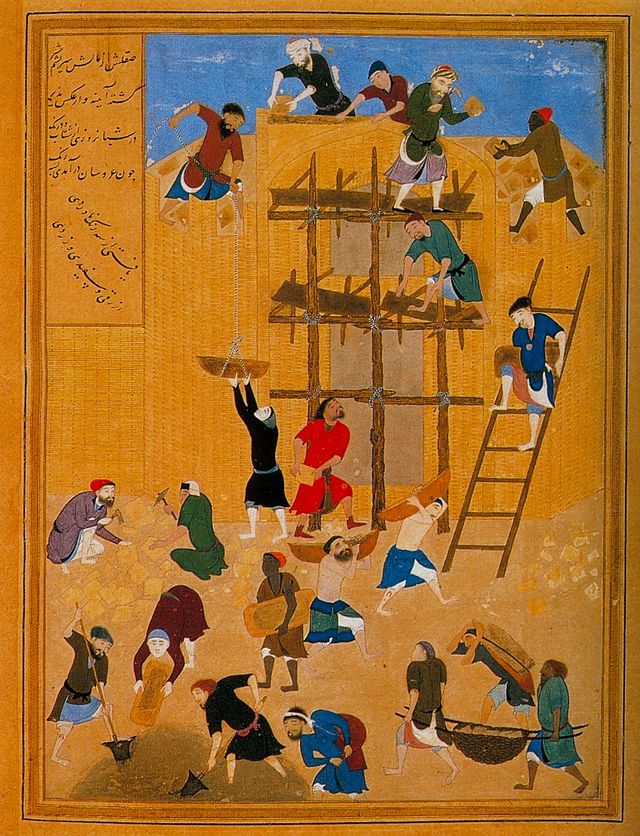
A Persian manuscript from the 15th century describing the construction of Al-Khornaq castle In Al-Hira, the Arab Lakhmids’ capital city. The Lakhmids were a Christian Arab tribe of Yemenite stock who established their center in southern Iraq in 266 A.D., near the Sassanid capital of Seleucia-Ctesiphon.

In the early days of the Prophet’s mission, there were only seventeen men in the tribe of Quraysh who could read or write. It is said that an Iranian man, known as Hammad ar-Rawiya, seeing how little the Arabs cared for poetry and literature, urged them to study poems. In fact it was Hammad who selected the Mu’allaqāt, the seven Arabic poems written in pre-Mohammedan times and inscribed in gold on rolls of coptic cloth and hung up on the curtains covering the Ka’aba. In this period, Hammad knew more than any one else about the Arabic poetry. According to Edward Browne, before the advent of Islam, the Arabs had a negligible literature and scant poetry. It was the Iranians who after their conversion to Islam, feeling the need to learn the language of the Qur’an, began to use that language for other purposes.

Ph. Gignoux hypothesizes that the Quranic phrase bismi’llahi’l-rahmani’l-rahim was modeled on the Middle Persian pad nam-i yazdan. Although there were antecedent Jewish and Christian parallels, a similar formula was also current among Zoroastrians and Manichaeans.

In The Vocabulary of the Quran, Arthur Jeffrey enumerates over 40 words of Iranian origin in Qur’an, among them the following: ebriq, estabraq, barzakh, burhan, tanur, jizya, junah (from gonah), dirham, din, dinar, rezq, rauza, zabania, zarabi, zakat, zanjabil, zur, sejjil, seraj, soradaq, serbal, sard and zard, sondos, suq, salaba, ‘abqari, efrit, forat, firdaus, fil, kafur, kanz, maeda, al majus, marjan, mask, nuskha, harut and marut, wareda, wazir, yaqut.

In addition, many terms in Classical Arabic literature are transliterations or calques of the Persian: Khamsa Mustaraqa from Panjeh-ye DozdidehMushahira from MahianehNisf an-Nahar from Nim-ruzan-Namal al-fares from Murcheh-SavariMaleeh (origin of Levantine Arabic mniih “good, well”) from NamakinBeyt an-Nar from AteshkadehBalut al-Moluk from Shah-balutSamm al-Himar from Khar-zahrehLisan al-thawr from Gav-zabanReyhan al-Mulk from Shah-Esperam.

Sources: 

Eilers, Wilhelm. Iranisches Lehngut im arabischen Lexikon: Über einige Berufsnamen und Titel. Gravenhage: Mouton, 1962.

Lane, Edward William. An Arabic-English Lexicon.
http://www.perseus.tufts.edu/hopper/text?doc=Perseus%3Atext%3A2002.02.0021%3Aroot%3Dxmn

Hovannisian, RIchard G.; Sabagh, Georges. The Persian Presence in the Islamic World. Cambridge University Press, 1988.

Tafazzoli, A. Arabic Language ii. Iranian loanwords in Arabic.
http://www.iranicaonline.org/articles/arabic-ii.

Browne, Edward. A Literary History of Persia, Vol. I. 

MacKenzie, D.N. A Concise Pahlavi Dictionary. Psychology Press, 1971.

Shir, Addi. Al-Alfâz Al-Fârsîyya Al-Mu`arraba (A Dictionary of Persian Words in the Arabic Language). Library of Lebanon, 1980.

Gharib, B. Sogdian Language i. Loanwords in Persian.
http://www.iranicaonline.org/articles/sodgian-language-i-loanwords

Agius, Dionisius A. Classic Ships of Islam: From Mesopotamia to the Indian Ocean. Brill Academic Pub, 2007.

Cheung, Johnny. Etymological Dictionary of the Iranian Verb. Brill Academic Pub, 2007.

علي الثويني. التائه بين التأثيرات اللسانية و عقدة الخواجة 2-9/محمد مندلاوي
http://www.hekar.net/modules.php?name=News&file=print&sid=8603

تاثیر زبان فارسی بر زبان و ادبیات شبه قاره هند. محمد عجم.
http://www.hozehonari.com/PrintListItem.aspx?id=22896