Persian Dominance in Commerce and Islamization on the Malay-Indonesian Archipelago: An Analysis of Historic Loanwords

Written by Afsheen Sharifzadeh, a graduate of Tufts University focusing on Iran and the Caucasus. The present article delves into historic commercial and religious contacts between West Asia and the Malay-Indonesian Archipelago from the 9th to the 18th centuries AD. While one might anticipate a significant presence of Arabic loanwords in Malay related to maritime activities and commerce, the analysis surprisingly reveals that such loans predominantly originate from Persian rather than Arabic, pointing to a misattribution of influence. The author argues that a Persian-speaking merchant network played a central role in the Indian Ocean and South China Sea, shedding light on historical linguistic dynamics and questioning the presumed dominance of Arabic in certain domains.

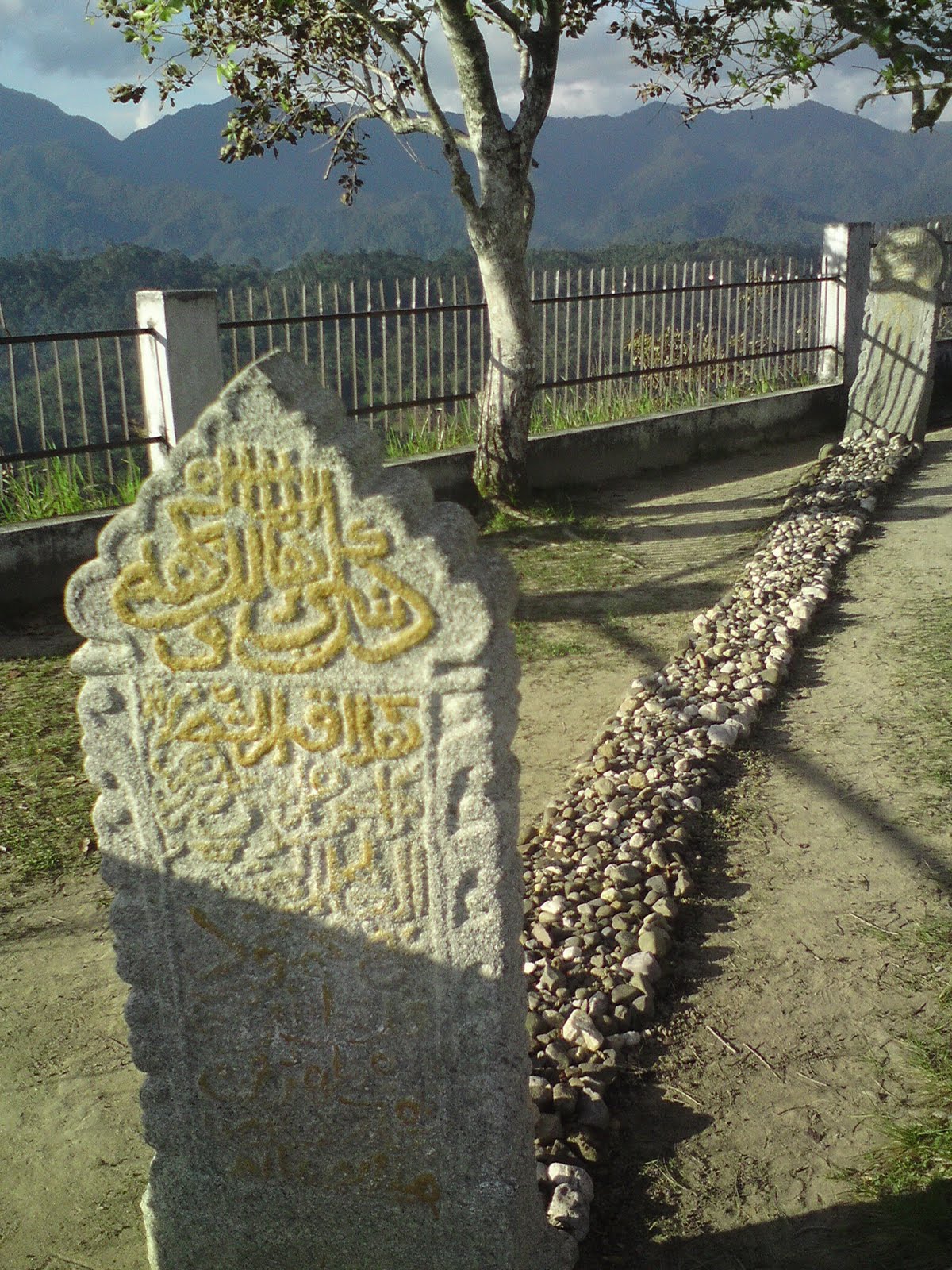
(1) Papan Tinggi cemetery complex at Barus, on the west coast of Sumatra, Indonesia (2) The gravestone of one Shaykh Maḥmūd (1426 CE). The headstone is inscribed with a couplet from the Shāhnāmah (Book of Kings) of Ferdowsī (d. c. 1020 CE) addressing the subject of mortality and the impermanence of “worldly life”: جهان یادگارست و ما رفتنى/ زمرد نماند به جز مردمى “The world is a perpetual remembrance and we all leave it in the end; people will leave nothing behind but their good deeds.”

Background
In examining commercial contacts between West Asia and the Malay-Indonesian archipelago between the 9th and 18th centuries AD, the term “Arabian” is often invoked to describe the ethnolinguistic affiliation of the foreign merchants involved in such exchanges across modern English, Malay and Indonesian language sources. We might therefore expect to encounter an array of vernacular Arabic loans in Malay (and in other indigenous Austronesian languages on Sumatra and Java, including Achehnese, Minangkabau, Javanese and Sundanese) pertaining specifically to maritime activities, commerce, and daily social exchanges. However, upon analysis, it becomes evident that loans in those domains almost exclusively originate from Persian rather than Arabic, offering a different narrative. This is in some ways unsurprising, since robust linguistic and genetic evidence have demonstrated that Persians rather than Arabs formed the dominant ‘Muslim’ component in China1, the Thai Kingdom of Ayutthaya2, and the Swahili coast of Africa3, and that use of the term ‘Arab’ is in many cases the result of a broad misattribution which has been replicated for various reasons, discussed below. The matter is further complicated by the historical currency of Persian throughout the Indian subcontinent, where it served as the official language in some regions such as Delhi and Bengal for a period of nearly 600 years and in others, at the very least, as the lingua franca, from the 13th century onwards. It appears, nonetheless, that diligent scrutiny of the available data has hardly been undertaken by numerous authors venturing to forward our understanding of the subject, and hasty reproduction of the same misconceptions surrounding ‘Arab’ involvement has, regrettably, obscured an authentic portal of contact, by now having apparently receded into oblivion among the Malay-Indonesians and Iranians themselves. Observe the following Persian loanwords in Classical Malay for important nautical terms (many now obsolete or archaic), including ‘merchant’, ‘sailor’, ‘captain’, ‘harbor master’, ‘port’, ‘warrant officer’:

Classical MalayPersianEnglish
Anjimanانجمن anjuman “association”An East Indiaman; a large transport or trading vessel belonging to the East India Company
Awarآوار āvārDamage of ship or load
Badباد bādWind
Balabad بالا باد bālā bādHigh wind, land breeze
Bamبام bām “ceiling”Crosspiece (a bar or timber connecting two knightheads or two bitts on a ship)
Bandarبندر bandarPort, harbor
Gazگز gazA Persian unit of length, ranging from 24 to 41 inches
Gusiگشا gušāmizzen sail; gaff mainsail
Jangkarلنگر langarAnchor
Kelasiخلاشى xalāši (from خلاش “rudder”)Sailor
Khojaخواجه ājaMerchant
Nakhodaناخدا nākhodāCaptain, shipmaster
Persanggaفرسنگ farsangA Persian measure of distance, equivalent to about four miles
Saudagarسوداگر sowdāgarMerchant
Serangسرهنگ sarhangThe officer (or warrant officer) in charge of sails, rigging, anchors, cables etc. and all work on deck of a sailing ship
Syabandar شاه بندر
šāh bandar
Harbormaster
Takhta rawan تخت روان
takht ravān
Plank

At the time of writing, the only Malay nautical terms of Arabic extraction known to this author are farsakh “an ancient Persian unit of distance, equivalent to about 4 miles” (doublet of persangga; from Persian فرسنگ farsang via Arabic فرسخ farsakh, also reborrowed into Persian as farsakh) and bahar “sea” (from Arabic بحر baḥr), but the route of their transmission is uncertain due to their simultaneous presence in Persian. If the primary participants in maritime trade were indeed predominantly Arab merchants hailing from the Ḥaḍramaut (a southern coastal region of the Arabian Peninsula), with Persian-speakers playing a secondary role in these exchanges, then the near complete absence of Arabic nautical loanwords in Malay poses a significant paradox. Why were nautical terms from a ‘minority’ foreign language selectively borrowed?

On the contrary, the remains of a shipwreck in Phanom Surin, Samut Sakhon province, Thailand dating to before the advent of Islam with an inscription of the presumed shipowner Yazd-bōzēd in Middle Persian, as well as a garnet set in gold finger ring found in Palembang, Sumatra (7th-9th century?) engraved in an elegant Pahlavi script with the Middle Persian word āfrīn, “blessing”, suggests Persians had maintained the maritime routes to China where sizable Zoroastrian, Manichaean, Christian and Jewish Iranian communities are known to have existed for centuries prior to Islam. Further Perso-Arabic, Pahlavi and Judeo-Persian inscriptions belonging to a 9th century Persian-speaking merchant community operating under state privileges on the Malabar Coast of southwest India in the same time frame as the shipwrecked Phanom Surin vessel confirms the wider network in which these objects’ discoveries must be seen. Later in the 15th century, according to the historian Ismail Marcinkowski, “…Persian was the lingua franca in the Indian Ocean trading world and a Persian-speaking merchant community was present in Malacca. The office with the Persian title of Šāhbandar (شاه بندر “harbor master”), known in many of the Indian Ocean trade ports as well as in several parts of the Ottoman Empire, was also established in Malacca.”4 This confirms and advances the existence of a longstanding Persianate commercial network in the Indian Ocean and South China Sea centered around a Persian-speaking merchant oligarchy, which in medieval times included Persian-speaking Gujaratis and Bengalis, as well as Hadhrami Arabs.

This is further corroborated by multiple foreign travelers’ attestations to the highly influential and thriving resident colonies of Persian-speaking merchants in Zaiton (泉州 Quánzhōu) in the 14th century and in Siam’s capital of Ayutthaya in the 16th century. Notably, the descendants of some of the original Persian traders in Ayutthaya (known since the 15th century by a Persian epithet Scierno, from Šahr-e nāv “City of Boats and Canals” among Western mariners and travelers around the rim of the Indian Ocean), members of the aristocratic Thai-Persian Bunnag, Siphen and Singhseni families, continued to be in positions close to the Thai throne into the 20th century. The rich and flavorful massaman curry (แกงมัสมั่น kǣng mát-sà-màn), a corruption of a Persian word mosalmān مسلمان “Muslim”, is attributed to the 17th century Persian community in Ayutthaya through Sheikh Ahmad of Qom (ca. 1543–1631), the patriarch of the Bunnag family.
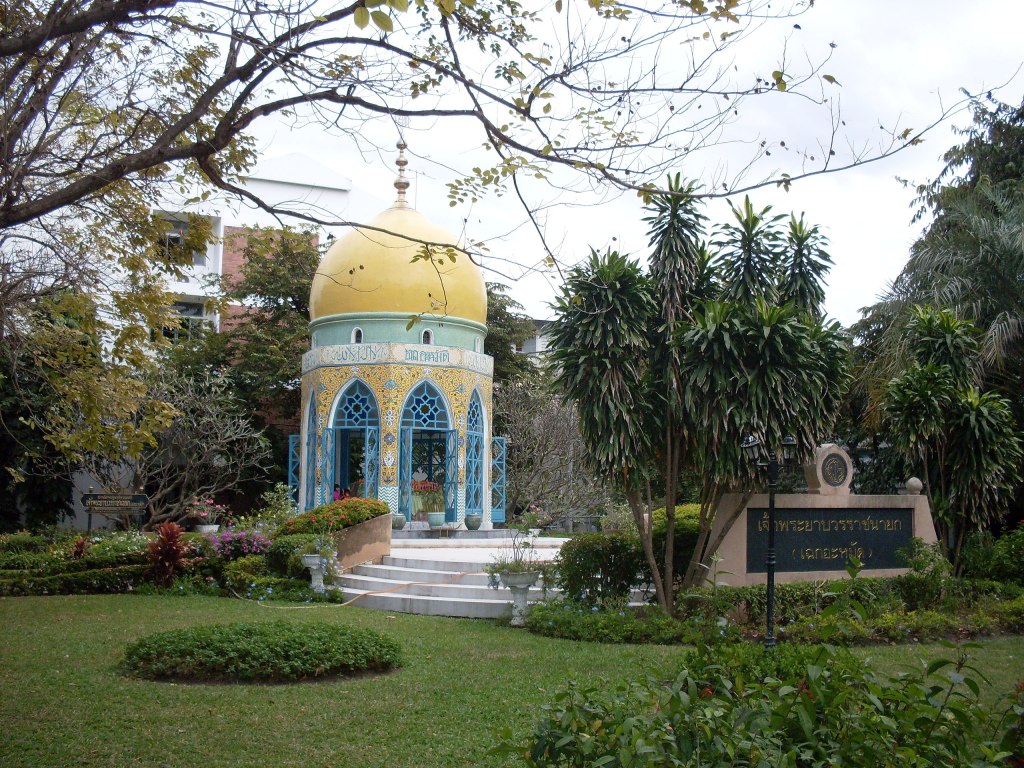
(1) Tomb of the Persian-born merchant Sheikh Ahmad of Qom (ca. 1543–1631), in Ayutthaya, Thailand. He became a powerful official in the Siamese court, where he was given the title of Châophráya Boworn Râtcháyók (Thai: เจ้าพระยาบวรราชนายก). He was the ancestor of the powerful Thai-Persian Bunnag family (2) Massaman curry paste (มัสมั่น mát-sà-màn, from Persian mosalmān مسلمان “Muslim”), created by the prosperous 17th century Persian community of Ayutthaya, consists of cinnamon, nutmeg, cumin, star anise, clove, cardamom, mace (all brought by traders, including Persians, from the Malay-Indonesian archipelago to Siam) and the decidedly un-Thai flourish of raisins and bay leaves (from Iranian cuisine) combined with ingredients more commonly used in Thai cuisine such as coriander, lemongrass, galangal, white pepper, shrimp paste, shallots, and garlic. This dish, along with others inspired by Persian dishes, is among the recipes in the funeral cookbooks of the Bunnag family5

Analysis of Persian loanwords in Malay related to the goods these merchants would have brought illuminates the story further:

Classical MalayPersianEnglish
Almasالماس almāsDiamond
Andamاندام andāmArrangement 
Anggurانگور angūrGrapes, wine (Thai: องุ่น à-ngùn)
Anjir انجير anjirFig
Badamبادام bādāmAlmond
Bajuبازو bāzū “arm”Shirt
Baksisبخشش baxšišWage, reward
Balurبلور bolūrCrystal
Biusبيهوش bi-hūšAnesthetic
Bozahبوزه būzeFermented drink made from wheat or millet
Cadarچادر čādar “tent, veil”Bed cover or tablecloth
Destarدستار dastārHeaddress
Gandumگندم gandomWheat
Gulگل golRose
Kaftanخفتان xaftānA long Persian tunic
Kahrabكهربا kahrobāAmber 
Kasaكاسه kāseBowl
Kelebutكالبد kālbodShoemaker’s last
Kismis كشمش kišmišRaisin 
Kojaكوزه kūzaBottlenecked earthenware
Kurmaخرما xormāDate
Lajakلچک lačakWoven fabric from yarn or silk
Mohorمهر mohrStamp, seal
Percaپارچه pārčaCloth from remainder fabric
Pialaپياله piālaCup, chalice
Picisپشيز pešiz “small”Penny (archaic), of small worth
Pingganپنگان pengān “bowl”Dish, plate
Piringپرنگ parang “copper”Plate
Pirusفيروز firuzTurquoise
Sadirنشادر nošâdorAmmonium chloride
Sakarشكر šakarSugar
Syalشال šālShawl
Tembakauتمباكو tambākuTobacco
Tenggahتنگه tangaA piece of gold or silver
Lazuardi لاجوردى lājevardiLapis lazuli
Zamrudزمرد zomorrodEmerald

On Arabic Loans in Malay-Indonesian
It is important to note that words with Arabic etymologies exist in high quantities in Malay (and by extension, Indonesian), far exceeding the number of ‘pure’ Persian loans. This is unsurprising since Classical Arabic—the mastery of which is required for proper interpretation of the Quran and Hadith—would have been known across generations of Muslim clergy even in the absence of a significant community of Arabs. Accordingly, the majority of Arabic terms in Malay-Indonesian are either demonstrably (1) learned borrowings of more recent literary provenance, based on their semantic domains and unadapted phonology, rather than the result of regular language contact with a vernacular Arabic variety or (2) adopted through the medium of Persian. The number of Malay words borrowed directly from Arabic in the opinion of this author has been, therefore, considerably overestimated. This extensive misclassification has lent false credence to the idea of a historically robust Arab–Malay relationship to the exclusion of Persians, who, according to all available evidence, probably formed the numerically predominant and culturally hegemonic ‘Muslim’ community in Southeast Asia in medieval times. Furthermore, the tombs of multiple venerated Persian shaykhs in Sumatra, such as that of one Shaykh Maḥmūd from Barus, dating to 1426 CE and inscribed, interestingly, with a couplet from the Shāhnāmah (Book of Kings) of Ferdowsī (d. c. 1020 CE), indicate that Persian Muslims served as a vector of Islamization and thus transmission of Arabic to the region.

Towards understanding the words in group (2) above, given the presence of manifestly Persian phonologic and semantic mutations to numerous Arabic terms in Malay, these lexical items must have been adopted through the medium of Persian rather than directly from Arabic. For example, feminine nouns with the final ta marbuta ة are often, but not always, transformed to ta ت in Persian, and this feature is present in numerous Malay words (e.g. Malay selamat “wellbeing” from Arabic سلامة salāma via Persian سلامت salāmat; hakikat “truth” from Arabic حقيقة aqiqa via Persian حقيقت haqiqat). Calques from Persian are also present which have been misattributed to Arabic influence. For example, Indonesian apa khabar? “How are you?” (lit. “what news”?) is in all probability a calque of Persian چه خبر če xabar? If this phrase had been calqued from a vernacular Arabic variety from the Arabian Peninsula, it would have been expected to yield a form like *apa akhbar mu, with the plural noun akhbar and the Malay second person possessive enclitic -mu (cf. Yemeni Arabic شو اخبارك šu axbārek). Moreover, Arabic-derived terms in Persian that were never actually used in living Arabic must have been borrowed into Malay via Persian. For instance, Malay tamadun “civilization” originates from the Arabic verbal noun تَمَدُّن tamaddun “to become urbanized”, but must have been adopted through Persian تمدن tamaddon “civilization”, since living Arabic instead uses حضارة ḥaḍāra “civilization”, a term unknown in Persian and, by extension, Malay.

The arrival of the British and Dutch East India companies in the 18th century heralded the end of Persianate commerce and the gradual disappearance of Persian-speakers from the Malay-Indonesian Archipelago. The subsequent introduction of steamships by the Europeans instead facilitated Malay-Indonesian contacts with sacred places and study centers on the Arabian Peninsula and in Egypt, wherefrom returning pilgrims began to spread puritanical ideas, particularly Wahhabism. Thus by the 19th century, the Malay-Indonesian world had decidedly turned its gaze toward Arabia rather than Persia, which was increasingly associated with heresy and deviant thought, especially with Shi’ism, Sufism and an abundance of Zoroastrian customs all flourishing on its soil. This, in turn, gave way to leveling of many Persian words in favor of their Arabic equivalents, as Arabic continued to be actively studied and mastered as the holy language of Islam. Words such as aftab “sun”, which were previously known in Malay, were survived only by their Arabic synonyms (Malay syamsu from Arabic شمس šams). In some cases, under prescriptive influences, Persianized Arabic words with meanings unique to Persian were supplanted by their original Arabic meanings. For example, Classical Malay logat which has the Persianized –at ending and historically held the Persian meaning of “word; dictionary” has now shifted towards the original Arabic meaning of “vernacular”, but retains its Persian phonology. In other cases however, such as sejarah “pedigree; history”, the Persian meaning was retained.

MalayPersianArabicEnglish
umatommatumma[Muslim] community
berkatbarekatbarakaBlessing
tamaduntamaddonḥaḍāraCivilization
sejarahšajare “family tree”šajara “tree”Family tree, history
akhlakakhlāq “character, nature”akhlāq “morals, ethics”Character, nature
logatloghat “word”lugha “idiom”1. Word; dictionary (archaic)
2. Vernacular, idiom

Commercial and Cultural Loanwords from Persian
Nevertheless, Persian loanwords with frequent occurrence in informal speech paint scenes of significant social interaction between Persians and the indigenous populations of the Malay Peninsula, Borneo, Sumatra, and Java. This includes both positive instances of intermarriage and occasions of disagreement or conflict. Note multiple words have undergone significant reshaping, in contrast to Arabic loans, indicating their adoption through normal language contact and transformation through high frequency use. More interesting is the conspicuous absence of Arabic loans in the informal register, including colloquialisms and explicit terms (compare Malay bedebah “damned; fuck it!” from Persian بدبخت badbakht; biadab “rude” from Persian بى ادب biadab; haram jadah from حرام‌زاده harāmzādah “bastard”; syabas from شاباش šābāš “well done!”; etc.), which further casts doubt upon the notion that Arabic was ever used for interethnic communication:

Classical MalayPersianEnglish
Acarآچار āčārPickle, marinade
Adatعادت ādatTradition, custom
Badi بدى badi Bad influence (obsolete)
Bahariبهارى bahāri “vernal”Beautiful (obsolete)
Bakhبخش baxšFortunate, happy (archaic)
Bedebah!بدبخت badbakhtDamned, infernal; (offensive, vulgar) fuck it! 
Betahبهتر behtarComfortable; recovered
Biadabبى ادب bi-adabRude, impolite
Bustanبستان bōstān Garden, orchard
Calakچالاک čālākGood, outstanding; talkative 
Derjiدرزى darziTailor
Dayahدايه dāyaFoster mother 
Dewala ديوال divāl “wall”Wall of a city
Dewanaديوانه devānaMadly in love
Geman, Gamangگمان gomān Afraid, frightened
Geramگرم garmIndignant; angry, infuriated
Gustiكشتى kuštiWrestling
Haram jadahحرام‌زاده harāmzādahBastard
Honarهنر honar “craft, ability”Mischief, commotion
Iniاين inThis
Kanduri خندورى khanduriFeast, ceremonial meal
Kawinكابين kābinTo get married; to have sex
Keskulكشكول kaškūlBeggar’s bowl
Kofteكوفته kōfta، from
كوفتن kōftan “to grind”
Various spicy meatball or meatloaf dishes
Nisanنشان nešānTombstone
Panjaپنجه panjeHand
Pasarبازار bāzārMarket
Pesonaافسون afsun “spell, incantation”Enthralling, dazzling
Pirangفرنگ farang “European”Blond; of a golden brown color (Thai: ฝรั่ง fá-ràng “foreigner”)
Sanubariصنوبرى ṣanobari “pine-like; the slender and graceful beloved”Heart, heartstrings
Serbat شربت‎ šarbatA drink prepared from fruits, flower petals
Siumanهوشمند hūšmand “intelligent, wise”Conscious, mentally healthy
Syabasشاباش šābāšBravo, well done!
Tamanچمن čaman “lawn, orchard”Park
Tamasya تماشا tamāšā “look, watch a spectacle”Festival; the act of going out and looking at things

Garnet set in a gold finger ring, engraved in Pahlavi script with the Middle Persian word āfrīn, “blessing”. Reportedly found in Palembang, Sumatra (the location of the historic entrepot of Srivijaya), 7th to 9th century. Private collection, Hong Kong

The Islamized Austronesians incorporated Persianate court styles and military culture into their societies, although most of these terms are today either archaic or have been rendered obsolete:

Classical MalayPersianEnglish
Bahadurبهادر bahādurHero
Cambukچابک čābok “horsewhip”Whip
Dewanديوان dēwānCourt, council
Firmanفرمان farmāncommandment
Getaكت katDais, throne
Jinزين zinSaddle
Johanجهان jahānWorld; hero
Khanjarخنجر khanjarDagger (Thai: กั้นหยั่น gân-yàn)
Kianiكيانى kiāniThrone
Kulahكلاه kulāhA kind of helmet, headgear
Laskarلشكر laškarArmy, soldier
Pahlawanپهلوان pahlavānHero, brave warrior
Siasatسياست siāsatTactic, politic
Syah Alam شاه عالم
šāh-e ‘ālam “King of the world”
Title of the sultan of Selangor
Tajukتاجک tājakCrown 
Takhtaتخت takhtThrone
Tarkasترکش‎ tarkašQuiver
Zirahزره zirihArmor

The Classical Malay literary tradition as well as Islamic scholarship were marked by widespread Persian cultural influences, much like on the nearby Indian subcontinent. The enigmatic Malay Sufi poet, Ḥamza Fanṣuri (of Fanṣur, modern Barus), who flourished under the reigning Sultan ʿAlāʾ al-Din Reʿāyat Šāh (r. 1588-1604), had a thorough knowledge of Arabic and Persian. In some of his works, he quotes from the masters of classical Persian mysticism such as Šabestari, either in Persian, or in Malay translation. Notable representation of the advice genre, or naṣiḥat, also bear clear parallels to classical Persian literature. An exemplary illustration of this link is the Tāj al-Salāṭin composed by Boḵāri al-Jawhari (perhaps a native of Johor in southern Malaya?) during the 17th century. This work, translated into Malay from an unidentified Persian source in the Acheh Sultanate of Sumatra, not only showcases thematic similarities with earlier Persian compositions like Neẓām al-Molk’s Siāsat-nāma, but also incorporates Persian expressions, such as nowruz, to denote the commencement of a new year. Another work is Bustān al-Salāṭin, also composed in Acheh around the mid-17th century, by Nur-al-Din Rāniri, who was born in India and was deeply immersed in the Persian scholarly tradition. The meticulous adherence to Persian models suggests these Malay works as faithful translations. Both compositions explore the theme of the “Just King” as epitomized by Anoshervan, the archetypal ruler of Sasanian Iran.

Thus, while Arabic enjoys special status for all Muslims including Persians, much like Ecclesiastical Latin for Catholics, review of historic loanwords in Malay reveals that the majority of borrowings pertaining to nautical, commercial, military and royal domains come from Persian rather than Arabic. Persian influence is further evident in Malay literature and Sufism, which manifest concepts and styles from Persian antecedents. Arabic words form the lion’s share of borrowings in the domain of religion and aspects of daily life influenced by Islamic teachings, which is expected and does not theoretically require the presence of an Arabic-speaking community. Persian was the vector of transmission for many Arabic words into Malay, which is revealed by the presence of idiosyncratic Persian phonological and semantic mutations to those Arabic words. More interesting is the absence of ‘pure’ Arabic loans in certain domains, particularly in informal speech including colloquial and explicit terms (compare Malay bedebah “damned; fuck it!” from Persian بدبخت badbakht; biadab “rude” from Persian بى ادب biadab; betah “comfortable; feeling better” from Persian بهتر behtar “better”; haram jadah from حرام‌زاده harāmzādah “bastard”; lahanat “damn!” from Persian لعنت la’nat “curse, damn”; syabas from شاباش šābāš “well done!”; etc.), which raises doubt whether Arabic was ever used as a language of communication. Nonetheless, the persistence of few but important Persian words alongside Arabic equivalents in the religious sphere bolsters the historic importance of Persianate Islamic culture on the Malay-Indonesian Archipelago:

MalayPersianEnglish
Abdasآبدست ābdastAblution (wudu’); compare Hui Chinese 阿布代斯 ā-bù-dài-sī, also from Persian
Bangبانگ
bāng
Islamic call to prayer (adhan); compare Hui Chinese 邦克 bāng-kè, also from Persian
Dargahدرگاه dargāhShrine associated with a Muslim saint
Darwisدرویش‎ darvišAn indigent, ascetic person; a Sufi
Langgarلنگر langarA small mosque
Periپرى
pari
Fairy

Eternal Fires of Ancient Iran–On the Sasanian-era Ādur Gušnasp Zoroastrian Temple

Written by Afsheen Sharifzadeh, a graduate of Tufts University focusing on Iran and the Caucasus. This article provides a brief history of the Zoroastrian (Mazdean) religion and the Ādur Gušnasp fire temple located at Taḵt-e Solaymān (Shīz), Iran, which served an important role in the religious and political framework of the Sasanian Persian Empire

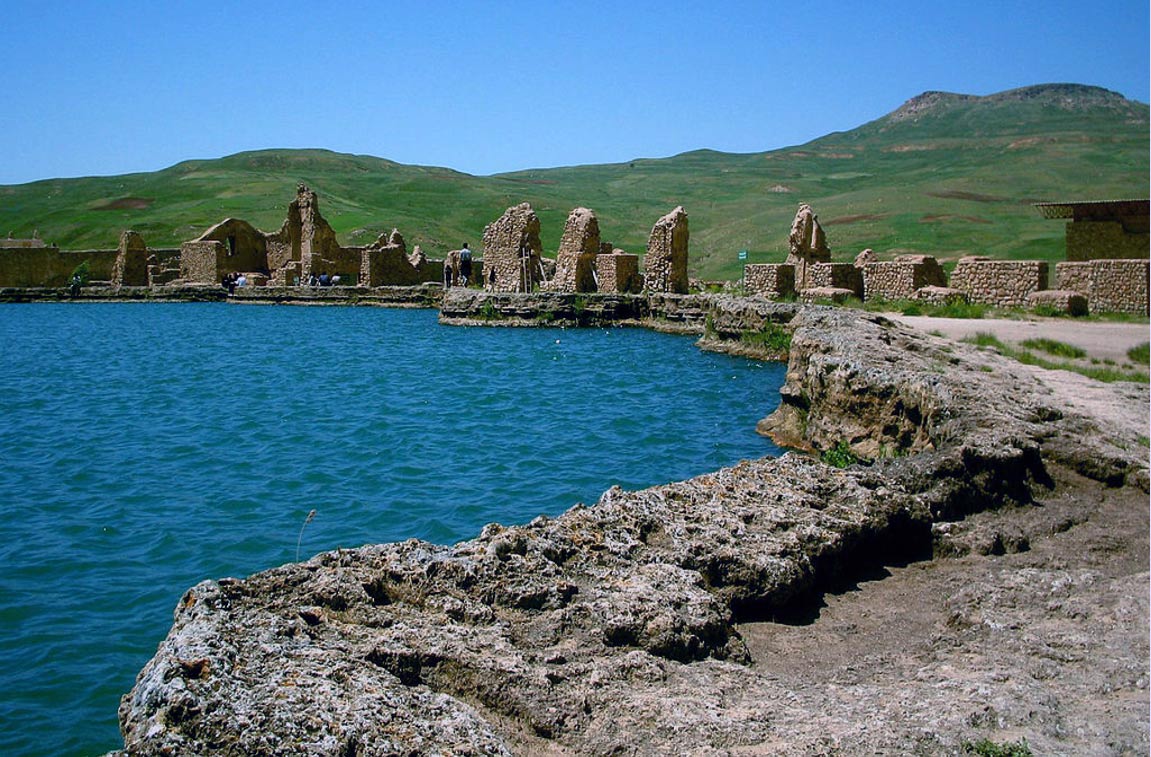
(1-5) The ruins of Ādur Gušnasp Fire Temple are situated on an extinct volcano 2,150 meters above sea level at Shīz, Iran. The complex sits atop sediments formed from the overflowing calcinating water of a thermal spring-lake (21° C) which formed in the volcano’s extinct crater. The site transports the observer to a bygone era, in which lofty passageways illuminated by the eternal fire’s soft glow would grant access to a large domed chamber housing Ādur Gušnasp in a grand stone fire-altar

Background
Immediately before the advent of Islam, a diverse range of religious beliefs existed among Iranian peoples, who once inhabited a vast region spanning from Gelonus to Seleucia-Ctesiphon to Khotan. These included native Iranian faiths such as Zoroastrianism (incl. Zurvanism), Manichaeism, Mazdakism, varieties of Iranian polytheism and the Scythian religion, as well as Indic traditions like Buddhism (Tantric Vajrayāna) and Abrahamic religions such as Christianity (Church of the East), Judaism and Gnosticism. However, Zoroastrianism (also called Behdin “the Good Religion”, Mazdaism or Mazdayasna, lit. “wisdom-celebration”) held the sole position of official patronage within the Sasanian Persian Empire beginning with Ardeshir I (r. 226–241 A.D.), the founder of the dynasty and grandson of the eponymous Zoroastrian high-priest of Staḵr, in Pārs, named Lord Sāsān (Sāsān xʷadāy). By the reign of Shapur II (r. 309–379 A.D.), it was declared the official state religion in a move, in all probability, to curtail sympathies towards the Christian state church of its archenemy, the Roman Empire. The Zoroastrian attitude of non-proselytization, however, fostered a policy of religious tolerance—a tradition started by the Persian Achaemenids and continued by the Arsacids—which facilitated strategic inclusivity of Christians, Gnostics, Jews, Manichaeans and Buddhists as a means of sustaining social harmony. Central to Zoroastrian ethics is the concept of personal agency and individual choice as a result of free thought; thus, proselytization was discouraged, while self-initiated conversion was welcomed. By contrast in the Roman Empire, coercive conversion and persecution against non-Christians was frequently used as a tool for maintaining societal cohesion.

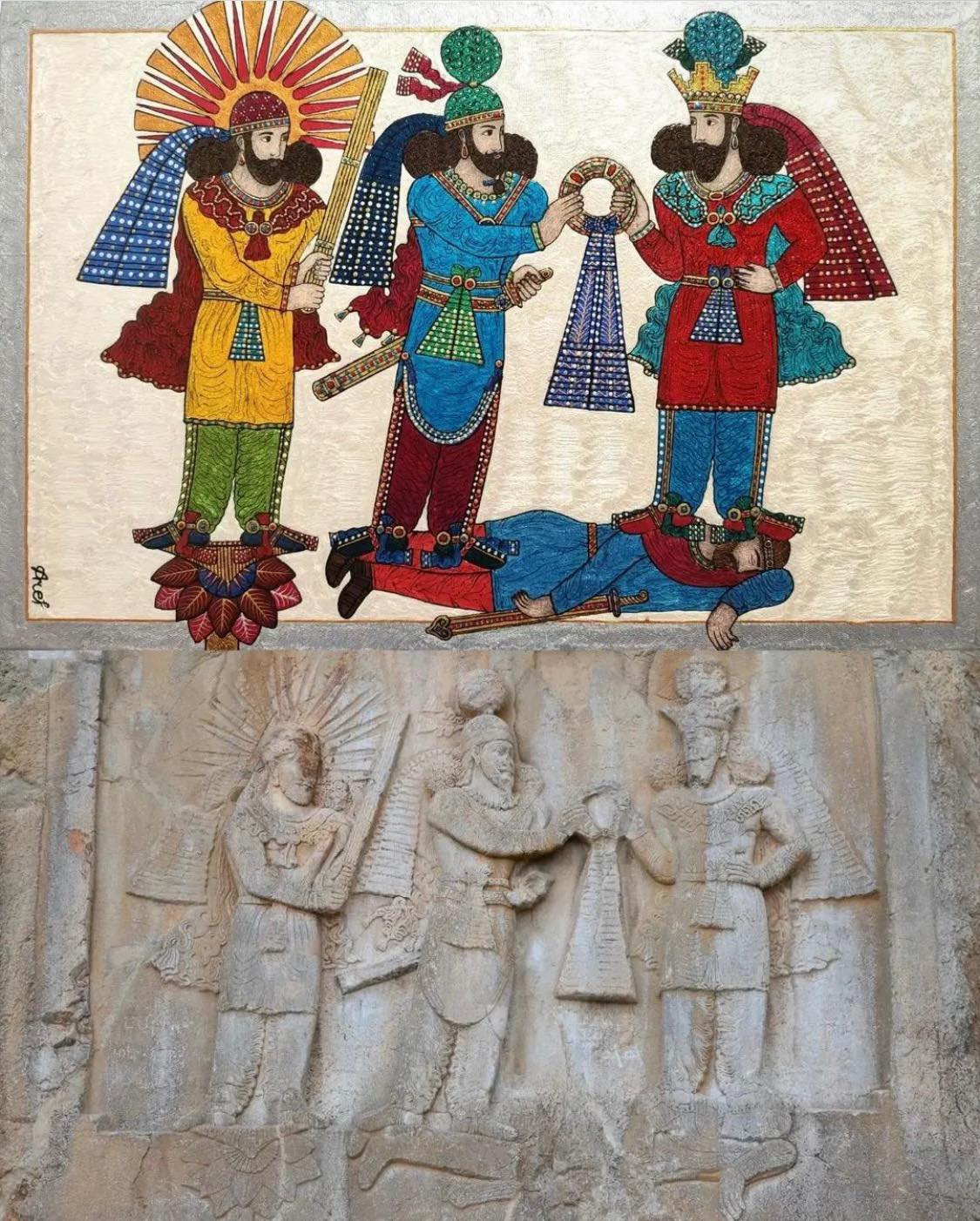
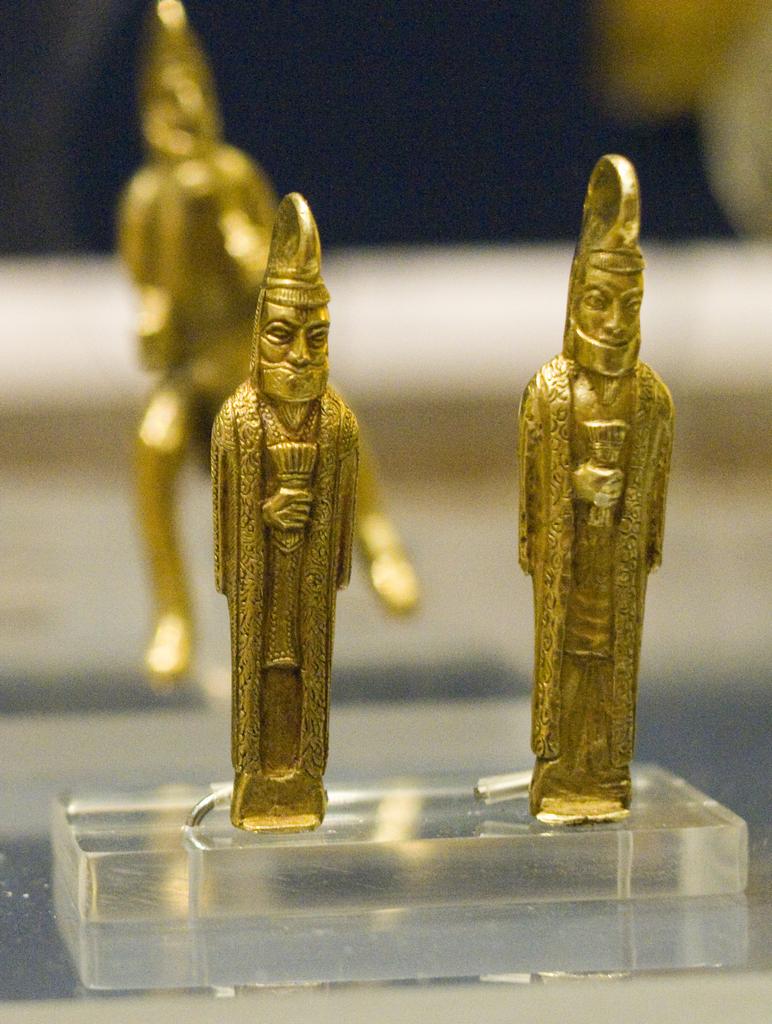
(1) A large relief of the investiture of the Sasanian king Ardashir II at Tāq-i-Bustān, Kermānshāh, Iran (c. 4th century A.D.). King Ardashir II and his predecessor Shapur II stand atop the fallen Roman Emperor Julianus Apostata (361-363 A.D.). The archangel (yazāta) Mithra stands atop a Lotus Flower on the left holding a “barsom”—a bundle of twigs from select medicinal plants used by Zoroastrian priests (Magi) in their role as traditional healers. (2) Gold statuettes carrying barsoms, a symbol of priesthood, discovered as part of the Achaemnid-era “Oxus Treasure” in Qobādiyān, Tajikistan.

As a result of gaining official status, concerted efforts were made in early Sasanian times (224-651 A.D.) to collate, edit and systematize the liturgy with the purpose of compiling a master copy of the scripture known by its Middle Persian name Abestāg (NP: Avestā; perhaps from Old Iranian *upa-stāvaka- “praise”). This so-called ‘Sasanian archetype’ canonized an assortment of written and oral traditions, many of which had been composed by priests in times far removed from the lifetime of Zoroaster (c. 1500-1000 B.C.?), in a manner deemed suitable for the likes of an organized state religion. A complete version of the holy scripture likely existed in the Achaemenid epoch (550–330 B.C.), “written on adorned ox hides with golden ink” and housed at the Fortress of Archives (diž ī nipišt) at Staḵr in Pārs. Lamentably, it and other copies were targeted and destroyed by Alexander of Macedon (ōy petyārag ī wad-baxt ī ahlomōγ ī druwand ī anāg-kardār aleksandar ī hrōmāyīg “that wretched, ill-omened adversary, the accursed, evil-doing heretic Alexander the Roman”), who also executed scores of the foremost “religious authorities (dastwarān), judges, hērbeds, mōbeds, religious leaders, and able and wise people of the land of Iran” according to the Sasanian-era Ardā Wirāz Nāmag.

The Sasanian descriptions further state that this original Avesta consisted of twenty-one Nasks or books, and must have been a sort of encyclopædia, not alone of religion, but of many matters relating to the arts, sciences, and professions, closely connected with daily life. It is speculated that among the lost materials were the descriptions of perhaps hundreds of botanical medicines, including the revered haoma (𐬵𐬀𐬊𐬨𐬀 “ephedra”[?], Zoroastrian Dari: هم hōm; a powerful stimulant). This is reflected in the Magi’s ancient renown as physicians and healers who are frequently depicted holding twig bundles (𐬠𐬀𐬭𐬆𐬯𐬨𐬀𐬥 barəsman; MP: barsom), a symbol of priesthood, which they used to prepare a wide array of plant-based extracts.

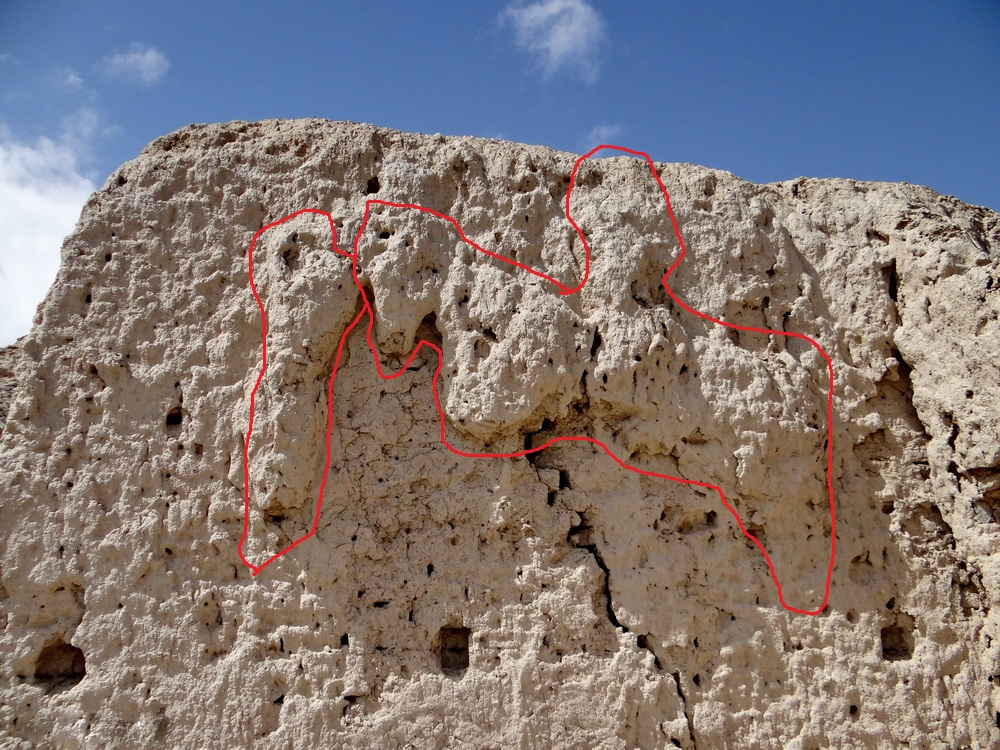
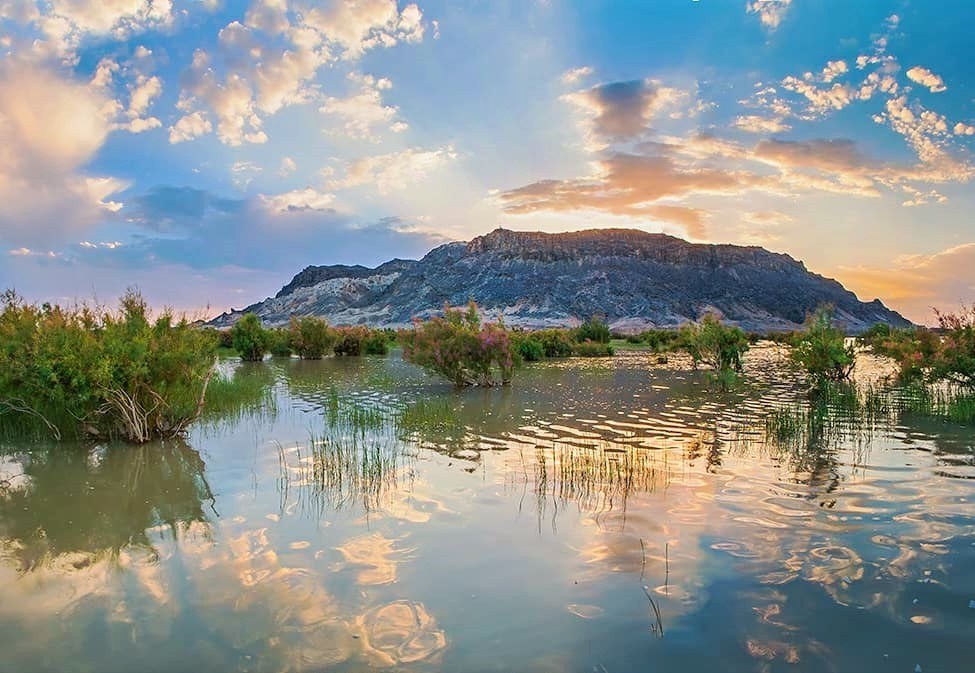
(1-2) Remnants of murals found in the fire sanctuary gallery at Kūh-e Xʷāja, Sistān, Iran. It appears in the Sasanian period, sacred Zoroastrians precincts had a wealth of luxurious decorations. Aurel Stein observed a three-headed creature and an ox-headed mace (gorz) held by a partially-obliterated seated figure in the first painting, identified as the hero Rostam with his weapon (3) The imposing south façade of the fire sanctuary bears the remnants of a stucco relief that portrayed a contest between a horseman and a lion (4-5) The Kūh-e Xʷāja complex sits on a basalt lava island in the historic Lake Hāmūn. Offerings to water, seen as nurturing the cosmic integrity and strength of the natural element, serves as the culmination of the daily Zoroastrian act of worship

Judging from the table of contents of the Nasks, it would seem that not more than a quarter, perhaps less, of the ancient monument of the Avesta could be restored even at the time of the Sasanian council. Nonetheless, reformists contend that this move on the part of the Sasanian monarchy introduced a host of stringent laws and disagreeable practices—particularly in the form of the Vīdēvdād (lit. “Given against Demons”) ecclesiastical code—that reflect contemporary attitudes among the clerics and communities who conceived of them rather than the abstract, progressive and morally profound tenets set forth by Zoroaster in the Gāthās over a thousand years prior. Indeed, the spirit of the Gāthās is largely non-prescriptive in that it promotes self-dependent righteousness as a result of freethinking and free will, as well as ecological stewardship in nurturing the cosmic integrity of water, earth, the animal and plant kingdoms, air and fire. The immortal personal spirit (Av. 𐬟𐬭𐬀𐬎𐬎𐬀𐬴𐬌 fravaṣ̌i; OP *fravarti- –> MP frawahr –> NP فروهر farvahar, forūhar) of each individual, residing somewhere in the intangible universe (Av. 𐬨𐬀𐬌𐬥𐬌𐬌𐬎‎ mainiiu “spirit [realm]”; MP 𐫖𐫏𐫗𐫇𐫃‎ mēnōg –> NP مينو mīnū), sends out the urvan (𐬎𐬭𐬬𐬀𐬥 ‘soul’; NP روان ravān) to take transient bodily form (𐬙𐬀𐬥𐬎‎ tanu; NP تن tan) in the material world (Earth; MP 𐫃𐫏𐫤𐫏𐫃 gētīg –> NP گيتى gītī)) which serves as the final battlefield in the eternal struggle between the forces of light, truth and intelligence and those of darkness, falsehood, and ignorance. On Earth, the individual possesses free will to act as a co-worker—rather than a slave—of Ahura Mazda and the forces of light or of his demonic adversary, Angra Mainyu (𐬀𐬢𐬭𐬀⸱𐬨𐬀𐬌𐬥𐬌𐬌𐬎; NP: اهريمن Ahrīman), without dooming repercussions, given the predicted final victory of good over evil and the universal salvation of souls. The Gāthās speak naught to matters such as disposal of corpses, bodily defilement and ritual purification, sodomy, and gender roles as outlined in the Vīdēvdād, whose authors were Magi writing in an unknown geographic location at a time far removed from that of their prophet, when Avestan had already ceased to be spoken, in a deliberately imitative but degenerate form of the Gathic language (Artificial Younger Avestan).

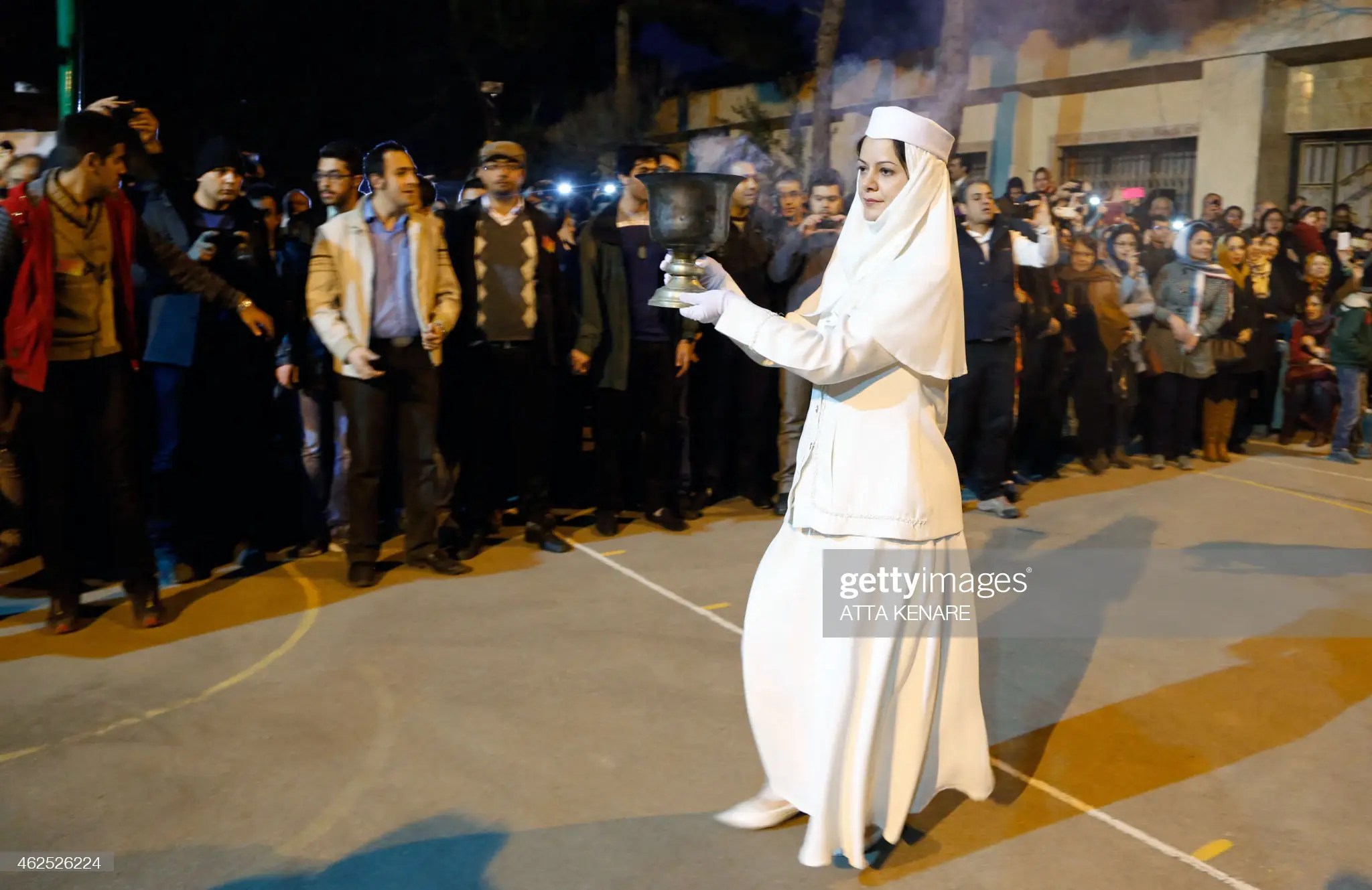
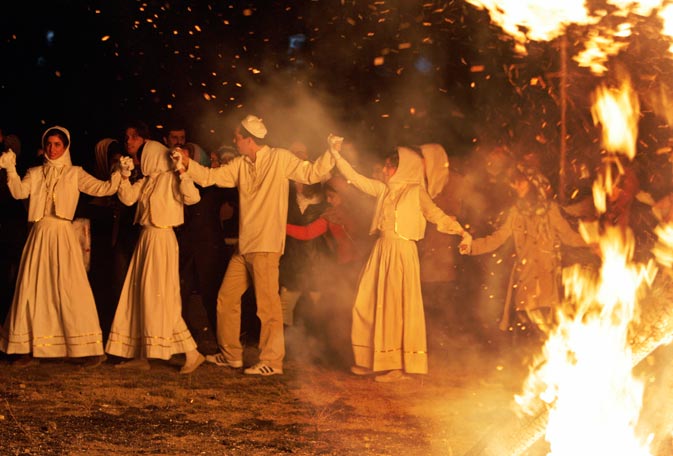
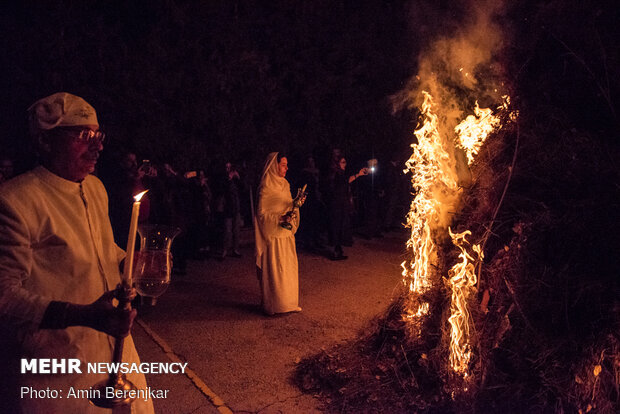
(1) A Zoroastrian priestess directs worship towards God (𐬀𐬵𐬎𐬭𐬋 𐬨𐬀𐬰𐬛𐬃 Ahurō Mazdā̊, lit. “Lord of Wisdom/Intelligence”) before the soft glow of an eternal fire during the ‘Sadeh’ festival, Tehran, Iran (c. 2020) (2) A priestess carries a vase of coals in order to set firewood ablaze for the expansion of an eternal fire for ‘Sadeh’ (3) Sadeh (lit. “one hundred”) is celebrated one hundred days and nights past the end of the summer. A massive bonfire is ignited using embers from a sacred temple fire to symbolize the ultimate triumph of light and positivity over darkness, cold and frost.

Since the establishment of the temple cult of fire likely in the late Achaemenid period (detailed below), Zoroastrians have frequently been known among followers of other faiths as “fire-worshippers”. However, Zoroastrians themselves have consistently rejected this title, asserting that fire instead serves as an icon, directing their thoughts towards God (Ahura Mazda), positivity and truth (𐬀𐬴𐬀 aṣ̌a) as described by their prophet. Indeed, perhaps the warm, animated and seemingly sentient nature of fire inspires veneration with greater immediacy than the static icons found in other traditions. Fire serves as a tangible embodiment of both the illuminated mind and the divine presence, symbolizing the ‘cosmic fire’ or life force in all animate things, plants, animals and men. Zoroastrian ‘eternal fires’—burning uninterruptedly since creation and consecration, sometimes for centuries or even millennia—are invested with an immense aura of sanctity among the faithful. It can be further stated that Zoroastrian liturgy places as much importance in sustaining the purity and integrity of water and the animal and plant kingdoms as it does fire. Special reverence for nature has undeniably bestowed a distinctive quality upon Zoroastrian worship, enriching its spiritual tapestry.

Zoroastrians in Shirāz observe the ancient festival of ‘Sadeh’. In ancient times, the fire was kept burning all night. The following morning, women would take a small portion of the blessed fire back into their homes to make new household fires. At the end of the year (Nowruz), remnants of the fire were returned to the eternal temple fire (c. 2020)

During the Sasanian period (226-651 A.D.), apparently three preeminent fires known as Ātaš Bahrāms (lit. “Flames of Victory”), existing since creation presumably in late Achaemenid or Parthian times, were assigned the highest grade of sanctity in the Zoroastrian religion. According to tradition, an Ātaš Bahrām is consecrated by purified embers from sixteen different sources, including the fire created by a lightning bolt. They therefore symbolized the utmost sanctity and purity, eclipsing other ritual fires (NP آتش ātaš > Avestan 𐬁𐬙𐬀𐬭𐬱 ātarš; regular MP 𐭭𐭥𐭥𐭠 ādur, whence NPآذر āar) in the realm, and each was in turn associated with a specific region and class of individuals. Each quarter of Iran thus had its own great fire, namely: Ādur Gušnasp in Media dedicated to warriors and nobility, Ādur Farnbāg in Pārs dedicated to the priest class, Ādur Burzēn-Mihr in Parthia dedicated to farmers, and a fourth much venerated great fire was that of Karkūy in Sistān.

After the 5th century A.D., it became customary for each Sasanian king to make a pilgrimage on foot to Ādur Gušnasp temple after his coronation at Seleucia-Ctesiphon. There, the kings lavished the temple with royal gifts, sought counsel from the priests, and received blessings from Ohrmazd through Ādur Gušnasp‘s gentle radiance. Lamentably, following the Arab-Islamic conquest of Persia, Muslims gradually extinguished sacred fires and either demolished fire temples or converted them into mosques (such as the Magok-i ʿAṭṭār Mosque in Bukhara). However, it is likely that an Ātaš Bahrām established in the Yazdi plain around the 13th century A.D. and which is now housed in the Zoroastrian Fire Temple of Yazd represents the union of two preeminent fires from Sasanian times, namely Ādur-Anāhīd from Staḵr and Ādur Farnbāg, whose embers were secretly removed from their original sanctuaries and safeguarded by priests in hiding for centuries.

A Zoroastrian priestess leads the rites to the Ābāngān festival at the Zoroastrian Fire Temple of Yazd, Iran. In this ritual called āb-zōr (from Avestan 𐬀𐬞 𐬰𐬀𐬊𐬚𐬭𐬀 ap-zaoθra, lit. “offering to the waters”), which is also part of the daily liturgy, a mixture called parahōm (from Avestan *para-haoma; lit. “before haoma [ceremony]”) consisting of cow’s milk, consecrated water, haoma (ephedra), and crushed leaves from a pomegranate tree is offered to a flowing body of water whilst reciting the Ābān-yašt. This is a symbolic gesture offering strength and gratitude to the waters for nourishing the plant and animal kingdoms–the fruits of which are to be found in the ingredients of the parahōm mixture. Āb-zōr, much like ātaš-zōr, is viewed as part of humanity’s responsibility in maintaining the cosmic integrity of the four natural elements created by Ahura Mazda on this planet–fire, water, earth (the plant kingdom), and air. Thus every fire temple must be built beside water, whose guardian divinity (yazāta) is Arədvī Sūrā Anāhitā.

History of the Role of Fire in Zoroastrianism
The religion of the prophet Zoroaster (as attested in the Gāthās ​​𐬔𐬁𐬚𐬁 lit. “hymns”; the oldest portion of the Avesta attributed to Zoroaster himself) was the world’s first monotheistic religion, although there remains no historical evidence pointing to the Zoroastrians’ awareness of this point. Even a hypothetical sect of the religion, Zurvanism, declared the existence of a single transcendental, neutral and passionless deity of infinite time and space that made no distinction between good and evil (Zurvān; from Avestan 𐬰𐬭𐬬𐬀𐬢 zruvan-, lit. ”time”). Zoroastrianism is thus characterized by a dualistic cosmology of good and evil within the framework of a monotheistic ontology and an eschatology which predicts the ultimate conquest of evil by good. Throughout history, the distinctive characteristics of Zoroastrianism, including its monotheistic nature, messianism, emphasis on free will and the notion of posthumous judgment, the concepts of heaven, hell, angels, and demons, among others, have deeply influenced Christianity, Judaism, Gnosticism, Northern Buddhism, and even Greek philosophy.

The veneration of fire within the Zoroastrian tradition can be traced to the Indo-Iranian cult of the hearth fire in Central Asia, in all probability having its origins in Indo-European times in the Pontic-Caspian Steppe (compare the analogous sacred eternal flame of Vesta in Rome, tended to by the Vestal virgins). The hearth fire, serving as a source of warmth, illumination, and solace, held profound significance for the ancient Iranians, who perceived it as a visible embodiment of the divine entity known as Ātar (Avestan 𐬁𐬙𐬀𐬭; of unknown origin). Celestial fires, present in the forms of the sun and moon, were also venerated by facing them and directing worship towards them in open-air, especially if a terrestrial fire was out of reach. This perception positioned Ātar as both the devout servant and the commanding master of humanity, reflecting an enduring reciprocal relationship. As an expression of gratitude for Ātar’s assistance, regular offerings of incense or fragrant woods and sacrificial animal fat (causing the flames to leap up) were presented through a ritual referred to as ātaš-zōhr (from Avestan 𐬁𐬙𐬀𐬭𐬱 𐬰𐬀𐬊𐬚𐬭𐬀 *ātarš-zaoθra “offering to fire”). Moreover, natural elements such as fire and water assumed a pivotal role in various religious ceremonies. The ancient Yasna Haptaŋhāiti ritual (Yasna 35–41) is believed to trace its lineage to a pre-Zoroastrian liturgical practice involving priestly acts of devotion directed towards fire and water.

The Aṣ̌əm vohū (Avestan: 𐬀𐬴𐬆𐬨 𐬬𐬊𐬵𐬏) manthra, among the most important prayers found in the Avesta, recited by High Priest (dastūr) Mehrabān Firuzgari. The lyrics translated from Old Avestan: aṣ̌əm vohū vahištəm astī / uštā astī uštā ahmāi / hyat̰ aṣ̌āi vahištāi aṣ̌əm “Righteousness is the best good and it is happiness. Happiness be to him who is righteous for the sake of righteousness.” Zoroastrians view goodness for the sake of goodness and as a result of free thought and free will, rather than goodness driven by God’s surveillance and promises of reward or punishment, to be a central tenet of their worldview and code of conduct.

Zoroaster further elevated this Indo-European cultural inheritance by associating fire to the creation of Aṣ̌a Vahišta (𐬀𐬴𐬀 𐬬𐬀𐬵𐬌𐬱𐬙𐬀 “Best Truth”; NP: ارديبهشت Ordibehešt > MP 𐭠𐭥𐭲𐭥𐭧𐭱𐭲𐭩‎ Ardwahišt) and recognizing it as the instrument through which God’s judgment would be executed on the Last Day. According to his teachings, a cataclysmic event, symbolized by a fiery flood of molten metal, would engulf the earth, subjecting humanity to a final judgment (referred to as Frašō-kərəti 𐬟𐬭𐬀𐬱𐬋⸱𐬐𐬆𐬭𐬆𐬙𐬌; MP:  𐭯𐭫𐭱𐭠𐭪𐭥𐭲 Frašagird ) before evil is destroyed once and for all, and the universe will be in perfect unity with Ahura Mazda. For Zoroaster, the cult of fire thus held profound moral and spiritual significance. As expressed in Yasna 43.9, he proclaimed, “I shall diligently contemplate truth (aṣ̌a) during the offering made with reverence to fire,” and he instructed his followers to always pray in high places and in the presence of fire—whether earthly fire or the celestial bodies of the sun and moon (as indicated in Mēnōg-ī xrad, chapter 53.3-5). At this early stage, it is thought that the cult of fire coexisted with other cults, particularly that of water (representing the yazāta Arədvī Sūrā Anāhitā).

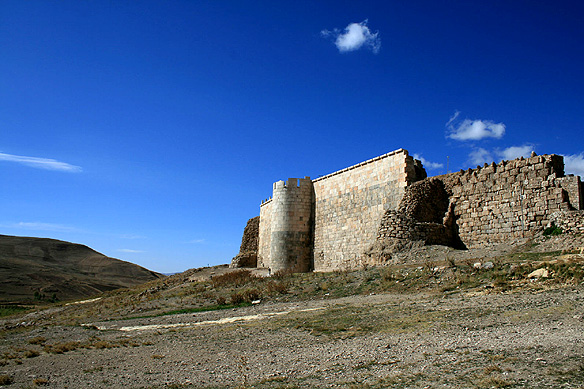
A fortified wall forming an oval with semi-cylindrical bastions (38 total) positioned at regular intervals surrounds the entire site. This wall was constructed during the Sasanian period, Ādur Gušnasp Temple, Shīz, Iran
A semi-cylindrical bastion and part of the fortified wall from the Sasanian-era has been restored, Ādur Gušnasp Temple, Shīz, Iran

The cult of terrestrial fire comprised both hearth fires and ritual fires, each serving distinct purposes. In the traditional setting, individuals would establish their own hearth fire upon founding a household, ensuring its continuous burning throughout their lifetime. This domestic fire, symbolizing perpetual warmth and vitality, held great significance for Iranian families. Notably, the Greeks also revered the hearth fire, and while Herodotus acknowledged the Persians’ deep reverence for it, he did not singularly label them as “fire-worshippers” and he made no mention of temples among them. However, in all probability during the later Achaemenid period, a Zoroastrian temple cult dedicated to fire emerged. This development, possibly instigated by the orthodox faction, served as a response to the introduction of temple cults with statues of Anāhīta.

The temple cult of fire, an extension of the domestic fire cult, involved a sacred fire enthroned on an altar-like stand (ātašdān; these were traditionally hewn of stone until the 19th century, when the Parsi community took to putting their sacred fires in big metal vases made of brass or German silver, which they then introduced to their coreligionists in Iran). It retained the traditional wood fire and continued to receive prescribed offerings five times a day, meticulously administered by a priest who safeguarded its purity. Details about the classification and constitution of sacred fires during the Achaemenid period are scant. Nevertheless, it is plausible that the temple cult was instituted with utmost grandeur and dignity, aiming to rival the majestic image-cult of Anāhīta. Consequently, the most revered type of sacred fire (Ātaš Bahrām) likely traces its origins to the earliest periods. According to a post-Sasanian tradition, this fire is created by combining purified embers from numerous fires, including lightning fire, in an elaborate consecration ritual. Once consecrated, the sacred fire is ceremoniously carried in procession to its sanctuary, a triumphant act known as pad wahrāmīh “towards victory”. Accompanying priests brandish swords and maces, and upon completion of the ceremony, some of these weapons are hung on the sanctuary walls, symbolizing the fiery entity’s warrior nature and its unwavering battle against all forces opposed to truth (aṣ̌a).

A hirbod or mugh (Old Persian 𐎶𐎦𐏁 maguš —> Ancient Greek μάγος magos “Zoroastrian priest; sorcerer, magician”, whence English “magi”, “magic”) tends to an Ātaš Bahrām housed in the Zoroastrian Temple of Yazd, Iran. This highest-grade fire was consecrated in the 13th century A.D. through the union of two preeminent fires from Sasanian times, namely Ādur-Anāhīd and Ādur-Farnbāg. Both great fires were originally installed in Pārs and were safeguarded by Zoroastrians in hiding following the Islamic conquest of Sasanian Persia

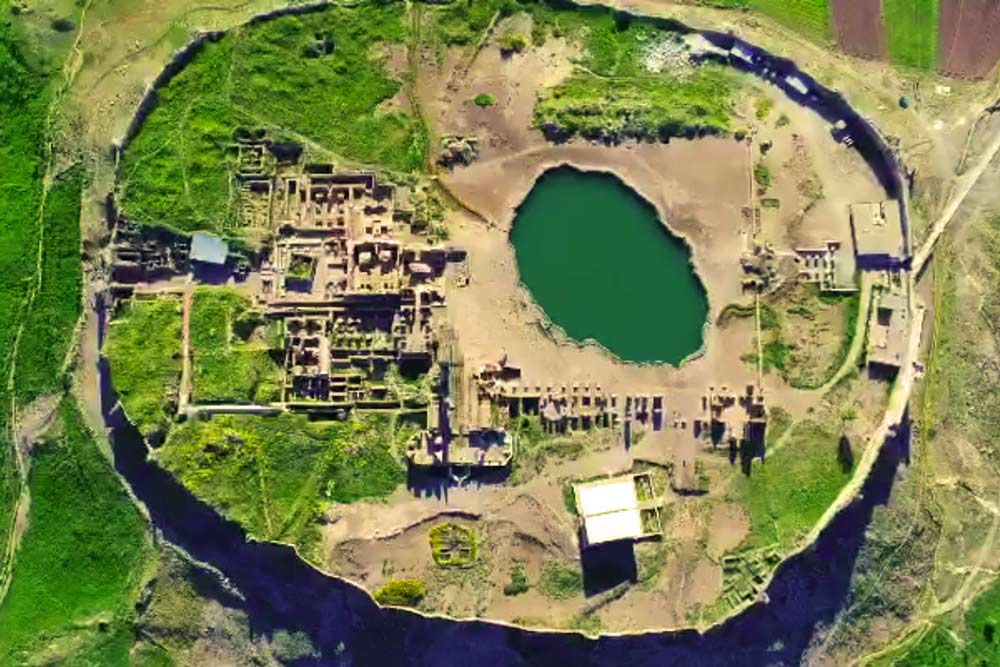
The temple site offers a view of what was called Zendān-e Solaymān since Mongol times; it is a cone-shaped hollow mountain built up of limestone during millions of years by a hot spring underneath. The mountain is 97 to 107 meters tall while its crater is 65 meters wide and around 80 meters deep. The crater was at one time full of water, fed by floor springs, but it dried centuries ago. Shīz, Iran

Ādur Gušnasp Fire Temple
The historical knowledge of Ādur Gušnasp surpasses that of the other two prominent fires, namely Ādur Farnbāg and Ādur Burzēn-Mihr, due to two key factors. Firstly, its temple in Azerbaijan was located near the western border of Iran, attracting the attention of numerous foreign visitors. Secondly, the Sasanian kings showed favor towards it starting from the early 5th century. As a result, it received frequent mentions in the later part of the royal chronicle, known as the Xwadāy-nāmag, and in the Šāh-nāma, where it was also referred to as Āḏar-Ābādagān (>”Azerbaijan”). Although the exact original location of Ādur Gušnasp remains uncertain, it appears that it was relocated to a remarkably beautiful site in Azerbaijan, known as Taḵt-e Solaymān during Islamic times, but likely called Mount Asnāvand by the Median magi. This site features a hill of mineral deposits formed by a spring within it, creating a picturesque lake atop the hill that is elevated above the surrounding landscape. A new temple was constructed for Ādur Gušnasp at this location, and its association with the Sasanian royalty was emphasized to the extent that it became customary for each king, following their coronation, to embark on a pilgrimage to the temple on foot (although accounts in the Šāh-nāma suggest that the monarch only walked from the base of the hill as a gesture of deep reverence). The shrine received generous offerings from the kings, and a legend developed claiming that the first monarch to enrich it was Kay Ḵosrow himself, who sought divine assistance against Afrāsīāb while praying at the temple alongside his grandfather Kāvūs.

(1) A recently restored fire temple (ātaškada) known as Qal’a-i Mugh, with a symbolic fire established on the fire-altar, near Istaravshan in the Sughd region, Tajikistan (2019). The structure features characteristic Zoroastrian architectural vocabulary and exterior decorations from Sasanian times, including a domed sanctuary (gombad) with intricate brickwork surrounded by a courtyard (2) The baked brick fire-altar (ātašdān) has a traditional three-step pedestal and long shaft decorated with recessed panels. Ātašdāns holding preeminent fires were historically hewn of solid blocks of stone, with lower-grade fires frequently held in mud-brick altars. However, they were replaced by metal vases per a Parsi trend in the 19th century

There are several references in the epic mentioning visits by Bahrām V (421-39 A.D.) to the fire temple. It is said that he spent the Nowrūz and Sadeh festivals there and, on another occasion, entrusted an Indian princess, his bride, to the high priest of the temple for conversion to the Zoroastrian faith. According to Ṯaʿālebī, upon Bahrām’s return from his campaign against the Turks, he offered the ḵāqān’s crown to the shrine and dedicated his wife and her slaves as servitors. Ḵosrow Anōšīravān is also said to have visited Ādur Gušnasp before embarking on a military campaign. Later, he bestowed a substantial amount of treasure from tribute received from Byzantium on the fire temple. Ḵosrow Parvēz prayed at Ādur Gušnasp for victory in battle and subsequently offered a generous portion of the spoils to the sanctuary. It was not only the kings who made petitions and offerings at the temple, as evidenced by a prescription in the Bundahišn, which states that those praying for the restoration of eyesight should vow to send a golden eye to Ādur Gušnasp, or those seeking an intelligent and wise child should send a gift to the temple.

(1) Ruins of the main domed sanctuary that housed Ādur Gušnasp, which was apparently adorned with a stucco frieze in high relief. Beneath the dome was found the three-stepped pedestal of a great fire-altar, as well as the base of its rounded, pillar-like shaft
An overhead view of the Taḵt-e Solaymān complex, including the Sasanian-era Ādur Gušnasp temple, various other religious buildings including a sanctuary devoted to Anāhīta, and the royal quarters, as well as Mongol-era buildings Shīz, Iran

The grandeur of the ruins of Ādur Gušnasp aligns with the accounts found in literary records and exceeds that of any surviving Zoroastrian place of worship. To safeguard the sanctuary, the hilltop was enclosed by an immensely thick mud-brick wall. Later, during the Sasanian period, a stone wall measuring 50 feet in height and 10 feet in thickness was erected along the rim of the hill, featuring thirty-eight towers at regular intervals. The temple precinct itself was surrounded on three sides by an additional wall, while the south side remained open to the lake. Extensive excavations have unveiled the layout of this grand complex. Approaching from the north, one would enter a spacious courtyard suitable for accommodating numerous pilgrims. From there, a processional path led towards the lake, featuring a square, domed room that faced north and south. This lavishly adorned room possibly served as a space for prayer and ceremonial ablutions, culminating in a large open portico that offered a lovely view of the waters. A covered pathway extended along the front of the building, leading to a remarkable sequence of pillared halls and antechambers that stretched from south to north on the western side of the processional way. It is believed that the sanctuary of Ādur Gušnasp itself occupied the northernmost end of these halls. Initially, the sanctuary took the form of a flat-roofed, pillared structure made of mud-brick, but it was later replaced by a stone construction with a domed roof. The walls of this sanctuary were adorned with a prominent stucco frieze in high relief, and judging by the elaborate Sasanian-era decorations found at the fire temple at Kūh-e Xwāja in Sistān, may have once featured an intricate scheme of paintings and bas reliefs. Beneath the dome, archaeologists discovered a three-stepped pedestal for a grand fire-altar (ātašdān) made of stone and the base of its cylindrical shaft. Fragments of smaller altars and ritual vessels have been unearthed within and near the pillared halls that led to the sanctuary, indicating the ongoing devotional activities, including offerings, prayers, and religious ceremonies.

A passageway at the ruins of the Ādur Gušnasp complex. The walls were covered in dressed stone during Sasanian times. Shīz, Iran

The vast temple complex included numerous additional rooms, such as smaller shrines and the temple treasury, which likely held valuable and priceless offerings. Objects that can be precisely dated have not been found in the ruins prior to the reign of Pērōz (A.D. 457-84). However, a room near the main entrance yielded a collection of over 200 clay sealings, including eighteen inscribed with the title “high-priest of the house of the fire of Gušnasp” (mowbed ī xānag ī Ādur ī Gušnasp). In A.D. 623, during his campaigns against Ḵosrow Parvēz, the Byzantine emperor Heraclius sacked the temple of Ādur Gušnasp, destroying its altars, setting fire to the entire structure, and mercilessly killing all living beings present. Nevertheless, the great fire itself was evidently rescued and later reinstated. The destruction of Ādur Gušnasp‘s shrine may be alluded to in a pseudo-prophecy found in the Persian Zand ī Vahman Yašt, which predicts the removal of Ādur Gušnasp from its original location due to the devastation caused by the invading armies, implying its relocation to Padašxwārgar. After being reinstated in its temple on the hill, Ādur Gušnasp continued to burn for many generations following the arrival of Islam. However, the temple faced increasing persecution, and the great fire was likely extinguished by the end of the 10th century or, at the latest, the early 11th century A.D. The ruins of the temple were subsequently utilized as a quarry for constructing a palace on the hilltop for a local Mongol ruler.

发热西 Fārèxī – A Look at China’s Muslim Hui Community, its Iranian Origin and Vernacular

Written by Afsheen Sharifzadeh, a graduate of Tufts University focusing on Iran and the Caucasus. The goal of this article is to familiarize the reader with the Iranian origins, history, and language of the Hui community of China.

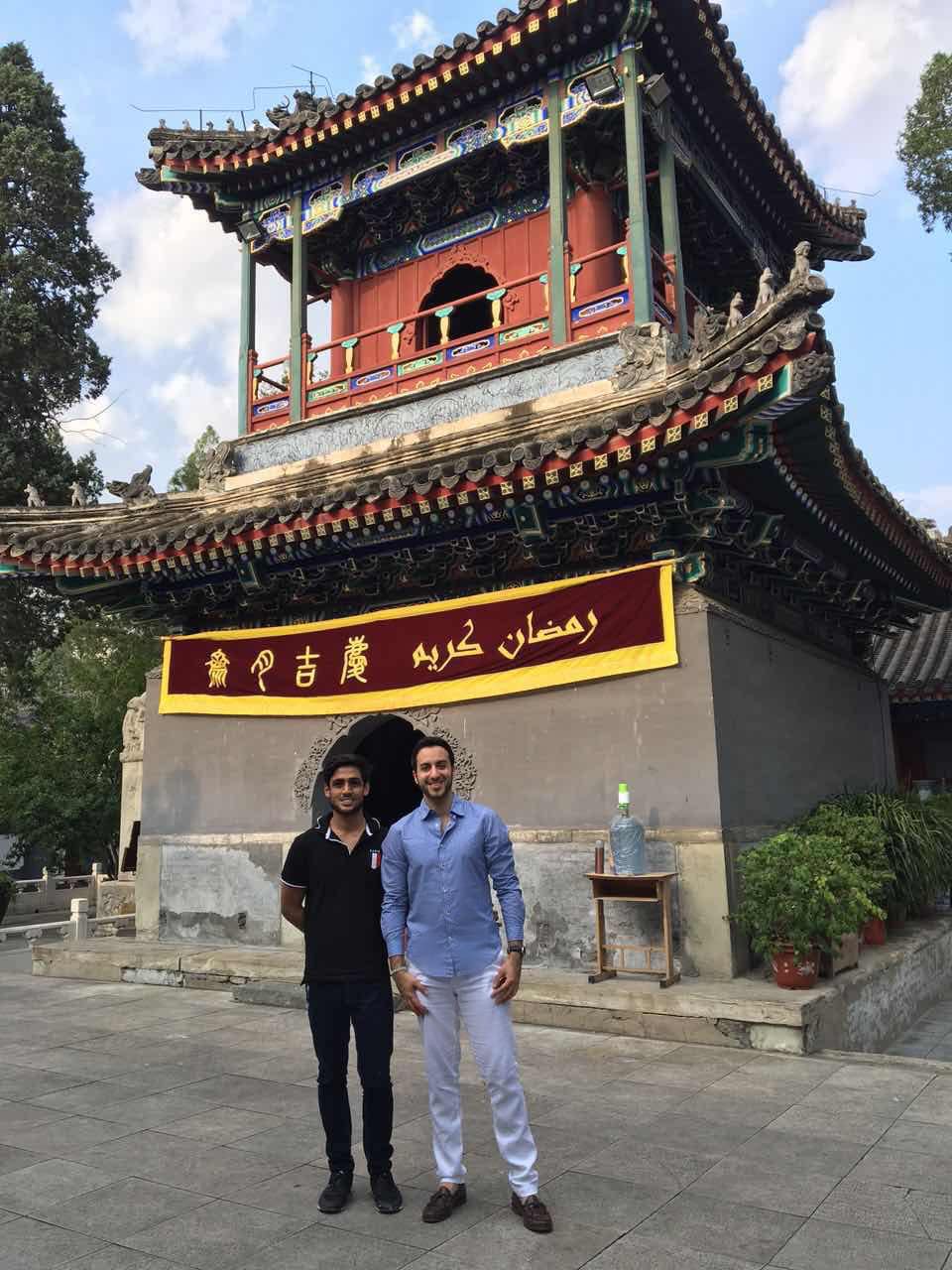
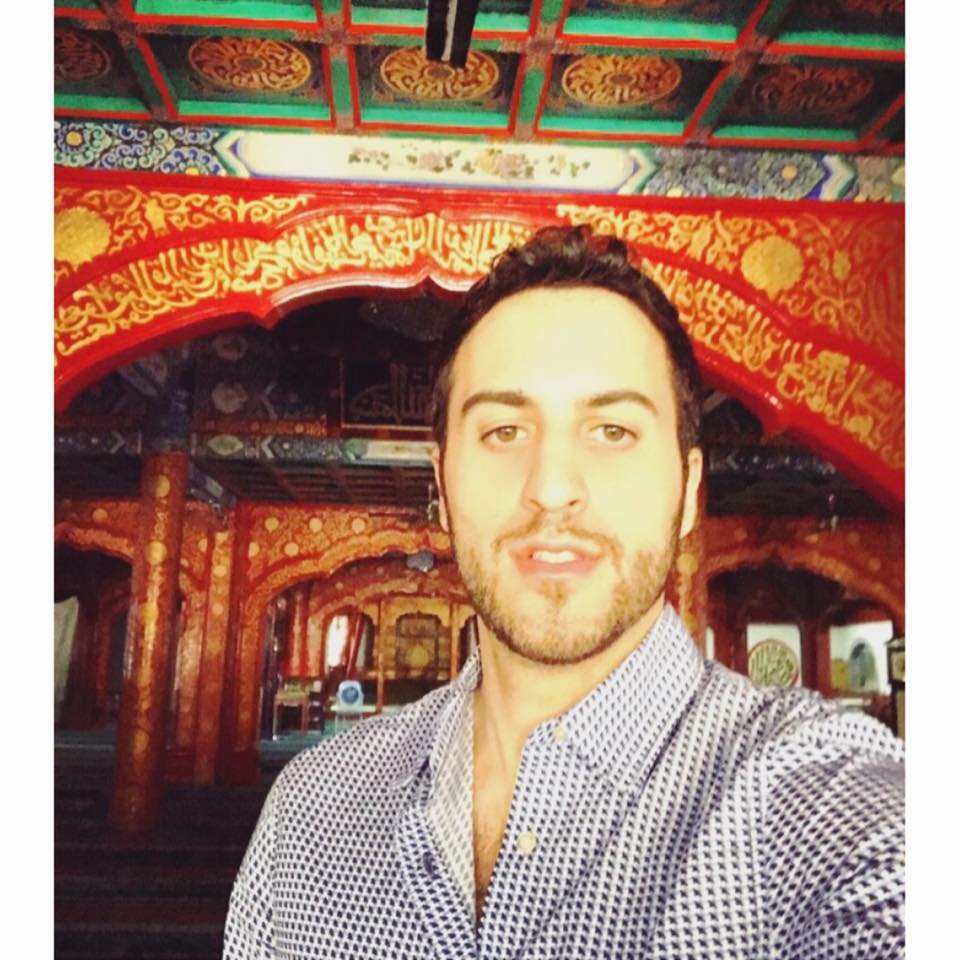
The author (right) and companion observe the Eid al-fitr proceedings at Ox Street Mosque (牛街礼拜寺 Niú jiē lǐbàisì; c. 1443 AD), Beijing (2017)

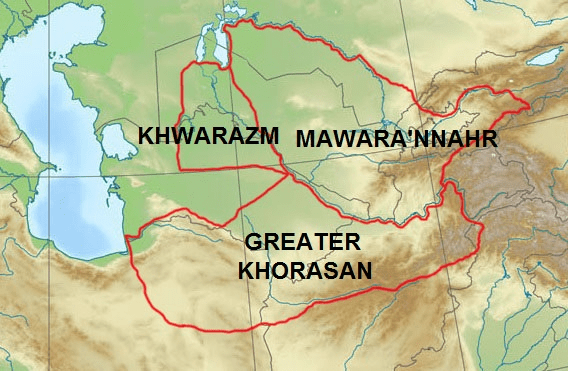
At greater than 10.5 million souls, the Hui people (回族 huí zú) compose the largest Muslim community and second largest “ethnic minority” in the People’s Republic of China. The Hui are the descendants of 13th century Persian-speakers who were deported thither following the Mongol conquest of Persia, Transoxiana, Khurāsān, and Khwārezm (the eponymous 回回國 huíhuí guó first referenced in a Ming Dynasty translation of the Mongolian chronicle 蒙古秘史 The Secret History of the Mongols). This means that after the Han Chinese (~1.3 billion) and the Zhuang (~18 million; whose homeland lies in the remote mountains bordering Vietnam), the descendants of Persian immigrants are the third largest ethnic community in China and are distributed broadly in nearly all of her major urban centers. Despite their importance, little international media attention has been devoted to their existence, perhaps due to the precarious conditions faced by smaller minorities such as Tibetans and Uyghurs in the country’s peripheries.

Much effort has been undertaken through the use of deliberately ambiguous language and, in some cases, pseudoscientific acrobatics, to assign Arab, Turkic, and even Indic identity to the ancestors of the Hui, but these attempts have fallen short of providing any compelling evidence towards those ends. The extant inscriptions and texts throughout China, Hui dialectical data as well as official Chinese dynastic accounts reveal without ambiguity that the Hui were originally a monolingual Persian-speaking community whose domestic, communal, and even spiritual life was conducted in Persian, while their Islamic faith necessitated knowledge of Arabic for access to their liturgy.

The Persian Muslims’ deportation to China was not in isolation, as they were originally accompanied in great numbers by Persian Jews (主鶻回回 zhǔhú huíhuí “Jewish Huihui”; zhǔhú being a phonetic transliteration of colloquial Persian جهود juhūd “Jew”) whom they had lived alongside in their homeland, and whose descendants are today referred to in loose terms as “Kaifeng Jews” (開封猶太族; Kāifēng Yóutàizú). Both of these groups preserved vernacular Persian for hundreds of years in diaspora, but were eventually faced with targeted assimilation pressures under the ensuing Ming dynasty (1368–1644) that resulted in their shift to local Chinese languages. Thereafter, for obvious reasons Arabic and Aramaic/Hebrew retained their currency as vital instruments in religious life, but Persian enjoyed a robust status in the arenas of both secular and religious literature, sermons, poetry, social institutions and diplomacy among Hui Muslims, Jews, and even the Chinese administration (discussed below). Today, the Persian language remains an important fixture in the Hui Muslim and Chinese Jewish identities. The Hui have even retained the endonym for the language of their forefathers, 发热西 Fārèxī (lit. “fever west”, a phonetic transliteration of فارسى fârsi) in a manner not dissimilar to the dissemination of the word “Farsi” in lieu of “Persian” by 20th century Iranian immigrants to the Occident–while standard Mandarin uses the historic Chinese allonym 波斯语 Bōsī yǔ “language of Persia”, from 波斯 Bōsī “Persia” first attested in the The Book of [Northern] Wei (Wèi-shū 魏書; composed in 551-54 AD).

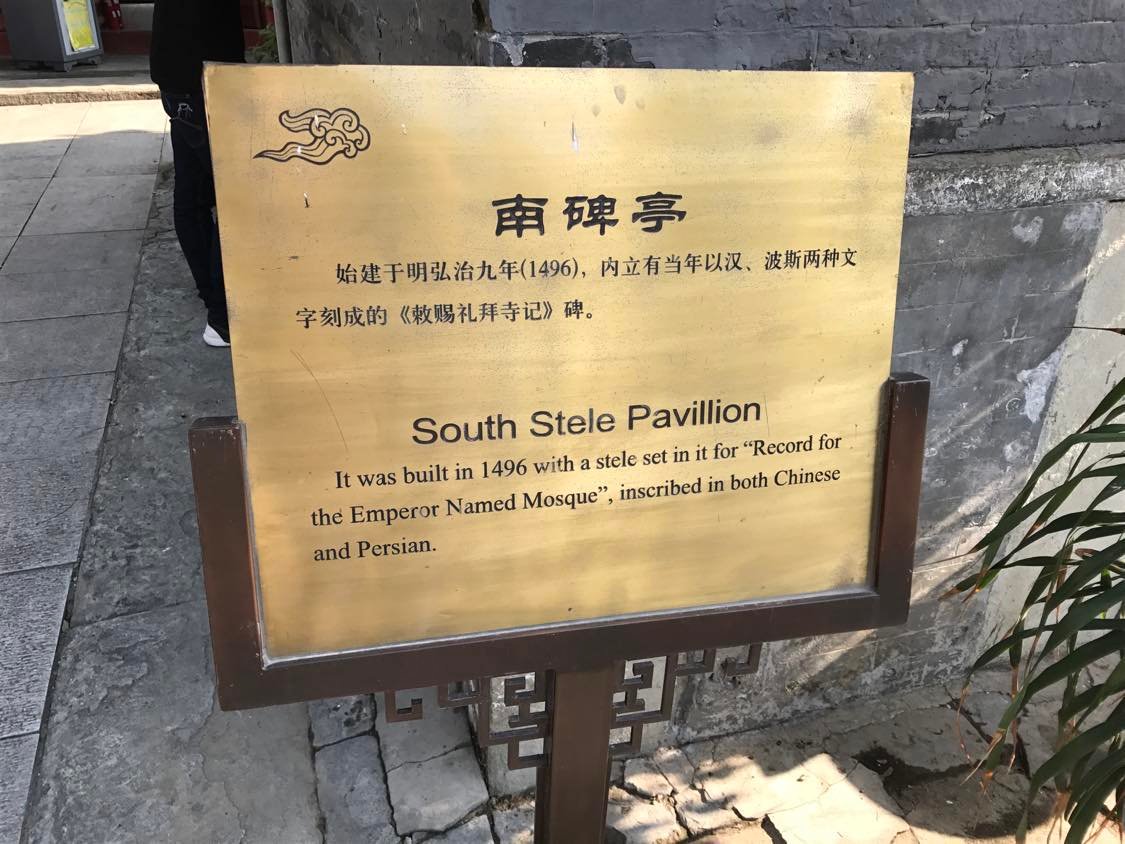
The gravestones of two founding Imams (ahōng 啊訇، from Persian âkhond آخوند “imam”) with the nisbahs البخارى al-Bukhārī and القزوينى al-Qazwīnī، revealing their places of origin, are interred here. Beijing’s Ox Street Mosque also includes a commemoratory stele erected at the end of the 15th century in Mandarin and Persian. (2017, photos by Afsheen Sharifzadeh)

On the Origins of the Hui
Insofar as it is possible to generalize about the origins of all the people in China who are classified as Hui, it seem likely that “the origins of most of them are in the thousands of mainly Persian speaking Central Asian Muslims recruited or conscripted by the Mongol armies which took control of China in the thirteenth century” (Dillon, p. 156). This fact at first seems unbewildering, since at its acme the Mongol Horde did not succeed in conquering India, the core of the Arabic-speaking world, Southeast Asia, Byzantium, or any “European” society west of Kievan Rus. The roughly contiguous Chinese and Iranian ecumenes (the Sinosphere 汉字文化圈 and Persosphere ايران بزرگ “Greater Iran; Iranian World”) were the two chief sophisticated urban civilizations that the Mongols succeeded in subjugating, and whose cultures were sufficiently advanced enough to be adopted wholesale by their conquerors (the Golden Horde lived in proximity to, but not among, the eastern Slavs). The popular depictions of plunder, destruction and massacre wrought by Chingis Khan–borne primarily from coeval Persian and Christian missionary sources–are in fact almost exclusively referring to Greater Iranian cities. After all, it was under the pretext of revenge for the Khwārazmshāh‘s execution of a Mongol merchant convoy at Otrār (فاراب Fārāb) that Chingis Khan chose to invade Central Asia and Persia. Minhāj al-Sirāj Juzjānī, a 13th century Persian historian who authored a synchronic commentary on the Mongol conquest of the Khwarezmian Empire from the safety of his refuge in Delhi, laments:

Alas, how much Muslim blood was spilled because of that murder! From all sides poured torrents of pure blood, and this movement of anger brought about the ruin and depopulation of the earth. (55 Levi, 2010, p. 127.)

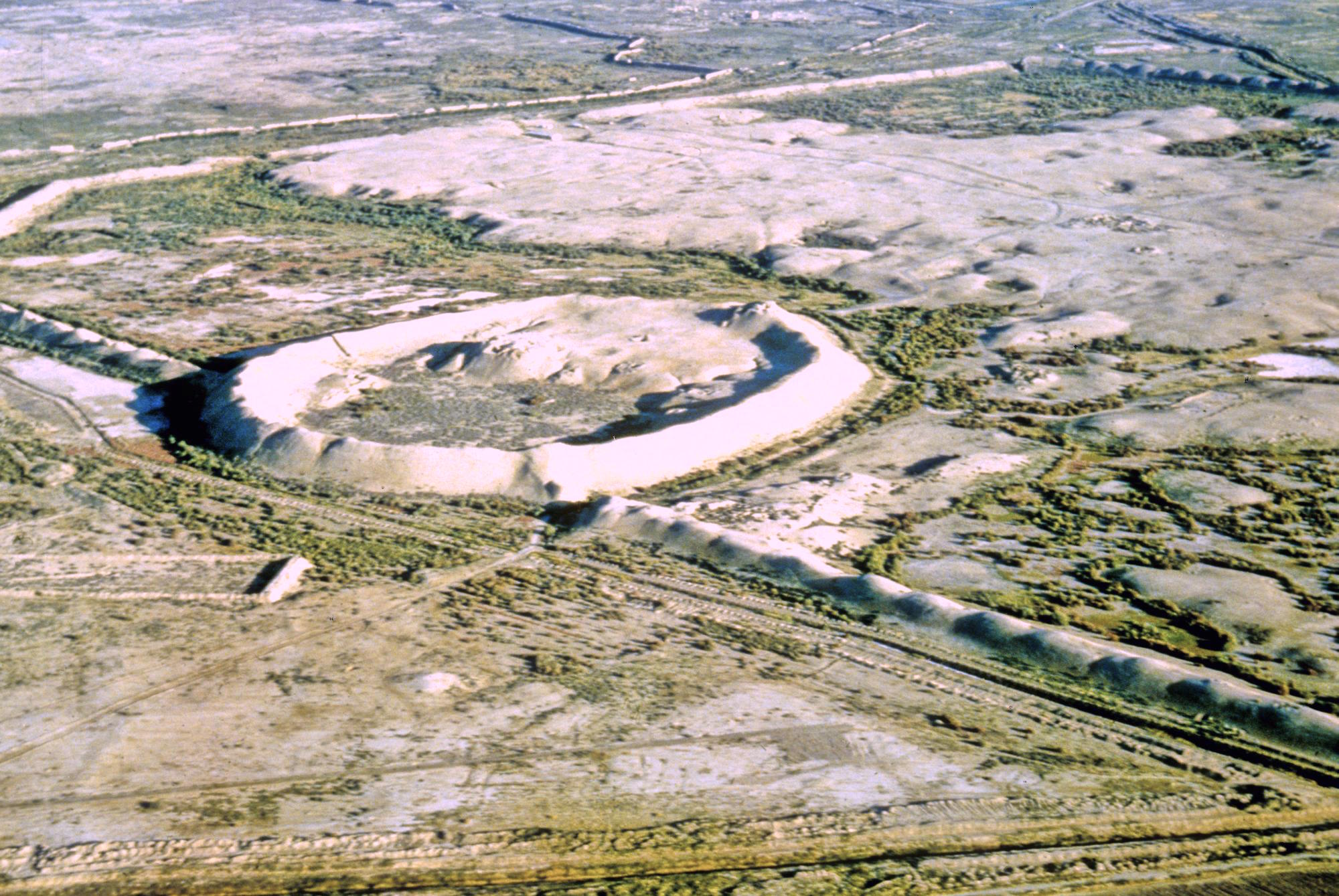
The ruins of Merv (Persian: مرو, Marv; Chinese: 木鹿 mù-lù), an Iranian metropolis in modern-day Turkmenistan once famed as Marv-i Shāhijān “Merv the Great”. A center of scholarship, silk textile production, fruit cultivation, riches and faith, the city possessed at least ten “grand libraries” and a renowned astronomical observatory where Omar Khayyām studied. Merv was razed to the ground and its entire population of ~500,000 slaughtered by the Mongol Horde in 1221 AD, making it one of the bloodiest captures of a city in world history. The other metropolises of Khurāsān, Khwārezm and Transoxiana faced a similar fate, however some of their inhabitants were deported to China.

Chief among the contemporaneous Persian sources is the account of another historian and later Mongol state official, Atā-Malek Juvayni, entitled “History of the World Conqueror” (تاریخ جهانگشای Tārīkh-i Jahān-gushāy; c. 1260 AD). Indeed, Juvayni writes that after the fall of Samarkand and the massacring of its inhabitants,

…the people who had escaped from beneath the sword were numbered; 30,000 of them were chosen for their craftsmanship, and these [Chinggis Khan] distributed among his sons and kinsmen, while the like number were selected from the youthful and valiant to form a levy.

As Huíhuí (referring to both Persian-speaking Muslims and Jews) spread throughout Yuan China, it was craftsman and artisans (工匠 gōngjiàng) who were most prominent after conscripted troops:

Many of the more than 30,000 craftsmen captured by Chinggis Khan’s forces in the 1220 Samarkand campaign, were specialists in delicate work who were enlisted in the official government crafts bureau, the guanju. This might include producing Central Asian style brocades or silks or the manufacture of cannons. All the artisans brought to China by the Mongols were pressed into the official quasi-military system under which the Yuan dynasty employed craftsmen and were not permitted to operate privately. (Dillon, Michael. China’s Muslim Hui Community, p. 23)

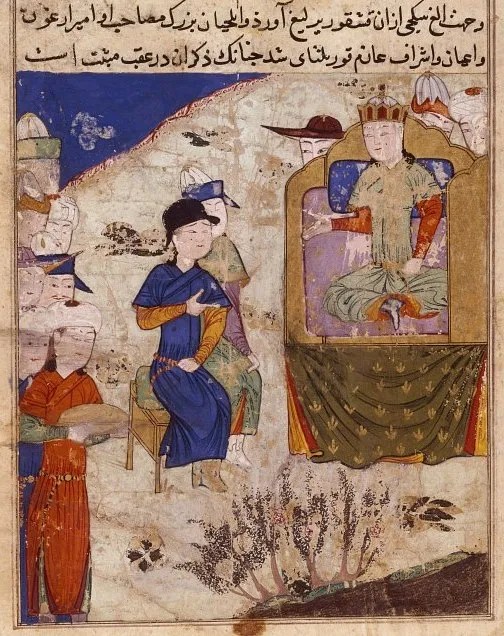
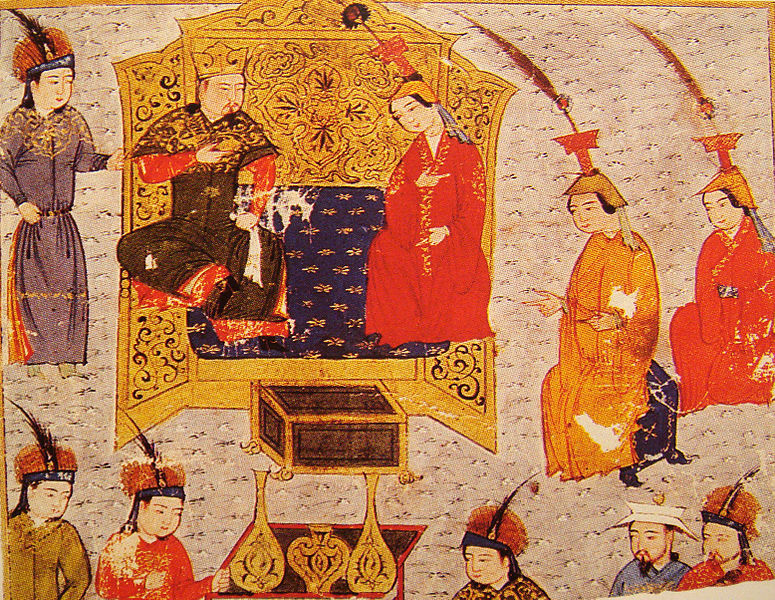
Audience with Möngke Khaqan (蒙哥可汗 Ménggē kèhán; منگوقاآن Mangū Qā’ān), illustration from the Persian language work تاريخ جهان گشاى جوينى Tārīkh-i Jahāngushāy-i Juvaini (c. 1260 AD) – BNF Supplément persan 206, fol. 101

Juvayni provides similar accounts of the odious fate that befell the people of Bukhārā, Merv, Nisā, Kāth, Gurganj, Termez, Balkh, Nishāpur, Tūs, Herāt and other major urban centers in the medieval Iranian World. For example, following the conquest of Gurganj, the capital of Khwārezm, Juvayni relates that artisans and others with valuable skills such as merchants, scholars and physicians–said to number over 100,000 (certainly hyperbole)–were separated from the rest and deported to China where they lived in diaspora:

‘To be brief, when the Mongols had ended the battle of Khorazm and had done with leading captive, plundering, slaughter and bloodshed, such of the inhabitants as were artisans were divided up and sent to the countries of the East [China and Mongolia]. Today there are many places in these parts that are cultivated and peopled by the inhabitants of Khorazm’ (Juvayni/Boyle 1952) p. 128

Notably, the en masse deportation of Huíhuí artisans from conquered territories in Central Asia is corroborated multiple times in the Secret History of the Mongols (蒙古秘史 Ménggǔ mìshǐ) as well as the official dynastic history of Mongol rule in China (Yuán Shǐ 元史; c. 1370 AD):

‘Hasana, a Kerait, transported 3,000 Huihui artisans from Samarkand and Bukhara and other places and put them in Xunmalin [near Kalgan/Zhangjiakou] in the reign of Ogedei.’ (Yuanshi 122; Leslie (1986) p. 79.

‘In the Yuan period, the Hui-hui (from Samarkand) spread over the whole of China. By the Yuan dynasty the Muslims had extended to the four corners [of the country], all preserving their religion without change.’ (Mingshi 332; Leslie (1986) p.79)

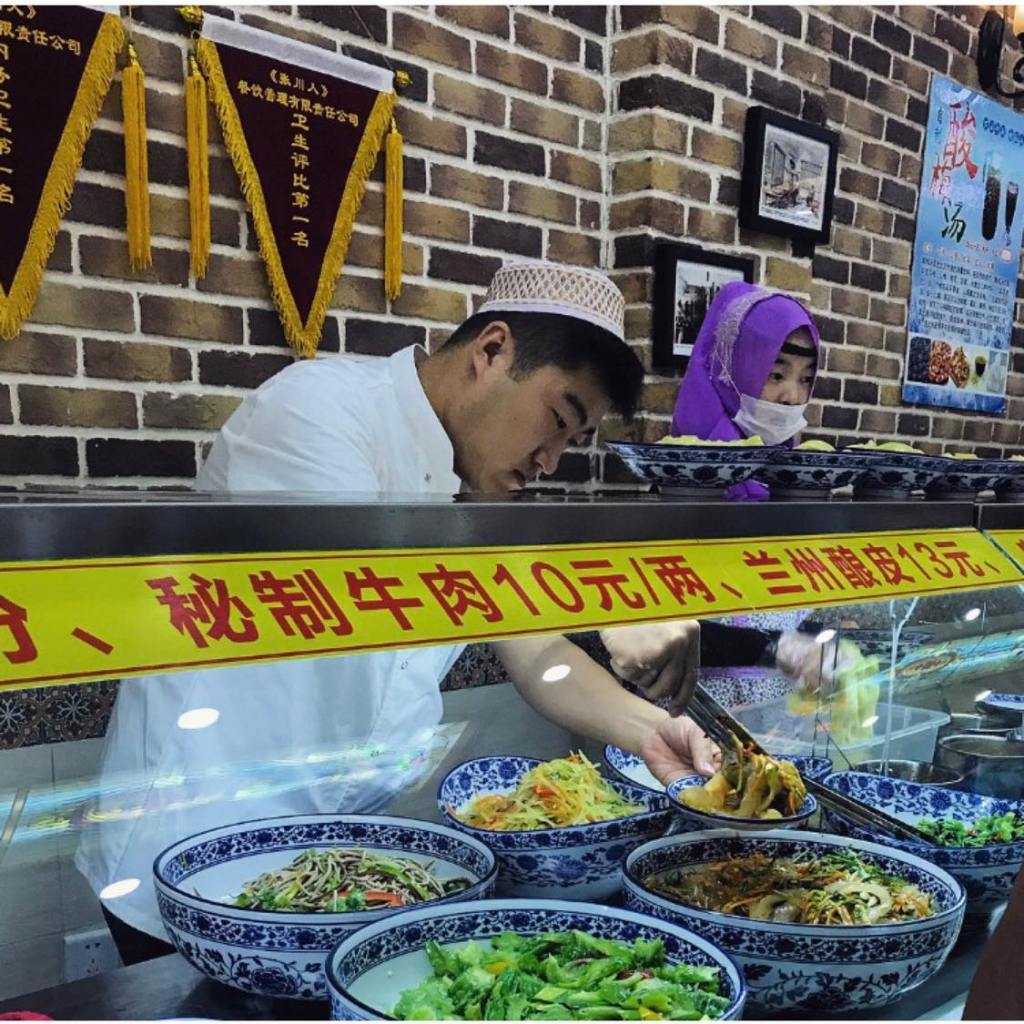
Lanzhou beef noodle soup (兰州拉面 Lánzhōu lāmiàn), originally a popular breakfast dish among Hui Muslims in Gansu, has become a common staple throughout China. The dish consists of carved beef, radish slices, red chili oil, garlic sprouts and hand-pulled noodles served in a broth of boiled lamb’s and cow’s liver. Hui cuisine (清真菜 qīngzhēn cài, lit. “pure and true [halāl] food”) is manifestly an iteration of local Gansu cuisine that developed in accordance with halāl dietary laws, however dishes such as 烤羊肉串 kǎo yángròu chuàn “grilled mutton kababs” and 馕 náng bread (from Persian نان nān) link the Hui cuisine with Central Asia.

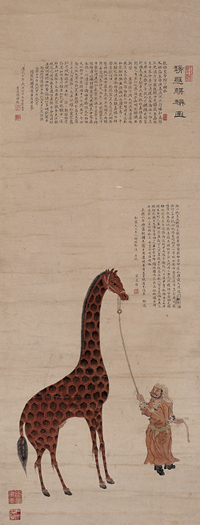
In the following centuries, Chinese sources make mention of prominent Persian Muslims and Jews in the administrative and mercantile spheres of Chinese society. Many of these individuals hailed from the primary Huíhuí cadre which had been conscripted and deported overland from Central Asia and Persia during the Mongol conquest of those regions. For example, the Persian Sayyed-e Ajall Šams-al-Dīn ʿOmar Boḵārī (d. 1279), a native of Bukhara, was appointed governor of Yunnan province by Qubilai Khan, and together with his son Nāṣer-al-Dīn was responsible for the spread of Islam in southern China (Persian: ماچين Māchīn “Greater China”; rarely منزى Manzī, from Chinese 蠻子 mánzi “southern barbarians; non-Sinicized southerner” > 南蠻 Nánmán via Mongolian). His great-great-great-grandson, the famous Iranian-Chinese mariner, explorer, diplomat, and fleet admiral Zhèng Hé 郑和 (born 马和 Mǎ Hé) commanded the largest and most advance fleet the world had ever seen to Java, Malacca, Siam, Ceylon, India, Persia, Arabia and the Horn of Africa during seven expeditions between 1405 to 1433. Zheng He presented gifts of silk, porcelain, gold, and silver, and China received such novelties as ostriches, zebras, camels, and ivory from the Swahili Coast in return. The giraffe that he brought back from Malindi was considered to be a 麒麟 qílín and taken as proof of the Mandate of Heaven (天命 tiānmìng) upon the administration.

While the Huíhuí nucleus (Muslim and Jewish Persian-speakers) was predominantly located in the northwest, center and southwest of China where they had been brought overland from Central Asia and Persia by the Mongols, by that period China had also established maritime contacts with merchants from the Persian Gulf, a limited number of whom were permitted to settle in port cities along the East China Sea. Chinese documents do not contain information on the ethnic origins of officials in the foreign quarters of the port of Zaiton (泉州 Quánzhōu; زيتون Zaytūn), however Ibn Baṭṭūṭa mentioned several prominent Persians: Kamāl-al-Dīn ʿAbd-Allāh Eṣfahānī, šayḵ-al-Eslām (dean of Muslim religious leaders) from Isfahan; Tāj-al-Dīn Ardawīlī, qāżi’l-Moslemīn (Muslim judge) from Ardabil; the prosperous merchant Šaraf-al-Dīn Tabrīzī of Tabriz; and Borhān-al-Dīn Kāzerūnī of Kazerun, a shaikh of the Sufi Kāzarūnīya order. While smaller in number, there was also mention of a community of Arabian merchants in Quanzhou that had arrived along the same maritime route as the Persians. Notably, it was through the Persians that the Chinese had first come to know of Arabia and the Arabs (大食 Dà-shí “Arab” < Persian تازى Tāzī “Arab”, referring to Arabs of the tribe of طي Ṭaī). The presence of Arabian merchants in a limited number of port cities where Persian-speakers still seem to have constituted a plurality and oligarchy among Muslims–compounded by the facts that the two coreligionists are usually not differentiated in Chinese historical documents and that Arabic is the liturgical language of both people–has lent false credence to a popular claim among those eager to influence China’s Muslims that the Hui are predominantly descendants of (1) Arabs, (2) Turks or, the deliberately ambiguous option, (3) an unknowable mixture of peoples.

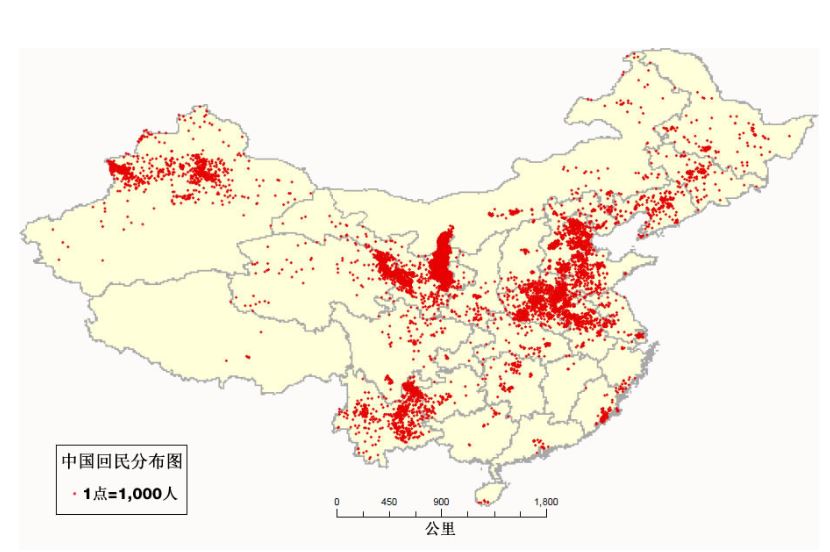
A map showing the modern distribution of the Hui Muslim population in the People’s Republic of China. Each red dot represents 1,000 people. The traditional epicenters of the Huihui (Persian-speaking Muslim) community from the Mongol Yuan period were Gansu, Ningxia, Beijing, Henan, Hebei, and Yunnan as they had been deported overland from Persia and Central Asia and settled primarily in peripheral regions and important economic zones. Few smaller communities persist in port cities on the East and South China Seas, having arrived there historically from Persia and Arabia by maritime route.

The Hui Under the Yuan, Ming and Qing Dynasties
The three officially recognized languages of Yuan administration and education were thus Chinese, Mongolian, and Per­sian; the terms 回回文 Huí-huí-wén (lit. “language of the hui-hui,” the term referring to Persian-speaking Muslims of Central Asia), 铺速蠻字 pù-sù-mán-zì (“Muslim language”, from Persian مسلمان musalmān), and 亦思替非文 yì-sī-tì-fēi-wén (“chosen language”, possibly < Ar. اصطفاء eṣṭefāʾ “choosing, selecting,” referring to the “chosen,” or “Islamic,” language; Yuan-shi LXXXVII, p. 2190; Huang, pp. 85-86) encountered in the documents of the period probably all refer to Persian (Chenheng, 2000 “Literature of Northwest China”; although it has been proposed that at least in some instances the third term refers to the language of the Qur’an). The Yuan administration opened a Persian language school called 回回國子學 Huíhuí guózi xué which is considered to the earliest foreign language school in China (Han Rulin, 1982; Fu Ke, 2004 “History of Chinese Foreign Teaching”).

During this period, Ibn Baṭṭūṭa, who was visiting China in the mid-14th century, mentions the son of a Mongol khan who was especially fond of Persian singing; apparently on one occasion he ordered his court musicians to sing several times a poem by Saʿdī Shīrāzī, which had been set to music (ibn Baṭṭūṭa, tr. Mowaḥḥed, II, p. 750 n. 2). Ironically, Saʿdī (1210-1292 A.D.), who himself had been cast into a life of itineration by the Mongol invasions, could barely restrain himself from lamenting at the ruin wrought by Chingis Khan, likening the destruction of Samarkand to the Arabian destruction of the Sassanid Persian capital of Ctesiphon six centuries earlier. Apparently, the Ottoman Sultan Mehmed II even recited Saʿdī’s forlorn couplet as he ambulated through the decrepit Mega Palation of Constantinople two centuries thereafter in 1453:

پرده‌داری می‌کند در قصر قیصر عنکبوت; بوم نوبت می‌زند بر تارم افراسیاب
Parde-dāri mikonad dar qar-e Qayar ankabūt; būm nowbat mizanad bar tāram-e Afrāsiāb

“The spider is curtain-bearer in the palace of Khosrow [Ctesiphon]; the owl calls the watch shifts in the towers of Afrasiab [Samarkand]”

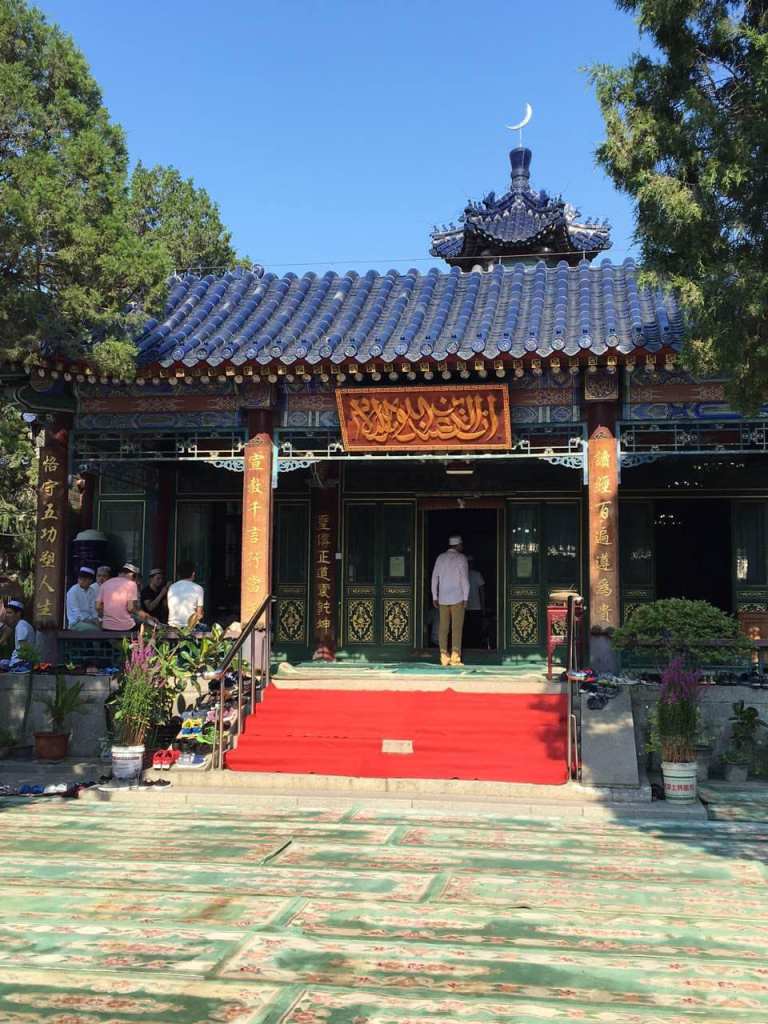
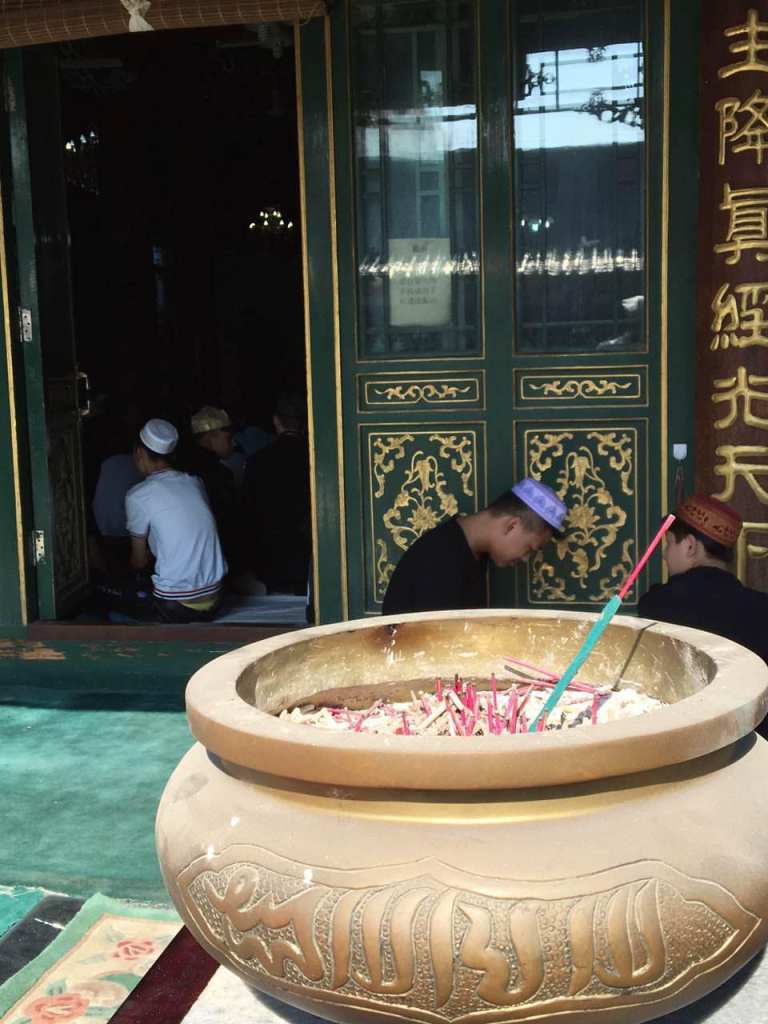
(1) The prayer hall of the Ming-era Ox Street Mosque (牛街礼拜寺 Niú jiē lǐbàisì; c. 1443 AD), Beijing (2) Hui Muslims on the mosque grounds (3) Entrance to a gǒng-běi (拱北 – “a small Muslim shrine”, from Persian گنبد gonbad “dome”) (4) An incense burner (香爐 xiānglú) used by Muslims (5) the author inside Ox Street Mosque, Beijing (photos by Afsheen Sharifzadeh)

Under the Ming dynasty (1368-1644), the Sì-yí-guǎn (四夷館, “Office for the four barbarian [nations]”) was established to train translators to provide official translations of books and diplomatic documents. Since Persian was one of the main diplomatic languages used by the Ming to communicate with Tibet, Ceylon, Cambodia, Champa, Java, Malacca, and the Timurid Empire, numerous Ming-era Persian language inscriptions have been discovered in these territories, including the trilingual Tibetan, Chinese and Persian language inscriptions at Tsurphu monastery in Tibet. The first Ming emperor, Tai-zu 太祖 (r. 1368-97), apparently ordered a group headed by Ma-sha-yi-hei (probably مشايخ Mašāyeḵ) to trans­late several Persian books, including one on astronomy, into Chinese, and in 1407 Ming Cheng-zu (r. 1403-25) issued an edict in Chinese, Mongolian, and Persian for the protection of Islamic minorities. Additionally the Huí-huí guǎn yì yǔ (回回館譯語 “Textbook for Translation from Huihui [Persian]”), com­piled by the Sì-yí-guǎn, was a textbook for teachers and translators; one extant copy includes a Persian-­Chinese vocabulary of 1,010 words. Other Chinese Muslim scholars of the Ming period who taught Persian, translated Persian works into Chinese, or integrated ma­terial from Persian works into their own books in Chinese were Chang Zhi-mei (1610-70) and Liu Zhi (ca. 1660­-1730).

In the mid-­16th century madrasas (schools of Islamic law, jīng táng 经堂, lit. “hall of doctrinal texts”) were established in China. Some Muslim scholars taught Islamic books in Persian in their homes and annotated both Arabic and Chinese texts with Persian, but, as time went on, it appears only Arabic was used in religious education, though in a few mosques there was instruction in both languages. Persian continued to be spoken and read among Muslims through­out the period, but by the end of the Ming period Chinese had become the primary spoken language among the Hui. However the Persian language was still taught in several Muslim schools that were established in the 1920s or later. Ha De-chen (1887-1943) and Wang Jing-zhai (1879-1948) were among the most noted Chinese translators from Persian under the National Republic of China. The latter translated Saʿdī’s Golestān گلستان as Zhēn-jìng huā-yuán 真境花园 (“Ethereal Garden”, published by Beijing Muslim Press, 1947).

Today, Beijing alone is home to at least 72 mosques, and visitors can encounter innumerable madrasas and perhaps dozens to hundreds of Hui restaurants with their idiosyncratic façades of crescent-shaped arches, serving traditional dishes such as 烤羊肉串 kǎo yángròu chuàn “grilled mutton kababs”, 手抓羊肉 shǒu zhuā yángròu “grabbing mutton”, and 馕 náng bread (from Persian نان nān).

Sayyed-e Ajall Šams-al-Dīn Boḵārī (Persian: سید اجل شمس‌الدین عمر بخاری; Chinese: 赛典赤·赡思丁 Sàidiǎnchì Zhānsīdīng; 1211–1279), a Persian from Bukhara, was appointed as Yunnan’s first provincial governor during the Yuan dynasty. His descendant, the celebrated Admiral Zheng He 郑和 commanded seven expeditionary treasure voyages to Java, Malacca, Siam, India, Persia, Arabia and the Horn of Africa from 1405 to 1433. The giraffe that he brought back from Malindi was considered to be a 麒麟 qílín and taken as proof of the Mandate of Heaven upon the administration

Hui Chinese Dialects
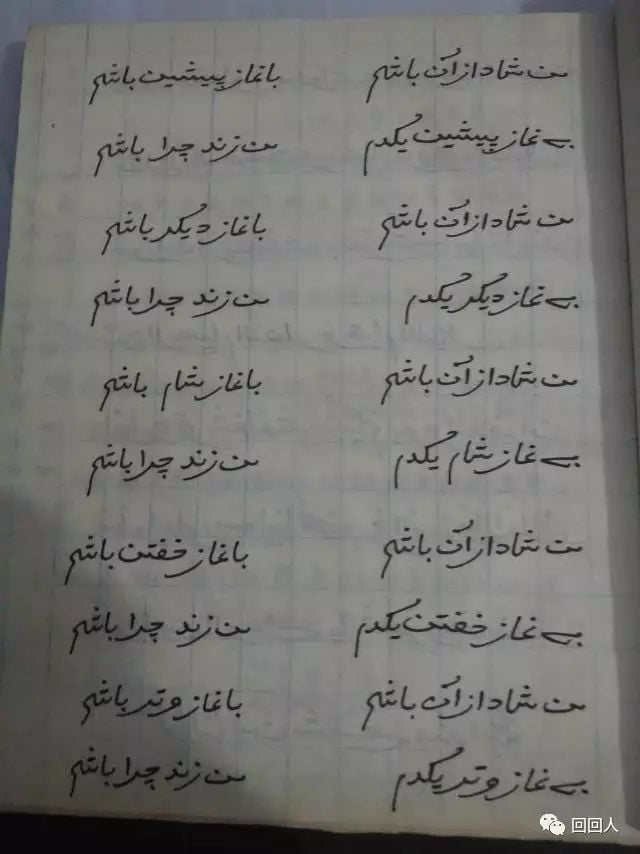
In the religious sphere, the Hui have inherited terminology from the Persian substrate of their forefathers, however Arabic terms derived from the Qur’an or their Chinese translations are also used today. For example, 木速蠻 mù-sù-mán “Muslim” (from Persian مسلمان mosalmān, first attested as 铺速蠻 pù-sù-mán in Yuan sources, meaning “Persian”; note 穆斯林 mù-sī-lín from Quranic Arabic muslim مسلم is also used today); 別安白爾 bié-ān-báiěr “prophet” (from Persian peyḡambar پيغمبر; cf. Arabic nabī نبي), the Persian term for the Prophet Moḥammad (first attested as 别安白尔皇帝 bié-ān-báiěr huángdì “Emperor prophet” in Xuanzong’s 赛氏总族牒 “Sai’s General Clan Sutra)”; 答失蛮 dá-shī-mán “learned man; scholar” (from Persian dānešmand دانشمند; cf. Arabic ‘ālim عالم); 迭里威士 dié-lǐ-wēi-shì “member of a Sufi order” (from Persian darvīš درويش); 乃瑪孜 nǎi-mǎ-zī “prayer” (from Persian namāz نماز; cf. Arabic alāt صلاة); etc. Many of them (e.g., dá-shī-mán and bié-ān-bái-ěr) were also fash­ionable in the writings of non-Muslim Chinese literati. Words like 多災海 duō-zāi-hǎi “hell” (from Persian dūzaḵ دزاخ); (Mathews, nos. 6421, 6939, 2014) and 榜达 bǎng dá “morning” (from Persian bāmdād بامداد) are still common among Muslims in Beijing. In addition to incorporating a great many Persian words in their daily religious rituals, Beijing Muslims also hear sermons in Persian, and at evening prayer during the month of Ramażān they recite poems of praise in Persian (Yu Guang-zeng, p. 9).

Hui Muslim restaurants abound throughout China, particularly in Beijing and other historic Hui centers. The Hui are distinguished from the Han Chinese by their round skullcaps and headscarves (戴斯达尔 dài-sī-dá’ěr, from Persian dastâr دستار) , although only sported by some members of the community (Photos by Afsheen Sharifzadeh)

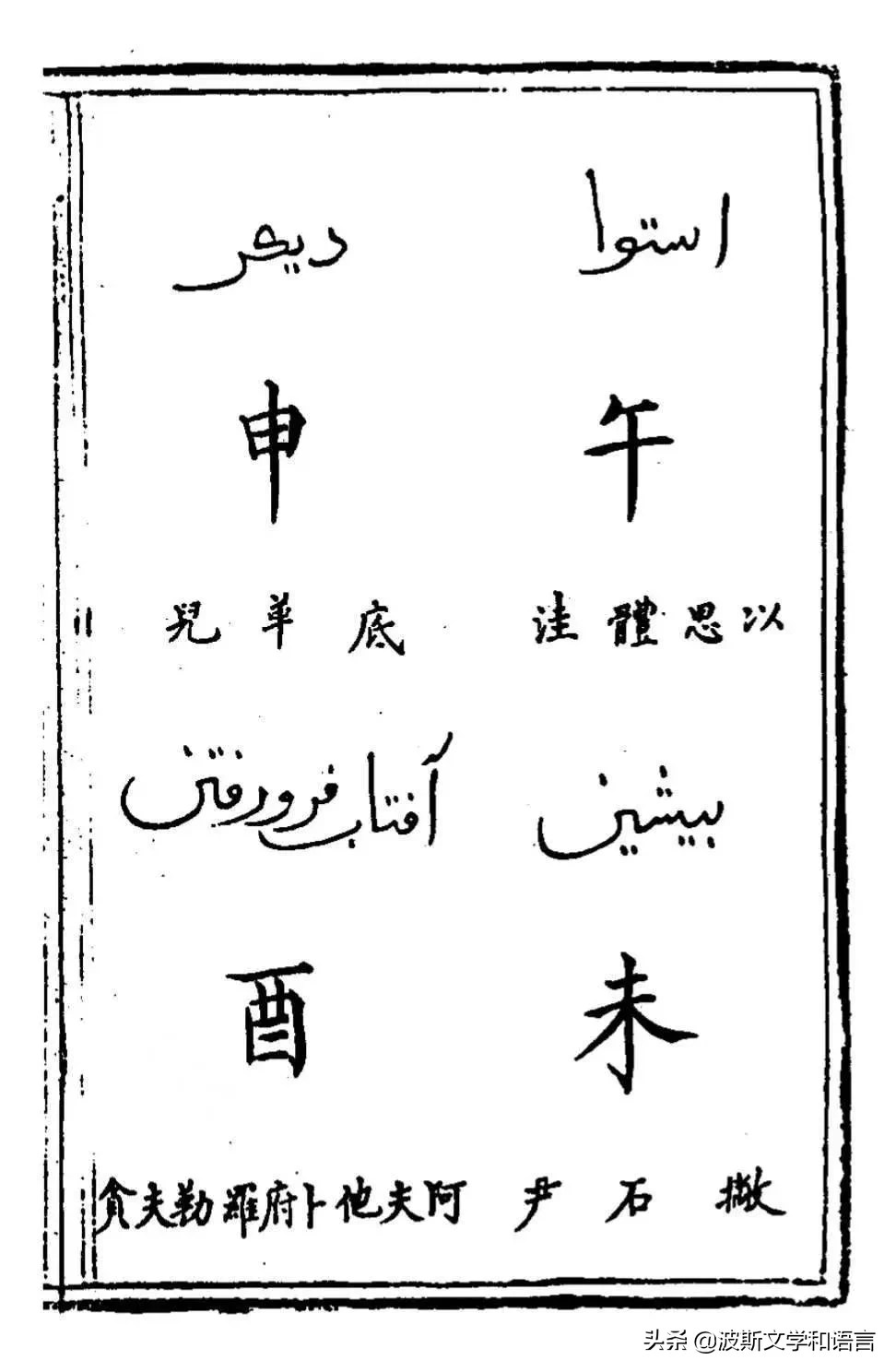
The evening prayer 阿夫他卜—府罗夫贪 Ā-fū-tā-bo fǔ-luō-fū-tān (from آفتاب فرورفتن āftāb forū-raftan) recorded in “Glossary of the Huihui Language”, Ming Dynasty (1368-1644)

Not surprisingly, the names of all of the five Islamic prayers still in use among the Hui are from Persian rather than Arabic. These are: 榜达 bǎng dá “prayer at dawn” (from Persian bāmdād بامداد), 撇石尹/撇申/撇失尼 piē shí yǐn/piē shēn/piē shī ní “prayer at midday” (from Persian pišin پيشين), 底盖尔 dǐ gài ěr “afternoon prayer” (from Persian digar ديگر), 沙目 shā mù “prayer at sunset” (from Persian shām شام), 虎夫贪 hǔfū tān “night prayer” (from Persian khoftan خفتن). We encounter another term 阿夫他卜—府罗夫贪 Ā-fū-tā-bo fǔ-luō-fū-tān “sunset prayer” (from Persian آفتاب فرورفتن āftāb forū-raftan “sunset”) in the Persian language glossary entitled 回回館譯語 Huíhuíguǎn Literacy Primer from the Ming Dynasty (1368-1644).

Additionally, the names for the days of the week in Hui are retained from Persian: 牙其閃白 yá qí shǎnbái “Sunday”, 都閃白 dū shǎnbái “Monday”, 歇閃白 xiē shǎnbái “Tuesday”, 查爾閃白 chá ěr shǎnbái, 潘值閃白 pān zhí shǎnbái “Thursday”, 主麻 zhǔ má “Friday”, 閃白 shǎnbái “Saturday”. Of note, the Ming-era Persian-Chinese glossary Huíhuíguǎn Literacy Primer also records the Persian celebration of the winter solstice 捨卜夜勒搭 shě bo yè lēi dā (شب يلدا šab-e yaldâ), which must have been celebrated among the Hui historically.

The Shab-e Yalda (捨卜夜勒搭 shě bo yè lēi dā) festival recorded in the “Seasonal” section of the Persian Language Work “Glossary of the Huihui Language” in the Ming Dynasty (1368-1644)

The Hui thus bare the mantle of Persislamic civilization, with persisting use of Persian words for an array of domestic, social and religious matters in lieu of the language of the Qur’an, which would only occur among a community that used Persian as its mother language. While many Arabic terms are also used in the realm of religious vocabulary, this is expected since it is the liturgical language of all Muslims. As Michael Dillon notes:

Arabic words are used in connection with religious observance and, since the Qur’an is read and studied in Arabic, this is not surprising. More interesting is the persistence of Persian vocabulary which has social and historical as well as religious connotations. (“China’s Muslim Hui Community”, p. 154)

Hui Words Derived from Persian
A selection of Hui terms pertaining primarily to the religious sphere and their Persian roots are listed below (list composed by Afsheen Sharifzadeh):

湖達 hú-dá – “God; Allah” (from Persian خدا khodâ(y))

別安白爾 bié-ān-báiěr – “prophet [Muhammad]” (from Persian peyḡambar پيغمبر; cf. Arabic nabī نبي)

夏衣马尔旦 xià-yī-mǎ’ěr-dàn – lit. “King of mortals” (from Persian شاه مردان šâh-e mardân)

阿斯曼  ā-sī-màn – “God, sky, heaven” among Qinghai muslims (from Persian آسمان âsemân “sky”)

頓亞 dùn-yà – “world, Earth” (from Persian دنيا dunyâ)

答失蛮 dá-shī-mán – “[Islamic] scholar; learned man” (from Persian dānešmand دانشمند; cf. Arabic ‘ālim عالم)

阿訇 ā-hōng“imam, mullah” (from Persian آخوند âkhond)

木速蠻 mù-sù-mán – “Muslim” (from Persian مسلمان mosalmān)

戴斯达尔 dài-sī-dá’ěr – “turban; cloth wrapped around head of Muslims” (from Persian dastâr دستار)

别麻日 bié-má-rì – “sick; ill” (from Persian bimâr بيمار)

依禪 yī-chán – “He, they” [referring to religious notables in place of 他们 tā-men “they”] (from Persian išân ايشان “they”)

肉孜 ròu-zī – “religious fasting during Ramadan” (from Persian roze روزه; cf. Arabic awm صوم)

阿布代斯 ā-bù-dài-sī – “ablution; Islamic ritual washing of head, forearms, feet before prayer” (from Persian آبدست âbdast; cf. Arabic وضوء wuḍūʾ)

达旦 dá-dàn – “willing to marry [the woman’s term for marriage]” lit. “to give” (from Persian دادن dâdan)

卡宾 kǎ-bīn – “marriage portion; dowry” (from Persian كابين kâbin)

古瓦希 gǔ-wǎ-xī – “matchmaker, marriage broker” (from Persian گواهى guvâhi “witness”)

掃幹德 sǎo-gàn-dé – “swear, oath” (from Persian سوگند sogand)

虎士努提 hǔ-shì-nǔ-tí – “like, satisfied” (from Persian خشنود khošnud)

麻扎 má-zhā – “Muslim grave” (from Persian مزار mazâr “tomb”)

乃瑪孜 nǎi-mǎ-zī – “[Islamic] prayer” (from Persian نماز namâz, cf. Arabic صلاة alāt)

古尔巴尼 ěr-bā-ní – “Eid al-Adha; sacrifice” (from Perso-Arabic قربان ghurbân, عيد قربان Eid-e ghurbân; cf. Arabic ضحي ḍaḥiy “sacrifice”, whence عيد الأضحى ʿEid al-aḍḥa)

班代 bān-dài – “servant, slave [of God]” (from Persian بنده bande)

朵斯提 duǒ-sī-tí – “friend or Muslim friend” (from Persian دوست dôst; note the irregular plural 多斯達尼 duō-sī-dá-ní, from Persian دوستان dôstân “friends”)

牙日 yá-rì – “friend, companion” (from Persian yâr يار)

拱北- gǒng-běi – “a small Muslim shrine” (from Persian گنبد gonbad “dome”)

邦克 bāng-kè-adhan; Muslim call to prayer” (from Persian بانگ bâng; cf. Arabic اذان adhān)

náng – “flatbread” (from Persian نان nân “bread”; cf. Arabic خبز khubz, Turkic ekmek, çörek)

郭 什 guō-shén – “meat [used by Hui to refer specifically to beef and mutton]” (from Persian گوشت gosht)

古纳罕 gǔ-nà-hǎn or 古纳哈 gǔ-nà-hā – “sin” (from Persian گناه gunâh)

哌雷 pài-léi – “fairy, genie” (from Persian پرى pari)

哈宛德 hā-wǎn-dé – “master, leader” (from Persian خاوند xâvand)

睹失蛮 dǔ-shī-mán – “adversary, enemy” (From Persian دشمن dušman)

貓膩 māonì (Beijing dialect)- underhanded activity; something fishy; trick (from Perso-Arabic معنی‎ ma’ni “meaning; subtext or underhanded activity”),  borrowed through the language of Hui

牙其閃白 yá qí shǎnbái “Sunday” (Persian يكشنبه yakšanbe), 都閃白 dū shǎnbái “Monday” (Persian دوشنبه dušanbe), 歇閃白 xiē shǎnbái “Tuesday” (Persian سهشنبه sešanbe), 查爾閃白 chá ěr shǎnbái (چاهارشنبه châhâršanbe), 潘值閃白 pān zhí shǎnbái “Thursday” (Persian: پنجشنبه panjšanbe), 主麻 zhǔ má “Friday” (Persian جمعه jum’a), 閃白 shǎnbái “Saturday” (Persian: شنبه šanbe)

榜达 bǎng dá “morning prayer” (from Persian bāmdād بامداد), 撇石尹 piē shí yǐn “prayer at midday” (from Persian pišin پيشين), 底盖尔 dǐ gài ěr “afternoon prayer” (from Persian digar ديگر), 沙目 shā mù “prayer at sunset” (from Persian shām شام), 虎夫贪 hǔfū tān “night prayer” (from Persian khoftan خفتن)

Remarkably, some conservative Hui dialects, such as the vernacular in Linxia county of Gansu known historically as 河州话 Hézhōuhuà, demonstrate Persian substratum in syntax. Of note, these dialects feature verb-final syntax, as in Persian, in contrast to standard Mandarin:

PersianHui Chinese (Hezhou)Standard Mandarin English
نماز خواندى؟ Namâz khândi?乃瑪孜做了没有?
Nǎimǎzī zuòle méiyǒu?
做礼拜了没有?Zuò lǐbàile méiyǒu?Have you performed [Muslim] prayer? 

A Persian hymn that has long been circulated among the Hui people in China called 五时赞 Wǔ shí zàn “Five Seasons Praise” or 乃玛兹芭莎 Nǎi mǎ zī bā shā”, revering the five daily Islamic prayers with archaic Persian names (پيشين، ديگر، شام، خفتن، وتر) The handwriting of Imam Zhang Guangyu (张广玉) in Cangzhou

References:
“CHINESE-IRANIAN RELATIONS viii. Persian Language and Literature in China” https://www.iranicaonline.org/articles/chinese-iranian-viii

Dillon M. China’s Muslim Hui Community: Migration, Settlement and Sects. Routledge; London, UK: New York, NY, USA: 2013.

Ford, G. (2019). The Uses of Persian in Imperial China: The Translation Practices of the Great Ming. In N. Green (Ed.), The Persianate World: The Frontiers of a Eurasian Lingua Franca (1st ed., pp. 113–130). University of California Press. http://www.jstor.org/stable/j.ctvr7fdrv.10

Khwārazm: Examining the Past and Present of the “Lowlands” and its Idioms

Written by Afsheen Sharifzadeh, a graduate of Tufts University focusing on Iran and the Caucasus. The goal of this article is to introduce the reader to the history of Khorezm located in modern-day Uzbekistan, as well as its historic Iranian and modern Turkic vernaculars.

The western gate (Ata-Darvaza) to the Ichan Qal’a complex, Khiva, Khorezm province, Uzbekistan (c. 17th century). Seen in the background are the Kalta Minor minaret (unfinished beyond a band of azure tiles near the top with an inscription in Persian), the madrasa of Mohammad Amin Khan, and the Islam Khoja minaret.

History of Khwarezm and its Indigenous Iranian Language

For at least two millennia until the Mongol invasion in the 13th century CE, the inhabitants of Khwarezm (Chorasmia) were of Iranian stock and spoke the Iranian Khwarezmian (Chorasmian) language. This once prominent Iranian language–attested first in royal wood and leather inscriptions at Toprak Kala (7th century C.E.) in an indigenous Aramaic-derived script, and later in al-Biruni’s manuscripts and Zamakhshari’s Arabic-Persian dictionary (Muqadimmat al-Adab)–belonged to the Eastern Iranian clade with nearby Sogdian and Saka (Khotanese, Tumshuqese, Scythian). In fact, with various settlements at Kuyusai 2 in the Oxus delta, which has been dated to the 12th-11th centuries B.C.E. by the presence of so-called “Scythian” (Saka) arrowhead, some scholars have argued that the Iranian Scythians were descended from these northern peoples and that Khwarezm was one early arena for their emergence as a distinct people. In another vein, University of Hawaii historian Elton L. Daniel believes Khwarazm to be the “most likely locale” corresponding to the original home of the Avestan people, and thereby the cradle of Zoroastrianism. Dehkhoda calls Khwarazm “the cradle of the Aryan tribe” (مهد قوم آریا mahd-e qawm-e āryā). 

Zoroastrianism was the dominant religion in this oasis, as it may have been the homeland of the religion (what is called in ancient Avestic texts Airyanəm Vaēǰah lit. “expanse of the Aryans”). Remains of the massive Chilpyk Zoroastrian tower of silence (daḵma) from the 1st century B.C.- 1st century A.D. confirms the preeminence of the religion, although it is likely that similarly to neighboring Transoxiana and Khorāsān there were once Manichaean, Buddhist and Christian communities present in the first centuries A.D. There must have been a sizable Zoroastrian community in the early capital Kāth even after the arrival of Islam, from whom the scientist al-Biruni obtained the rich research data on Zoroastrianism in his Āṯār al-bāqia. As Biruni, a native of Khwarezm, verifies in his Āṯār al-bāqia:

أهل خوارزم […] کانوا غصناً من دوحة الفرس
Ahl Ḵawārizm kānū ḡuṣnan min dawḥat al-furus
“The people of Khwārezm were a branch from the Persian tree.”

(1) A map illustrating the historic Iranian regions of Māwara’nnahr (Transoxiana), Khwārazm (Chorasmia) and Greater Khorāsān overlying modern political borders (2) Map of Khwārazm and its important settlements during the early Islamic period (3) Location of the main fortresses of the Chorasmian oasis during the Sassanian period, 4th century BC-6th century AD (4) Fortress of Kyzyl-Kala (c. 1st-4th century AD; restored), one of the many fortresses constructed when the region was inhabited by the Iranian Chorasmian people

Throughout antiquity, the fate of the Khwarezmians rested upon the unpredictable currents of the fierce Oxus river (Āmu Daryā). A large oasis region nestled in a fertile river delta where the Oxus meets the historic Aral Sea, Khwarezm’s urban settlements relied on a complex system of man-made canals and irrigation networks for agricultural growth. Its name is most likely a reference to being the lowest region in Central Asia: kh(w)ar ‘low’ and zam ‘land’. But Khwarezm owed both its glory and demise to the Oxus; due to the nearly flat plain, its cities were frequently flooded when the river changed course. This was particularly felt in the early capital city of Kāth on the right bank of the river, which at its zenith in the 10th century CE apparently rivaled the cities of the Iranian plateau. According to Biruni, who eye-witnessed the flooding of his hometown Fir, a suburb (birūn) of Kāth, before his emigration at the age of twenty-five (in 998 CE), Fir “was broken and shattered by the Oxus, and was swept away piece by piece every year, till the last remains of it had disappeared” in the year 1305 of the Seleucid era (994 CE) (Biruni, Āṯār, tr., p. 41).

During the reign of Shapur I, the Sassanian Persian Empire extended its territorial boundaries to encompass Khwarezm. Historical sources, such as Yāqūt al-Ḥamawī, confirm Khwarezm’s status as a regional capital of the Sassanid empire, with references to the pre-Islamic “Khosrau of Khwarezm” (خسرو خوارزم), Islamic “Amir of Khwarezm” (امیر خوارزم), and the Khwarezmid Empire. These sources explicitly indicate that Khwarezm was a part of the Iranian (Persian) empire, and the conquest of significant areas of Khwarezm during the reign of Khosrow II further supports this assertion. Moreover, Al-Biruni and Ibn Khordādbeh, among other sources, attest to the use of Pahlavi script, which was employed by the Persian bureaucracy in conjunction with the local Chorasmian alphabet around the 2nd century AD.

(1) Khwarezmian frescoes from Kazakly-Yatkan fortress (1st century BC-2nd century AD), modern Republic of Karakalpakstan, Uzbekistan. Ancient Iranians in Central Asia made frequent use of cosmetics, as depicted in the figure’s full red ears and lips, thick eyebrows and eyeliner (2) Ruins of the massive Chilpyk Zoroastrian Tower of Silence (daḵma) from the 1st century B.C.- 1st century A.D, Republic of Karakalpakstan, Uzbekistan (3) The native Iranian Chorasmian (Khwarezmian) language was likely spoken at least until the Mongol conquest in 13th century A.D., after which it was definitively supplanted by Persianized Turkic dialects and Persian. The language first employed a script derived from Pahlavi and after Islam, a modified Perso-Arabic script. Both scripts read: zβāk āy xwārazm “Khwarezmian language”

The arrival of Islam in the 8th century A.D. delivered a catastrophic blow to the Iranian Chorasmian language, identity and the native Zoroastrian religion in the oasis. According to al-Biruni, the Arabs systematically annihilated the strongholds of the religion, punished those who retained competency in their language and culture, engaged in massive-scale book burning and massacred the region’s scholars and literati. Speaking to the fate of Khwarezm after the Arab conquest, al-Biruni lamented:

When Qutayba ibn Muslim under the command of Al-Ḥajjāj ibn Yūsuf was sent to Khwarazmia with a military expedition and conquered it for the second time, he swiftly killed whoever wrote in the Khwarazmian native language and knew of the Khwarazmian heritage, history, and culture. He then killed all their Zoroastrian priests and burned and wasted their books, until gradually the illiterate only remained, who knew nothing of writing, and hence the region’s history was mostly forgotten.

Khwarezm became increasingly Turkicized in the centuries after Islam, particularly after 1044, when it came under the Seljuqs (Tolstow, pp. 290-­92). At the same time, however, Persian language was asserting itself in the same area (Spuler, 1966, p. 171), although the indigenous (Middle) Iranian languages Sogdian and Chorasmian were also still spoken (Henning, “Mitteliranisch,” pp. 56-58, 84). With the fall of indigenous Iranian dynasties including the Afrighid and Ma’munid lines, the title of Khwarezmshah was assumed by the Turks, but court life and high culture was conducted in Persian, as confirmed by existing chancery documents authored by a reputable Persian poet Rashid al-din Vatvat who lived at the court in Gurganj. Additionally, the fact that Khwarezmshahs such as ʿAlā al-Dīn Tekish (1172–1200) issued all of their administrative and public orders in Persian further corroborates Al-Biruni’s claims of the status of Persian in the oasis. It appears that the autochthonous Iranian Chorasmian language was still in use in the 13th century A.D., but it disappears from the record following the Mongol invasion of the region. In contrast to the valleys and major oases in Transoxiana such as Bukhara and Samarqand which retained Persian as the dominant language, a deeply Persianized Turkic (Chaghatai) emerged as the dominant language in Khwarezm, while Persian was used as a language of literature, poetry and administration.

A band of glazed azure majollica tiles with an inscription in Persian in nastaʿlīq script adorns the top of the unfinished Kalta Minor, Khiva, Uzbekistan (c. 1851 AD). The minaret and the madrasa that adjoins it were commissioned by the Uzbek Qongrat ruler, Muhammad Amin Khān, who originally planned to build the highest minaret in the world. The poem reads in Persian:

منار عالی فرخنده بنیاد که مانندش ندیده چشم افلاک
Menār-e āli-ye farḵonde bonyād ke mānandash nadide chashm-e aflāk
عمارت شد بامر شاه عالم ز جمله عیبها و نقص ها پاک
Emārat shod be amr-e Shāh-e ‘ālam, ze jomle ‘aybhā va naqṣhā pāk
بچشم عقل در وقت نمودش شده سرو سهی مانند خاشاک   
Be chashm-e ‘aql dar vaqt-e nemudash shode sarv-e sahi mānand-e ḵāshāk
چو از طوبی آمد دلگشاتر به جنت کرد نادرش عرضه خاک
Cho az ṭubā āmad delgoshātar be jannat kard nāderash ‘arze-ye ḵāk
رسیده چون ستون بر كاخ گردون ز وصفش قاصر آمد عقل و ادراک
Raside chun sotūn bar kāḵ-e gardūn, ze vafash qāṣer āmad ‘aql-o-edrāk
از این در آگهی سال بنایش رقم کرده ستون خاک افلاک
Az in dar āgahi-ye sāl-e banāyash raqam karde sotūn-e ḵāk-e aflāk

Chingis Khan’s conquest of the Khwarezmid empire dealt a fatal blow to the region from which it would never fully recover its former eminence. Its cities, including the imperial capital of Gurganj, were systematically flooded by destruction of the region’s ancient dams, and the majority of Khwarezm’s population was executed by the Mongol horde. Several thousand craftsmen and soldiers who escaped the sword were deported to the China, where they established a thriving diaspora community that persists in present times (for further reading about China’s Hui community, see here). The decimation of the ancient Iranian population of Khwarezm created a vacuum that occasioned the gradual influx of nomadic Turko-Mongol peoples, some of whom maintained their nomadic lifestyle over the centuries, while others came to settle in newly constructed urban centers where they adopted Persian culture. Khwarezm was originally assigned to the Chaghatayid dominion and later–following devastations by the Golden Horde and Timurids– came under the control of a local Jochid-line clan ‘Arabshāhids. Reflecting on the Mongol invasion, the Persian poet Anvari writes:

آخر ای خاک خراسان داد یزدانت نجات
Āḵar ey ḵāk-e Ḵorāsān dād yazdānat nejāt

“Oh land of Khorāsān! God hath saved you,

از بلای غیرت خاک ره گرگانج و کات
Az balā-ye eirat-e ḵāk-e rah-e Gurganj o Kāt

from the disaster that befell the land of Gurganj and Kāth [Khwarezm]”

Divān of Anvari

(1) The inner shell of the dome covering the hexagonal main hall of the Turabek Khānum Mausoleum. The surface is covered in colorful Persian mosaics depicting ornamental patterns of flowers and stars; a visual metaphor for the heavens (2) The partially-restored mausoleum of Turabek Khānum, wife of Qultugh-Temür (ruled between 1321 and 1336). The capital of the Khwarazmshahid dominion, Gurganj (modern Urgench, Turmenistan) was destroyed and its entire population annihilated at the hands of Genghis Khan

Following the demise of the ‘Arabshāhids, various khans were brought from the steppes to Khiva where they held the reins of power, usually as puppets, while the actual authority was wielded by the inaq, or military chief, of the Mongol Qongrat clan. In the 18th century A.D., nomadic Karakalpaks–a Kipchak people closely related to Kazakhs–settled in the lower reaches of the Āmu Daryā and its delta with the Aral Sea, dotted with the ruins of innumerable fortresses, settlements, and Zoroastrian buildings of ancient Khwarezm, while the upper shores of the river and its watershed have been inhabited by Persianized, mixed Oghuz-Karluk-speaking peoples through modern times. The region came under the control of imperial Russia, and the Soviet era saw the creation of the short-lived People’s Republic of Khorezm (Khorezm SSR; Хорезмская Народная Советская Республика Khorezmskaya Narodnaya Sovetskaya Respublika) before it was incorporated into the Uzbek SSR and thence, Uzbekistan.

There appears to be little, if any, Iranian Chorasmian substrate in modern Khorezmian Turkic. A few terms relating to irrigation (arna “large canal” and yab “small canal”), which survived only at Ḵīva and among the Turkmen are supposed by Barthold (1956, p. 15) to be of Chorasmian origin. By coincidence, Iranian Chorasmian had the dental fricatives [ð] and [θ], a unique feature which it shares with the language that at least partially supplanted it, Turkmen. The largest influence on Khorezmian Turkic is Persian (discussed below), and more recently, Russian.

Khorezmian-Uzbek singer Ulug’bek Sobirov performs a song, “Janim” (“my soul”, from Persian), in the Khorezmian Uzbek language:

-Jan al uch erkalik ba süziŋde, yuz miŋ ma’na karashiŋde, güziŋde
“There are three heart-robbing tricks in your words, there are a hundred-thousand hidden meanings in your glance, in your eye”
-Janim, mani janim sani ichiŋde, kachan-g’acha öldurasan iziŋde
“My soul, my soul is within you, until when will you kill all those who cross your path?
-San küŋlim bag’ini rahyan güli, qalbim nazirasi javahir duri
“You are a basil flower in the garden of my soul, you are a pearl worthy of my whole heart”
-Kimlar man dab aysta– aytaversinlar, sani mandin sevolmiydi hich biri
“Whoever tries to woe you like me, let them woe! None of them can ever love you more than me”


Khorezmian-Uzbek singer Feruza Jumaniyozova performs contemporary iteration of a traditional Khorezmian song, “Man bandang bo’lin” (“May I become thy serf”):

Aksham düshümde, bir gül-i ranoni güribman
“In my dreams at night, I am holding a beautiful flower”
-Shul gül-i rano bilen bog’da yuribman
“Holding that beautiful flower, I am standing in a garden”
-Ul bog’ ichinde sorı, kızıl güller tiribmen
“In this garden, I am picking yellow and red flowers”
-Shuni yollara harna bela gelsa turibmon
“If any manner of calamity should cross his path, I shall stand my ground”
-Man bandaŋ bo’lin, ko’lıŋ bo’lin, yor, soŋo banda!
“May I become thy serf, may I be thy slave; a slave to thee, my beloved!”
-Sodog’oŋ bo’lin, sariŋa dünin, ö’rtama shuda. Kıynama beda!
“May I be thy sacrifice, may I rotate about thy head; do not interfere in this!”

Khorezmian Turkic as a mixed Oghuz-Karluk language

The main dialect is spoken in Khiva-Urgench and appears to be a mixed language, consisting of an Oghuz core with a strong admixture of Karluk elements. This language appears to descend from an ancestor close to that of the Chaghatai language. In morphology, some Karluk elements have supplanted the Oghuz elements, while in phonology and lexicon KT can in some respects be seen as closer to Oghuz than to Karluk. There is a Kipchak language spoken in Khwarezm, but it does not seem to have influenced the prestige language in Khiva-Urgench to an appreciable degree.

The largest foreign influence on Khorezmian Turkic has been Persian, a fact that is frequently underestimated when speakers compare the “Turkness” of KT to Standard Uzbek (adabiy til, lit. “literary language”) or Sarti Uzbek dialects, which by comparison are viewed as heavily Persianized. There is some truth to the idea inasmuch as KT has retained Turkic phonological features such as vowel harmony while Persian influence eradicated them from Uzbek. However, Khorezmian Turkic also contains hundreds of Persian words used in daily life, some of which do not exist in Uzbek. Like all Islamized Turkic languages among which Chaghatai, Uyghur, Azeri, Ottoman Turkish and Tatar may be enumerated, both Uzbek and Khorezmian Turkic rely heavily on Persian lexicon and formulas (calques, subordinate clauses, relative clauses) in the literary register.

A selection of distinguishing phonological, morphological and lexical features of Khorezmian is discussed below.

Phonology:

The most striking feature of KT’s phonology is the presence of vowel harmony, whereas Karluk in Transoxiana (Sarti Uzbek) lost vowel harmony under the influence of Persian (Tajik). KT has expected phonological correspondences for an Oghuz language: /d/ for Uzbek /t/ ; /g/ for uzbek /k/, i.e: Uzbek til — KT dil “language, tongue”; Uzbek tish — KT dish “tooth”; Uzbek kel —KT  gal “come”; Uzbek kerak — KT garak “need”.

Khorezmian, unlike Uzbek, retains vowel harmonized modifications to the personal pronouns: i.e. KT män, maŋa “I, to me” and sän, saŋa “you, to you” for Uzbek men, menga and sen, senga, respectively. This feature is shared with Oghuz, where the presence of -g- reflects early Oghuz dative forms prior to being lost it in modern Azeri mana and Turkish bana.

TurkishKhorezmian TurkicUzbekEnglish
Yanıma gelib sırrını söyleYanıma gelib sırıŋnı sölleYonimga kelib siringni aytCome to me and tell me your secret
-Adınız ne?
-Sana söyleceğim
-Adıŋız ne?
-Saŋa sölejekmen
-Ismingiz nima?
-Senga aytaman
-What is your name?-I will tell you (later)

Like Oghuz but in contrast to Karluk, KT has an aversion for the voiceless uvular plosive /q/ which is instead approximated as the voiceless velar plosive /k/. In higher registers, /q/ is sometimes realized in an attempt to emulate Standard Uzbek phonology. When followed by rounded /a/, /q/ becomes /g’/.

TurkishKhorezmian TurkicUzbekEnglish
Kapkara kaşına bak, efendimKap-kara kashına bak, og’ojonQop-qora qoshiga boq, akajonLook at her darkest black eyebrows, mister
Akkan suAkkan suwOqqan suvRunning water

/X/ is usually realized as /h/, like in nearby Turkmen and western varieties of Anatolian Turkish. Frequently speakers pronounce /v/ as /w/. Additionally, the Uzbek ablative suffix -dan “from”  is vowel harmonized -nan/-nen in KT:

Khorezmian TurkicUzbekEnglish
Harezmıŋ hanları hiwanan kachdılaXorazmning xonlari xivadan qochdilar“The Khans of Khwarezm fled Khiva”

Morphology:

Speakers of KT are frequently socially conscious of linkages between Khorezmian Turkic and Oghuz Turkic languages, particularly Anatolian Turkish. Khorezmian is confederate with Oghuz in use of -n- in third person genitive constructions while Uzbek lacks it. Indeed, it is possible to construct phrases which reveal the affinity of Khorezmian to Anatolian Turkish:

TurkishKhorezmian TurkicUzbekEnglish
Gözlerinde büyü var, elinde bal varGüzlerinde efsun ba, elinde bal baKo’zlarida afsun bor, qo’lida asal borThere is sorcery in his/her eyes, there is honey in his/her hands
çiçeklerin içindechicheklerıŋ ichinda gullarning ichidainside the flowers

Contrarily, verb endings and morphological paradigms in KT are definitively Karluk in character, with only literary use of the Oghuz styles such as -mish:

TurkishKhorezmian TurkicUzbekEnglish
Yediğim yemekYegen yemegimYegan ovqatimThe food I have eaten
Yaprağlar çok güzelmişYaprag’la dım xushro’y ekenBarglar juda chiroyli ekanThe leaves are very beautiful

Khorezmian Turkic and Standard Uzbek have variably inherited morphological features that existed in Chaghatai. For example, Khorezmian more frequently uses the focal present marker -yotir- while Uzbek favors -yap-. Of note, -yatir was consciously introduced into Uzbek in the 1920s, but its use remains confined to the literary register

Khorezmian TurkicUzbekEnglish
Og’o galyotıAka kelyapti“The man is coming”

KT makes more use of definitive future -ajak/ejek which it shares with Oghuz Turkic, while Uzbek uses the present-future -a(y)-, presumptive future -ar and intentional -moqchi with higher frequency to indicate actions in the future

Khorezmian TurkicUzbekEnglish
Opojon galajakmı?
Hawa, galajak
Onajon keladimi?
Ha, keladi
-“Will mother come?”
-“Yes, she will come”
Et satajakmanGo’sht sotmoqchiman“I want to/will sell meat”

KT has the optative singular ending –in for Uzbek -ay/-ayin and the vowel harmonized optative plural –eli/alı for invariable Uzbek –aylik 

Khorezmian Turkic UzbekEnglish
Bu aksham degirmana baralı, chürek yapalıBu oqshom tegirmonga boraylik, non yapaylik“Let’s go to the mill at tonight, let’s make bread”
Kara güzinnen aynanin Qora ko’zidan aylanay “I’ll ritually circulate around her black eyes to ward off harm from them” (aylanmoq is calqued from the Persian دور گشتن, گرد گشتن)
Nich etinNima qilay“What should I do?”

Like Oghuz, origin is expressed with -li/lı instead of Uzbek and Uyghur (Karluk) -lik, –liq respectively.

Khorezmian TurkicUzbekEnglish
Hiwakizla bashkachaXivalik qizlar boshqacha“Girls from Khiva are wonderful”

Vocabulary:

In general Khorezmian Turkic lexicon is close to Karluk Uzbek, but contains three classes of distinct vocabulary from it: (1) Oghuz words (2) Native words of unclear origin, and (3) Persian words (including Persianized Arabic) which are present in one language but not the other.

Some examples of Khorezmian vocabulary and comparison with Uzbek are listed here: el “hand” (Uz. qol) , bol “honey” (Uz. asal) , et “meat” (Uz. gosht), ne, novvi “what” (Uz. nima), nerda “where” (Uz. qayerda), nichik (Uz. qanaqa/qanday), eshik “door” (Uz. qopi), chechak “flower” (Uz. gul), yapraq “leaf” (Uz. barg), ad “name” (Uz. ism), salma “burn” (Uz. soy), taka “pillow” (Uz. yostiq), karvuch “brick” (Uz. g’isht), etmek “to do” (Uz. qilmoq), söllemek “to say” (Uz. aytmoq), dali “crazy” (Uz. devona), pitta “a little” (Uz. biroz), kadi “gourd” (Uz. qovoq), ina’ “here it is; right here; voila” (Uz. mana), mazali “beautiful” (Uz. go’zal), dim “very, a lot” (Uz. juda), xushro’y “beautiful” (Uz. chiroyli), zangi “ladder” (Uz. narvon), yimirta “egg” (Uz. tuxum), brinj “rice” (Uz. guruch).

Khorezmian-Uzbek artist Murod Qilichev performs “Qiliqlari”, a song in the Khorezmian Uzbek language:

-Kılıkları kurmag’ay, sho’xlıkları durmag’ay
“Don’t do these delightful behaviors, don’t let your naughtiness stop”
-Wakh shu kiznı azabları hichkima buyurmag’ay
“Oh goodness, do not direct this woman’s wrath at anyone else”
-Koymin sıra sho’xlıkıŋ, bılmin özda yoklıkıŋ
“May I never stop your contentment, may I never know your absence”
-Shu kiz bilen ekansin, yanib turg’an otlıkıŋ
“When you’re with this girl, your embers burst into flames”

The Persian Vernacular of Samarkand and Bukhara: A Primer

Written by Afsheen Sharifzadeh, a graduate of Tufts University focusing on Iran and the Caucasus. The goal of this article is to introduce the reader to the history, language and culture of the autochthonous Tajik Persian-speaking population of Uzbekistan.

day 3 uzbekistan bukhara miriarab st
The anterior façade of Madrasa-i Mīr-i ‘Arab (c. 1535 A.D.) from the vantage point of the portal to Masjid-i Kalon, together part of the Po-i Kalon complex; Bukhara, Uzbekistan.

اگر آن ترک شيرازى بدست آرد دل ما را، به خال هندويش بخشم سمرقند و بخارارا
“If only that Shirâzian maiden would deign to take my heart within her hand,
I’ll donate Samarkand and Bukhara, for her Hindu beauty mole”
-Ḥāfeẓ-e Shīrāzī, Ghazaliāt

Background
Northern Tajik, a dialect of Persian, is the mother tongue of the majority of people born in the Samarqand and Bukhara oases located in the modern-day Republic of Uzbekistan. Multiple experts, international commentators, as well as Tajiks within and outside of the republic suggest that there may be between nine and ten million Tajiks in Uzbekistan, constituting 30% of the republic’s 33 million population, rather than the government’s official figure of 5%. Mainstream English sources, however, are mute on this matter.

Astonishingly, until quite recently many reputed web-based sources and encyclopedias erroneously reported that Persian had functionally vanished from those oases several centuries ago–the equivalent of disseminating the idea that Catalan and its dialects have not been spoken along the eastern shoreline of the Iberian Peninsula since the reign of House of Aragón. On the contrary, Bahodir, a local 52-year-old Uzbek man from Hokimullomir who learned to speak in Tajik in Bukhara, reports:

In Bukhara you have to speak Tajik. If you want anything to be done, it is far better. Everything gets done quicker if you speak Tajik with them. Like I told you, we lived in Bukhara for many years. Back then, at home, we spoke Uzbek, but outside we spoke Tajik. ( Peter Finke, “Variations on Uzbek Identity”. Pg 82)

Another informant, manager at a popular Samarqandian restaurant in Brooklyn, NY, told this author (translated from Persian):

Samarqand and Bukhara are Tajik-speaking cities. The majority of Uzbeks in New York City hail from Samarqand and Bukhara, and have been labeled as “Uzbeks” in our nationality, but we are in fact Tajiks.

The reasons for this perplexing discrepancy are manifold. On the one hand, official census statistics released by the Uzbek government reflect the continuation of a well-documented Soviet-era effort to trivialize the Tajik population of Central Asia. Indeed, it is hard to deny that there is some truth in this, in light of the rather arbitrary territories assigned respectively to Uzbekistan and Tajikistan S.S.R.’s in the 1920s. Those assigned to the latter were primarily mountainous hinterlands; sparsely inhabited by speakers of various Eastern Iranian languages rather than Persian dialects. Fueled by fears of the more sedentary and more literate Tajik population posing potential resistance to Soviet rule, as well as the possible geopolitical linkage with Iran, in 1929 the areas of modern-day Tajikistan were split off to form the Tajik SSR, but the Uzbek SSR retained the traditionally Tajik-speaking regions of Samarkand, Bukhara, and parts of the Ferghana Valley. In order to make the borders look plausible, authorities forced the majority of Persian speakers in cities such as Bukhara and Samarkand to register as Uzbeks (Allworth 1990; Subtelny 1994). Many Tajik intellectuals continue to assert that the cities of Bukhara and Samarkand, which were (and are) predominantly Tajik-speaking, should have been assigned to Tajikistan (Atkin 1994; Foltz 1996). Of note, in 2009, Tajik President Emomali Rahmon reportedly told journalists that he had threatened Uzbek President Islam Karimov that he would “take Samarkand and Bukhara back.”

Second, and closely connected with the ideas about ethnogensis, is the fate of the concept of Uzbekness during the period of national delimitation. The process of creating the Uzbek natsional’nost’ (националъностъ “nationality”) in early Soviet times has been regarded as the most artificial in the region and as a deliberate act on the part of the authorities with little justification in pre-existing patterns of identity (although the name “Uzbek” had existed before to refer to the 16th century Qipchaq-speaking tribal confederation led by Shaybani Khan, it had been used for self-designation by only a fraction of the ancestors of the present day population, who instead used terms such as “Turki” and “Sart”, yet more commonly identified with their city rather than language).

On the other hand, in most contexts Tajik-speakers in Uzbekistan prefer not to differentiate themselves from the so-called Uzbeks, and consequently lump themselves together with them as a distinct entity from the citizens of neighboring Tajikistan who are– secondary to decades of strained relations and economic instability–the subject of negative public opinion. As nearly all Tajik-speakers in Uzbekistan are functionally bilingual in both Tajik Persian and Uzbek, identification with the titular nationality affords Tajik-speaking citizens social prestige and heightened prospects for social and economic mobility. Cases where brothers ended up with different ethnicities have been reported for Bukhara in particular (Naby 1993). Despite their decided indifference in matters of national identity, the Tajik-speakers of Uzbekistan continue to safeguard their distinct language which is often referred to colloquially as Forscha (“Persian”), Tojikcha (“Tajik”), Bukhorocha and Samarqandcha, and several informants recall the scorn of their elders imploring them as children to “not speak Turki.” As such, Northern Tajik will likely survive in Uzbekistan, however with governmental pressure its domain of use is becoming increasingly restricted to the domestic sphere. Of note there are, however, a minority of Tajiks in Uzbekistan who identify foremost as Tajiks and are active in local spheres of television broadcast, music, and other cultural activities.

Samarqand-based television program “Shomi Samarqand” is one of several regional programs that are broadcasted in the Tajik-Persian language within Uzbekistan

By law, Uzbek is Uzbekistan’s exclusive nation-wide state language. Government policy requires the use of Uzbek in all dealings with officials, in street signage, and in business and education. Russian is still spoken widely and boasts widespread prestige, however, and as in other post-Soviet states enjoys ambiguous legal status as “the language of interethnic communication.”

Paradoxically, in the autonomous Republic of Karakalpakstan (Qoraqalpogʻiston Respublikasi) located in ancient Khwarezm, Karakalpak (a Kipchak Turkic language closely related to Kazakh, brought by nomadic migrants to that region in the 18th century) enjoys official status alongside Uzbek, even though numerically there are estimated to be at least twelve times as many Tajiks as there are Karakalpaks within Uzbekistan.

Bukhara Oasis
In linguistic and ethnic terms, the city of Bukhara is still renowned for its Tajikness, and outside the region sometimes everyone originating from there is depicted as Tajik. Foltz believes 90 percent of the population of Bukhara city to be Tajiks (1996:213). According to Finke, the ubiquity of Tajik is obvious to the most casual observer. Even in social situations among strangers, such as on buses or talking on the phone, Tajik is spoken. Many Uzbeks report learning or improving their Tajik after moving to town.  In addition, in contrast to many official reports, Tajik is also spoken in many of the rural areas, particularly in the north and west of the Bukhara oasis. It may also be worth noting that Bukharan Tajik enjoys some prestige in Bukhara province as the language of city dwellers. Not surprisingly, the oft-quoted aphorism associated with the city is a Tajik-language quote originating with the Naqshbandi Sufi order which was founded in Bukhara: “Дил ба ёр у даст ба кор” dil ba yor u dast ba kor “One should devote their heart to God and their hands to the production of crafts.”

Khorezmian-Uzbek pop artist Feruza Jumaniyozova performs a folk medley in the local Bukharian Tajik language in Bukhara. Many Uzbek national singers perform songs in Tajik Persian which they devote to their fans in Samarqand and Bukhara regions

Virtually every Bukharan Tajik speaker is bilingual in Tajik Persian and Uzbek, the heavily Persianized Turkic language with which Tajik has been in intensive contact for centuries. Within Bukhara, the Uzbek language is spoken with a decidedly Tajik character (i.e. pronunciation of man, san instead of standard men, sen for the 1st and 2nd person singular pronouns; preferences for Persian-style subordinate clauses using the Persian article ki ). Language mixing, i.e. code switching and code mixing, takes place even in households where every member is a native speaker of Bukharan Tajik. However, Tajik–Uzbek bilingualism is not limited to those who have Bukharan Tajik as their first language – native Uzbek speakers who grow up in the city of Bukhara usually acquire some command of Bukharan Tajik, which they utilize either passively or actively. Among Uzbeks, Tajik (Persian) is often idealized as shirin or “sweet”, and proficiency in Tajik language, music and literature remains, much like centuries in the past, a desirable skill.

The autochthonous people of the Bukhara oasis are Tajik-speaking, including the once sizable Jewish community that still boasts several hundred souls within the city today. Despite popularization of Bukhoric as a distinctively “Jewish language” by migrants to the West, there exist few if any tangible differences between the Tajik vernacular of the Jews and Muslims in Uzbekistan, save terminology for Jewish religious concepts and rites which are borrowed from Hebrew and Aramaic. The language of Bukharian Jews therefore does not constitute a true sociolect, and is better understood simply as Northern Tajik.

Performance of “Mavrigi” in Bukhara, part of the local musical traditions of Bukhara and designated by UNESCO as part of the “Intangible Cultural Heritage of Uzbekistan.” Mavrigi is a cycle of local  Bukharian folk songs in couplet form in the Tajik Persian language, alternating between the songful-lyrical and improvisatory-recitative nature, often with doira accompaniment
Interview with local Bukharian musician Nishon Otamurodov, broadcasted locally on “Payomi Ruz” program on Bukhara TV, Uzbekistan

The city of Bukhara is renowned as a historic center of silk and cotton textile production (atlas and adras), a craft that has its origin in the material culture of the autochthonous Tajik population. Known in the West as “ikat”, abrabandi is the art of resist-dyed warped silk, rendering bold, abstract motifs that is often used in garments and upholstery. In abrabandi (literally “binding of clouds” in Persian, referring to the fuzzy appearance of the patterns), the master pattern of the atlas textile is determined by the nishonzan (“one who sets the marks” in Persian), and the silkworms cocoons are carefully processed in the pillakashkhona (Persian for “workshop where cocoon is pulled”). Following the charcoal marks of nishonzan, the abraband (“binder of clouds”) carefully prepares the warps for the next skillful master, the rangrēz, or “dyer.” In Bukhara, the blue and indigo rangrēz were traditionally Jews. The warps are then carefully placed on a wooden loom and hand-woven into a finished textile. Evidently, despite becoming popularized throughout the country and the world as a quintessentially “Uzbek” craft, this complex art and its technical terminology has its roots in the indigenous Tajik-speaking Muslim and Jewish urban population of Transoxiana rather than the more recent Turkic migrants.

002_2713088_original3img_0141
Abrabandi, or “binding of clouds” in Persian, is a magnificent resist-dyed silk textile produced in Bukhara. 

ikat 2005.36.118
A traditional abrabandi kaftan from Bukhara, early 20th century. 

04653v
“Bukharan Bureaucrat” (c. 1905) by the Russian photographer Sergei Mikhailovich Prokudin-Gorskii, who used a special color photography process to create a visual record of the Russian Empire in the early 20th century. The bureaucrat is pictured vested in a splendid abrabandi kaftan of local production.

Samarqand Oasis
The prominence of Tajik in Samarqand, located just 30 kilometers from the border of the neighboring post-Soviet Republic of Tajikistan, is not dissimilar to the situation in Bukhara. According to Richard Foltz, Tajiks account for perhaps 70 percent of the population of Samarqand. Much like in Bukhara, Northern Tajik (Persian) is the primary vernacular heard in the streets, markets, and domestic sphere, and the city is home to many renowned local Tajik-language singers such as Daler Xonzoda, Sherzod Uzoqov, Rohila Olmasova, Ruslan Raxmonov, and Baxtiyor Mavlonov, among others. Local crafts for which Samarkand is famed, such as the Samarqand style of zarduzi or golden-thread embroidery, take their technical terminology from Tajik Persian. As a famous epithet uttered by locals goes,

Tajik Persian: Самарқанд сайқали рўйи замин аст, Бухоро қуввати ислом дин аст
Persian (Iran): سمرقند صیقل روی زمین است، بخارا قوت اسلام و دین است
English: “Samarkand is the gem of the earth, Bukhara is the powerhouse of faith”

There exist a number of local radio and television broadcasts in Tajik Persian, such as the Shomi Samarqand television program which covers local festivals, arts, crafts and other civil activities. The local Tajik Persian newspaper Ovozi Samarkand (“Voice of Samarkand”) publishes twice weekly, but it appears to be absent in other parts of the country. Traditional Tajik maqom ensemble pieces abound in the local music culture, including the renowned Ushoqi Samarqand:

Performance of the famous Ushoqi Samarqand (refrain lyrics below), part of the local Tajik-language maqom repertoire, by Samarqandian vocalist Bakhtiyor Mavlonov

Tajik Persian: Биё ки зулфи каҷу, чашми сурмасо инҷост; Нигоҳи гарм у адоҳои дилрабо инҷост (biyo ki zulfi kaj u čašmi surmaso injost; nigohi garm u adohoi dilrabo injost)
English:Come! The lover’s curly locks of hair and kohl adorned-eyes are here; her warm gaze and her enchanting coquetry is here.”

Local Samarqandian pop singer Rohila Olmasova performs “Samarqand” in Tajik (Persian)

While Tajik remained the language of choice for many Samarqand residents during the Soviet era, migration and state policy are steadily changing the city’s linguistic landscape. These days, there are hardly any signs written in Tajik, and there are limited opportunities for residents to educate their children or access media in their mother tongue, local Tajiks complain. Official figures for Tajik-language education in Samarqand and the surrounding region are not available, but an overall countrywide trend shows that the number of schools in minority languages is declining: There were 282 Tajik and mixed Tajik-Uzbek schools in Uzbekistan in 2004, down from 318 in 2001, according to the Moscow-based Federal Center for Educational Legislation.

gold-embroidery3vyshevka_04
Zarduzi or gold-thread embroidery is a delicate craft passed down from masters to apprentices in guilds throughout Samarkand.

photo0jpg-1
According to local lore, Masjid-i Bibi Khanym (c. 1404 A.D.) in Samarqand was commissioned by Timur’s favorite wife, Bibi Khanym, in honor of his return from a campaign in India. The two lateral sanctuaries flanking the main iwan each feature an elegant melon-shaped, longitudinally ribbed cupola whose outer shell is adorned with polychrome glazed ceramic tiles. Stalactite cornices form the articulation between each dome and a high cylindrical drum ornamented with belts of thuluth inscriptions 

LANGUAGE

Today, mutual intelligibility between the Persian vernacular spoken in Uzbekistan and those in Iran, Afghanistan and Tajikistan is limited without training. Beyond obvious differences in core lexicon and phonology which would otherwise constitute surmountable dialectical variation, easy intelligibility is hindered by pervasive Uzbekisms that are otherwise alien to Persian grammatical canons. These influences include a greater tendency towards agglutination, such as in the form of prepositional suffixes, as well as a complex system of conjunct auxiliary verbs which furnish participles with metaphorical ‘modes of action’, among others. Some of the salient features of the Samarqand and Bukhara dialects vis-à-vis Western Persian are outlined here.

*note: The future of the official orthography for the Uzbek language–that is, Cyrillic vs. Latin script–is currently the subject of heated debate. The Latin script (Lotini) will be used in this article. In contrast, the Standard Tajik language is written in a modified Cyrillic script, and official Tajik-language newspapers published in Uzbekistan also use this orthography.

GRAMMAR AND MORPHOLOGY
The Persian directional preposition به /be/ “to, towards” is a suffix in Samarkand Tajik (-ба /ba/), and its function is more versatile, occupying a variety of semantic fields corresponding to the diversified Uzbek use of -da, -ga. This constitutes a departure from both Standard Tajik and Western Persian vernaculars–wherein prepositional suffixes are absent–and a convergence with Uzbek Turkic agglutinative structure:

UzbekSamarkand TajikWestern PersianEnglish
Qozonda tuz tushdilarДегба намак рехтан
Degba namak reḵtan
 نمک توى ديگ ريختن
Namak tūye dīg ritan
They poured salt into the pot
Bizlarga non beringlarМоҳонба нон детон
Mohon
ba non deton
به ما نان بديد
Be
mâ nân bedid
Give us bread (“to us”)
Bolalar uchun yangi maktab ochdilarБачаҳонба мактаби нав гушодан
Bačahon
ba maktabi nav gušodan
مدرسه جديدى براى بچهها باز كردن
Madreseye jadidi barâye baččehâ bâz kardan
They opened a new school for the children
Shungaҳаминба
Hamin
ba
به خاطر همين
Be âtere
hamin
For this reason
Toshkentga kelganimdaТошкентба омадамба
Toškent
ba omadamba
وقتى كه به تاشكند آمدم
Vaghti ke
be Tâškand âmadam…
When I came to Tashkent…
Onam bu mavzu haqida gapirib qoldiМодарам ин мавзуба суҳбат карда монд
Modaram in mavzuba suhbat karda mond
مادرم شروع كرد راجع به اين موضوع صحبت كردن
Mâdaram shoru’ kard
râje’ be in mowzu’ sohbat kardan
My mother suddenly began to talk about this subject
Tepada turganТаппаба истода
Tappa
ba istoda
روى تپه ايستاده
Rūye
tappe istâde
Standing on top of the hill

As such, the prepositional suffix -ба /-ba/ is very powerful indeed in that it is encountered in a remarkable number of semantic fields corresponding to Western Persian توى tūye “in, into”, به be “to”, براى barâye “for”, به خاطر be ḵâtere “for [a reason], وقتى كه vaghti ke “when”, راجع به râje’ be “about”, بر روى bar, rūye “on, atop.” In formal speech, the more specified prepositions are used. Finally in the ablative and locative constructions, /-ba/ may occur in fields in which it would be considered redundant in Western Persian: haminjaba “right here” (literally “in right here”), a feature which is shared with dialects in northern Afghanistan (da inja).

Note: The dialect of Bukhara uses a unique ablative case suffix -бан /-ban/ “from”: Наманганбан Фаргонаба рафтем Namanganban Farġonaba raftē“We went from Namangan to Ferghana.”

Northern Tajik has developed numerous prepositional suffixes such as кати -kati or truncated ки –ki “with” (also found in Afghan dialects, as a prepositional prefix قت qat-e), барин -barīn “like”, and баъд /-ba’d/, пас /-pas/, апушта a’ pušta “after”. For example, dadem-kati Khuqandba raftēm (Uzbek: otam bilan Qo’qonga ketdik) “I went to Kokand together with my father”; man ham kalon šavam bobom-barīn tariḵčī šudanī (Uzbek: men ham katta bo’lganimda, otam kabi tarikhchi bo’laylik) “When I grow up, I want to become a historian like my father”; in suruda navistan-ba’d (Uzbek: bu qo’shiqni yozishidan keyin) “after writing this song…”, whereas enclitics are absent in Western Persian: ba’d az neveštan-e in âhang. These examples are represented in table form below:

UzbekSamarkand TajikEnglish
otam bilan Qo’qonga ketdikдадем кати Хуқандба рафтем
dadem
-kati Khuqandba raftēm
I went to Kokand together with my father
men ham katta bo’lganimda, otam kabi tarikhchi bo’laylikман ҳам калон шавам бобом барин тарихчӣ шуданӣ
man ham kalon šavam bobom-
barīn tariḵčī šudanī
When I grow up, I want to become a historian like my father
bu qo’shiqni yozishidan keyinин суруда навистан баъд
in suruda navistan
-ba’d
After writing this song

The superlative construction uses an Uzbek loan eng in place of Standard Persian ترين –tarīn: eng baland “the tallest” (Western Persian: بلندترين boland-tarīn).

In addition, a number of native Persian constructions have evolved to mirror Uzbek. These include:
1) anī construction, parallel to Uzbek –moqchi signifying will or intent (discussed below), and all of its derived uses with + bo’lmoq“to be, become”
2) onda construction, parallel to Uzbek -yotgan signifying a continuous action

UzbekSamarkand TajikWestern PersianEnglish
Agar dasturda qatnashmoqchi bo’lsangizАгар барномаба ширкат карданӣ
бошетон…
Agar barnomaba širkat kardanī bošeton
اگر بخواهيد در برنامه شركت كنيد…
Agar beḵwâhid dar barnâme
šerkat konid…
“If you would like to participate in the program…”
Olov uyni yondirmoqchi bo’lardi, lekigin ko’klamgi yomg’ir uni bartaraf etganАлов хоная сухтанӣ мушуд, аммо борони баҳорӣ вая хомуш кард
Alov xonaya suxtanī mušud, ammo boroni bahori vaya xomuš kard
آتش ميخواست خانه را بسوزد، ولى باران بهارى آتش را خاموش كرد
Ataš miḵwâst ḵâna râ besuzad, vali bârâne bahâri âtaš râ ḵâmuš kard
“The fire was about to burn the house, but the spring rains extinguished it”

Communal commands follow the Uzbek pattern using the past tense of the 1st person pl.: рафтем raftēm “let’s go” (literally: “we went”, often preceded by набошад nabošad; compare Uzbek ketdik bo’lmasa) as opposed to Western Persian which uses the subjunctive prefix /be-/: برويم beravīm. The second person plural enclitic is -етон -eton (Western Persian: يد-īd):

Northern Tajik

Western Persian

English

дастатонба гиретон
dastatonba gireton

تو دستتان بگيريد
tu dastetân begirīd

“Hold [it] in your hands”

гуетон
gūyeton

بگويد
begūīd

“Say!” (pl., command)

09-Bukhara-2013
Masjid-i Bolo Hauz (c. 1712 A.D.) Bukhara, Uzbekistan. The most striking feature of this mosque are the twenty slender wooden columns, each comprised of two trunks bound together by metal rings, and crowned with painted stalactite capitals. The mosque takes inspiration from Safavid pavilion forms, such as the Chehel Sotun Palace in Isfahan, Persia.

Tajik-Uzbek artist Munira Mukhammedova, a native of Bukhara, performs the Persian song “Ey Nigori Nozanin” in the Khan’s palace in Bukhara

The Uzbek emphatic/intensifying modal particle -ku or a Tajik equivalent -da is used when there is doubt whether the interlocutor is aware/sure about the information, or in order to intensify the sentiment: xама ҷоиба ҳамту-ку! hama joyba hamtu-ku! “It’s like this everywhere!” (cf. Uzbek hamma joyda shunday-ku!); мушудаст-ку mušudast-da! “Bravo!” (calqued from Uzbek bo’lardi-ku; note alternative expressions are also used: Standard Tajik офарин ofarin and Russian молодец/молодцы molodets’/molodts’y.)

Another peculiarity of Northern Tajik is the present continuous tense of the verb. In contrast to Western Persian, the formal register of the language employs a construction consisting of the past participle followed by a conjugated form of the desemanticized verb истодан istodan (originally meaning “to stand”) in lieu of Western Persian داشتن dâštan (“to have”). This feature is shared with Standard Tajik. However, the informal register of the language employs a contracted reflex of this past participle + istodan form, resembling the Uzbek focal present form –yap-, whereby -[i]s- in Samarkand and -ašt- in Bukhara:

Samarqand Tajik (colloquial)Standard Tajik Western Persian
(colloquial)
English
mehnat kaisemмеҳнат карда истодам
mehnat karda istodam
دارم زحمت مى كشم
dâram zahmat mikešam
I am working hard [currently]
davom daisemдавом дода истодам
davom doda istodam
دارم ادامه ميدم
dâram edâme midam
I am continuing
omaisas омада истода
omada istoda
داره مياد
dâre miyâd
S/he/it is coming
varaq zaisemварақ зада истодам
varaq zada istodam
دارم ورق ميزنم
dâram varaġ mizanam
I am turning the page
kalon šusenкалон шуда истодан
kalon šuda istodan
دارن بزرگ ميشن
dâran bozorg mišan
They are getting bigger
chi puxseton?чӣ пухта истодаед?
chi puḵta istodaed?
چي داريد ميپزيد؟
chi dârid mipazid?
What are you(pl.) cooking?

An alternate use of desemanticized гаштан gaštan (originally meaning “to roam, wander”) for the auxiliary usually gives a perfect progressive sense: kor karda gašta-ast “he has been working.”

Characteristic of Northern Tajik spoken in Uzbekistan are conjunct (or serial) verbs, of which the progressive tenses (see above) are grammaticalized instances. There are some eighteen lexically established conjunct auxiliaries corresponding to models in Uzbek, which in regularly conjugated tenses furnish adverbial ‘modes of action’ for the non-finite participle—which is, semantically speaking, the main verb. Some are fairly literal in sense:  kitob-mitob ḵarida mebarad “he buys (up) books and stationery (and takes them away with him),” to highly metaphorical: in adrasa pūšida bin “try on this resist-dyed tunic” (дидан/бин didan/bin- ‘to see,’ tentative mode; cf. Eng. “see if it fits”). Other typical conjunct auxiliaries are гирифтан giriftan ‘to take’ (self-benefactive): dars-i nav-ro navišta giriftem “we copied down the new lesson”; додан dodan “to give” (other-benefactive): nom-i ḵud-ro navišta mēdiham “I shall jot down my name (for you)”; партофтан partoftan “to throw (away)” (complete or thorough action): berunho-ya toza karda rūfta parto! “sweep all the outside nice and clean!” This last illustrates a double conjunct construction, the auxiliary governing both of the non-finite forms of руфтан rūftan “to sweep” and тоза кардан toza kardan “to clean” (a typical Persian-type composite verb).

Colloquially, the copula is omitted: вай номашон Дилбар vay nomashon Dilbar “Her name [is] Dilbar.” Non-finite verb forms are used much like in Uzbek: шумо озмойш карданӣми? šumo ozmoiš kardani-mi? “Are you going to give it a try?”; ин маҳаллаба моҳон чил у панҷ сол яша кадагӣ; In mahallaba mohon chil u panj sol yaša kadagi “We have lived in this neighborhood for forty-five years”; ман дар бораи чашмаҳо китоб навистагӣ man dar borayi čašmaho kitob navistagi “I have written a book about fresh water springs”.

photo0jpgdecorations-on-the-entrance.jpg
palast-ak-saray
Remains of the entrance portal to Timur’s royal palace “Oq Saroy” at Shahrisabz, Uzbekistan. The Spanish ambassador, Ruy Gonzalez de Clavijo, who passed through Shahrisabz in 1404, was astounded by the structure’s enormous scale and elaborate ornamentation using dark blue- and turquoise-colored glazed ceramic tiles. Brick mosaic work, forming large geometrical and epigraphic designs on a background of polished building brick, affords the portal a special softness of color and an air of grand mystery. Calculation of the proportions of the surviving elements of the site makes it fairly certain that the height of the main portal reached 70 m (230 ft). It was topped by arched pinnacles (ko’ngra), while corner towers on a multifaceted pedestal were at least 80 m high. Today, only the lower segment of the pillars and part of the arch remain.

Occasionally the contracted enclitic form of the 1st person copula is substituted wholesale from Uzbek. This occurs particularly at the end of the -anī construction, which is based on Uzbek –moqchi signifying will or intent, whereby -man instead of Persian -[hast]am: Man bukhorocha usluba yod giftaniman “I intend to learn the Bukharian style [of embroidery]”; man unjaba raftaniman “I want to/will go there” (Uzbek: men uyerga ketmoqchiman).

*Note: in the first example above, the Uzbek construction bukhorocha uslub is used instead of Persian uslūbi bukhoroi, which is considered canonical.

Representing another radical departure from Persian syntax and morphology, colloquial Northern Tajik displays synthetic relative constructions in lieu of post-nominal subordinate or relative clauses (e.g. constructs using Persian ke که “that”; although, these do exist in the formal register and Uzbek through Tajik influence). It instead mimics Turkic nominalized clauses:

UzbekSamarkand TajikWestern Persian English
U aslida menga do’st emasligini tushundim Vay aslašba manba do’st nabudageša famidamFahmidam ke u dar haqiqat dust-e man nistI realized that he/she is not really my friend
Sizlarga ham kattakon raxmat o’yinimizda qatnashganingiz uchunŠumohonbayam raxmati kalon bozemonba qati šudagetonbaAz shomâ ham kheyli mamnun ke dar bâziye mâ sherkat kardidThank you very much too for partaking in our game
Chunki u hayotda baxt nimaligini bilmagan odam, shuning uchun sevgiga ishonmaydiChunki u xayotba baxt chi budageša namedonistagi odam, azbaroi hamin naġz didanba bovar namukunadChon u âdami ast ke tâ hâlâ nadâneste khoshbakhti dar zendegi chist, be hamin dalil be eshgh bâvar nadâradBecause he is a person who has not known what happiness is in life, that’s why he doesn’t believe in love

Northern Tajik makes extensive use of the verbs баромадан baromadan (coll. buromdan) “to come out” and баровардан barovardan (coll. burovardan) “to bring out”, which are parallel to the versatile Uzbek verbs chiqmoq and chiqarmoq, respectively. For example: Зўр буромадаст zōr buromdast “It came out great/wonderfully” (cf. Uzbek zo’r chiqibdi). Notably, these verbs are conjugated with the affix bar- treated as part of the verb stem. Баровардан barovardan is sometimes used in lieu of the Western Persian verbs بردن، آوردن bordan, âvardan “to take”, “to bring.” For example: писар хиёнат кунад агар, духтар кечири мукунад лекин ҳеч вақт а есаш намубурорад pisar iyonat kunad agar, dutar kečiri mukunad lekin heč vaġt a’ esaš namuburorad “If a guy cheats, the girl will forgive him but she will never forget it” (cf. Western Persian: از یادش نمى برد az yâdaš nemibarad; cf. Uzbek: yigit xiyonat qilsa agar, qiz kechiradi lekin hech qachon esidan chiqarmaydi.)

The Turkic interrogative particle -ми –mi is used in final position, or as an enclitic on the component questioned. In Western Persian, a construction using آيا âyâ is optionally used:

UzbekBukhara/Samarkand TajikWestern PersianEnglish
Siz Buxoro shahrini yaxshi ko’rasizmi?Шумо шаҳри Бухороя нағз мебинедми?
Šumo šahri Buoroya naġz mebined-
mi?
آيا شما شهر بخارا را دوست داريد؟
Âyâ
šomâ šahre boârâ râ dust dârid?
Do you like the city of Bukhara?
Otasi bilan tanishdingmi?Падараш кати шинос шудими?
Padaraš-kati šinos šudi-mi?
با پدرش آشنا شدى؟
Bâ pedaraš âšenâ šodi?
Did you meet his father?

Occasionally, a construction signifying ownership is calqued from the Uzbek nominal predicate bor, whereby: pronominal enclitic + ҳact hast (“to exist”) instead of the Persian verb داشتن dâštan (“to have”): Tuya eng naġz mididagi aktriset hast-mi? Ha, hast (Uzbek: Senda eng yaxshi ko’radigan aktrising bormi? Ha, bor.) “Do you have a favorite actress? Yes, I do.” The corresponding optional construction for “to not have” is based on Uzbek yo’q, whereby: pronominal enclitic + нест nēst (“to not exist”) instead of the Persian verb نداشتن nadâštan (“to not have”): хабаромо нест abaromo nēst (Uzbek: xabarimiz yo’q) “I don’t have knowledge [of that].”

The Western Persian deontic modality using بايد bâyad is not encountered colloquially, but is used infrequently in the literary register. Instead, the auxiliary даркор darkor is placed following the clause. This construction mirrors the Uzbek form using kerak:

UzbekSamarqand TajikWestern PersianEnglish
Kelajakda shundan ham ko’proq harakat qilishimiz kerakОяндаба аз ин ҳам зиёда ҳаракат кардагомон даркор
Oyandaba az in ham ziyoda harakat kadagomon darkor
در آينده بايد از اين هم بيشتر تلاش كنيم
Dar
âyande bâyad az in ham bištar talâš konim
In the future, we have to try even harder than this

In contrast to Western Persian, the reporting of speech centers on гуфта gufta (occasionally гуйон gūyon), a non-finite form of гуфтан guftan “to say” with the speech string preceding, forming a sort of idealized quotation to explain the cause or purpose of the action in the main clause. It also the proceeds the statement of an opinion. This form has evolved on the analogy of a typically Turkic construction, using deb/degan “saying” in Uzbek:

UzbekBukhara/Samarkand TajikEnglish
Onamiz doimo yaxshi xizmat qilinglar, hech qachon boshqa odamlarga yomon gaplar aytmanglar deb bizlarga o’rgatib kelganOčamon hameša naġz xizmat kuneton, hečvaght hečkasba gapi ganda nazaneton gufta mohonba yod doda omadagiOur mother has always taught us to work hard, and to never speak disrespectfully to others.
Agar ota-onam topgan bol’salar demak yaxshi bola deb o’ylayman Agar xonangom yoftagi boshan demak naġz bachcha gufta o’yla mukunamIf my parents found him, then I think he is a good guy

022_Klub_puteshestviy_Pavla_Aksenova_Uzbekistan_Samarkand_Registan_Medrese_Sherdor_Foto_efesenko_-_Depositphotos-1024x623
Madrasa-i Sherdor (c. 1636 A.D.) in Registan square, Samarkand, Uzbekistan. “Sherdor” translates to “baring lions” in Persian.

LEXICON

Northern Tajik features numerous archaisms, as well as neologisms and loanwords from Uzbek and Russian. In some instances, alternative native forms vis-à-vis Western Persian have developed or been differentially favored over time: such as the suffix –kati or simply -ki for Western Persian “with” (also found in Afghan dialects as a preposition qat-e); ganda for Western Persian bad “bad”; kalon for bozorg “big”; xursand for xošhâl “happy”; pagah for fardâ “tomorrow”; mayda, xurd for kučak “small, little, young”; šifokor for pezešk “doctor”; san’atkor for honarmand “artist; singer”; tayyor for âmâde, hâzer “ready”; anakun, akun for al’ân, aknun “now”; iflos for kasīf “dirty”; pēš, soni for qabl, ba’d “before, after”; –barin for mesle “like”; o’īd ba for râje’ be “about, concerning”; pazandagi for âšpazi “cooking”; harakat kardan for sayy’ kardan, talâš kardan “to try”; sar šudan for šoru’ šodan “to start”; daromadan for vâred šodan “to enter”; bevaqt for dir “late”; monda, halok for xaste “tired”; šištan for nešastan “to sit”; partoftan for raftan “to leave”; xezedan for pâ šodan “to rise, get up”; mondan for gozâštan “to place, to lie (object onto a surface)”; fursondan for ferestâdan “to send”; foridan, whence foram “pleasing”, for oš âmadan “to please”; allondan for farib dâdan “to cheat, delude”; koftan/kobedan for jostojū kardan “to look for, search”; mazmun for ma’ni “meaning”; jindi for divâne “crazy”; mehnat for zahmat “exertion; duty to another according to prevalent Iranian social ideals”; yoftan for peydâ kardan “to find”; dastgiri for komak “help”; chuva for cherâ “why”; yakjoya for bâ hamdigar “together”; sonitar for ba’dan “then, after”; apušti for donbâl-e “follow, pursuit”; azbaroi or postposition baroš for barâye, vâse “for; for the purpose of”; darkor for lâzem, bâyad “need”; minnatdor for mamnūn “thankful”; xunuk for zešt “ugly”; naġz (Samarkand) and sara (Bukhara) for Western Persian ūb “good; nēk for qašang “beautiful, nice”; ušrő and dősrő for zibâ “beautiful”, among others.

There are a few verbs which function differently from Western Persian, such as буровардан burovardan for درست كردن dorost kardan “to make, to produce”. In this case, the adjunct bar- is treated as part of the radical: hence, present tense mebarorand instead of bar meyorand “they produce.” Additionally, the verb омадан omadan “to come” in the present tense uses the stem biyo- instead of â-mebiyod instead of miâyad.

Common loanwords from Uzbek include qiziq for jâleb “interesting”; qiyin for saxt, moškel “difficult”; ovqat for ġazâ “food”; omad for xošbaxti ‘”good fortune, luck”; yigit for mard “boy, young man”; yordam for komak “help”; juda for xeyli “very”; yaša kardan for zendegi kardan “to live”; őyla kardan for fekr kardan “to think”; qišloq for deh “village”; turmuš, tōy for ezdevâj, arusi “wedding”; kelin for arus “bride; yošagi for bačegi “childhood”; qiziqi kardan for alâghe dâštan “to take interest in”; es for yâd “memory”; butun for kâmelan “completely”; rivojlani for pišraft “development, progress”. As discussed above, the majority of Persian speakers in Uzbekistan are bilingual in both Persian and Uzbek.

In some cases, phraseology has been calqued from Uzbek, such as Tajik naġz didan for Uzbek yaxshi ko’rmoq “to like; love” (but literally “to see as good”).

Russian loans dating to the Soviet period are more numerous than those found in Standard Tajik, which has replaced most Soviet-era loans with native forms. The lexemes are usually technical terminology pertaining to science, transport, technology and government administration: вокзал vokzal “train station”, аеропорт aeroport “airport”, операция operatsiya “operation”, композитор kompozitor “musical composer”, реконструкция rekonstruktsiya “reconstruction”, ассоциация assotsiatsiya “association”, рестоврация restovratsiya “restoration”. Some Russian loanwords have been assimilated to the native phonology, such as корейс Koreiis “A member of the Soviet Korean community in Uzbekistan” (Russian has корейц Koreiits’).

po-i-kalyan_mosque_with_kalyan_minaret86d6c18da36588b50670e621f1870b1e
The Kalon Minaret (Минораи Калон “Great minaret”), designed by “Bako” according to the frieze, was commissioned by the Qarakhanid ruler Mohammad Arslan Khan in 1127 A.D. and stands at 48 m (157 ft). Proving the versatility of sun-baked brick, each band is composed of either circular, square or rectangular bricks arranged in differing patterns to give an extraordinary texture. The body of the minaret is topped by a rotunda with 16 arched fenestrations forming a gallery, which is in turn is crowned by a magnificent cornice adorned with muqarnas (stalactites) and a pointed conical stump.

The pronouns are similar to those in Southern Tajik, including вай vay and вайхо vayho for the 3rd person singular and plural. This has been elaborated colloquially to mean “he”, “she”, “it”, and “that”. In Western Persian, its equivalent وى vey is only encountered in the meaning of “he, she” and its use is restricted to the literary register, particularly in media and news broadcast, while it is never encountered colloquially.

The Persian 1st person pl. pronoun ما mâ “we” is used with a plural suffix forming an ‘explicit plural’, which may also refer deprecatingly or deferentially to a singular person: моҳон mo-hon “I/We” (often heard as мон mon); while mo without a plural suffix is heard in compounds: mo-yam gɵsh metemda “we are listening [right now] too“, otherwise its use is restricted to the literary register. Similarly, šumo ‘you’ (sg. or pl.) becomes šumo-yon, šumo-ho ‘you (pl.)’. 

The deferential pronoun ešon for 3rd person plural (“he, she,” lit. “they;” cf. Pers. ايشان išān) evolved into an honorific title for religious notables, and has been replaced in Northern Tajik by ин кас in kas or ун кас un kas (lit. “this person”, “that person”). 

navruz3
Tajik-Uzbek artist Munira Mukhammedova (right) at Navruz (Persian New Year) celebration in Tashkent, Uzbekistan.

Tajik artist Sitora Karomatullo performs traditional Samarqandian maqom piece “Ranjidi Az Man” in the local Tajik Persian language in Samarqand (refrain lyrics below, translation by the author)

Tajik Persian: Чи кардам, ин ки ту дил канди аз мано; Зи роҳи ваъдаи худ рафта берун (či kardam inki tu dil kandi az mano, zi rohi va’dai ud rafta berun)
English: What did I do, that you have torn your heart away from me? That you have transgressed from the path of your own promises?

PHONOLOGY
Bukharan Tajik and the dialect of Samarkand belong to the Northern dialects, which share basically the same phoneme inventory.

There are differences in pronunciation between Northern Tajik spoken in Uzbekistan and the dialects of Tajikistan. Colloquially, certain words are transformed rather radically, following a pattern whereby medial consonant clusters are truncated or omitted entirely, such as giftan or gitan for гирифтан giriftan “to take; to get”; kadan for кардан kardan “to do” (the latter also found in Afghan dialects).

Additionally, Northern Tajik–as opposed to Standard Tajik–has the phoneme /ő/, but the close-mid central vowel is pronounced /ū/ in Standard Tajik:

Samarkand TajikStandard TajikEnglish
mőgőt, mőgőftanmēga, mēguftanS/he says, they were saying
mukunatmēkunaS/he does
namőšődnamēšudIt couldn’t happen
dőstidūstiFriendship
gőštgūštMeat
őzbegūzbakUzbek

There are slight variations in pronunciation between the Tajik varieties in Bukhara and Samarkand cities:

Bukharan TajikSamarkand TajikEnglish
mēgőmmőgőmI say
dilom dard mēkunatdilam dard mukunatIt pains me (lit. “my heart hurts”)
Da bozor namērőmBozorba namőrőmI won’t go to the bazaar
Uno kadaštenVayon kaisenThey are doing it

Tajik direct object marker -ra becomes -a after consonants and -ya following vowels

Northern TajikStandard TajikEnglish
man tuya naġz mebinamman turo dūst medoramI love you


Sources:

Bhatia, Tej K. “Societal Bilingualism/Multilingualism and Its Effects.” The Handbook of Bilingualism and Multilingualism, 2012, pp. 439–442., doi:10.1002/9781118332382.part3.

Encyclopaedia Iranica

Finke, Peter. Variations on Uzbek Identity: Strategic Choices, Cognitive Schemas and Political Constraints in Identification Processes. 1st ed., Berghahn Books, 2014. JSTOR, http://www.jstor.org/stable/j.ctt9qck24.

Foltz, Richard. “The Tajiks of Uzbekistan.” Central Asian Survey, vol. 15, no. 2, 1996, pp. 213–216., doi:10.1080/02634939608400946.

Ido, Shinji. “Bukharan Tajik.” Journal of the International Phonetic Association, vol. 44, no. 1, 2014, pp. 87–102., doi:10.1017/s002510031300011x.

Trdat’s Legacy: The Revival of 7th Century Church Forms in Medieval Armenia

Written by Afsheen Sharifzadeh, a graduate of Tufts University focusing on Iran and the Caucasus. This article surveys medieval church forms in historical Armenia and examines the role of Trdat the Architect in appropriating vocabulary from Armenia’s own remote past.

1024px-Akhtamar_Island_on_Lake_Van_with_the_Armenian_Cathedral_of_the_Holy_Cross
The church of the Holy Cross (Sourb Khach Yekeghetsi) on Aghtamar Island, Lake Van, Turkey. Aghtamar was once the capital city of the Armenian Kingdom of Vaspurakan, which was ruled by the Artsruni noble family. This church served as the seat of an Armenian Catholicosate for nearly 800 years, between 1116 and 1895 A.D, before it was dissolved and abandoned in the aftermath of the Hamidian Massacres against the Ottoman Empire’s Armenian population. 

Introduction
The Armenian architectural tradition is distinguished by its conservation of a particular visual quality throughout the ages while simultaneously internalizing foreign influences from both East and West. But despite the timeless persistence of a uniquely Armenian aesthetic, the repository is not a monolith. Greek, Roman, Iranian, Muslim, and later Mongol sovereignty over the Armenian Highland left appreciable imprints on the visual vocabulary of both architecture and art. And whilst new, foreign pages were being added to the growing compendium of Armenian forms, indigenous architects were also drawing inspiration from the familiar pages of their own past; particularly, from well-known precedents scattered throughout Anatolia and the Caucasus that presumably remained operative in the social memory of the Armenian people. We can observe this tendency in a slew of 10th and 11th century Armenian churches that were unmistakably inspired by the earlier 7th century repository. That is, Armenian church architecture of the 10th and 11th centuries is marked by revival and appropriation of 7th century forms—the culmination of which took place under the architect Trdat, whose patent style infused centuries-old church plans with refined architectural details, an array of new local elements, as well as foreign borrowings.

1024px-Ani_from_Armeniaani-turkey-armenia-turkish-armenian-city-2ani-turkey-armenia-turkish-armenian-city-6
ani-turkey-armenia-turkish-armenian-city-11ani-turkey-armenia-turkish-armenian-city-3
s_a01_20110419ani turkey armenia turkish armenian city 4
Ruins of the medieval city of Ani, the capital of the Armenian Bagratuni Kingdom, now in modern-day Turkey. Known as “the city of 1001 churches”, Ani once represented the pinnacle of Armenian architectural feats and material art. The city was sacked by Mongols, Turks, Persians, Georgians, and Arabs, and experienced a number of earthquakes before being abandoned by the end of the 16th century. Top: Ruins of Ani; Second row left: Cathedral of Ani and Church of Christ the Redeemer; Second row right: Cathedral of Ani, apse; Third row left: Church of the Apostles, south narthex (added 13th century); Third row right: Chapel of St. Gregory of Shushan Pahlevuni; Fourth row left: Monastery of the Hripsimian Virgins; Fourth row right: Church of St. Gregory of Tigran Honents

Renowned seventh century structures such as Zvartnots Cathedral at Vagharshapat and Mren Church came to inform the 9th and 10th century forms of Ani Cathedral and Gagkashen, as well as a number of other structure including Aghtamar, Haghpat, and Sanahin. Most importantly however, the fundamental forms and layouts of these churches were incorporated into the ever-shifting socio-political landscape of historical Armenia. But these two churches were certainly not alone in the compendium of 7th century churches. For example, the Church of Hripsime at Echmiadzin also served as a “mother church” or archetype of sorts, in turn inspiring an array of the 10th and 11th century replications throughout historical Armenia. The basic interior and exterior themes of Hripsime reappear at several sites throughout historical Armenia centuries after its construction, including at the Monastery of Haghpat and Church of the Holy Cross at Aghtamar, the 10th century capital of the Artrsuni Kingdom of Vaspurakan. Aside from the prominent example of Hripsime, other 7th century church forms were also revived and appropriated, such as the 7th century Church of Irind and the 11th century Church of the Redeemer at Ani.

sanahin-armenia-travel800px-Sanahin_indoor
The monastery of Sanahin (left) and its gavit (right), 10th century, Lori province, Armenia. Gavit (Armenian: zhamatun), the distinctive Armenian style of narthex, came to serve as the entrance, mausoleum, and assembly room of many churches throughout Caucasus. 

Aspects of Armenian Church Architecture
Pre-Christian Armenia stood at the crossroads of the ancient urban civilizations of the Near East and Greece. At the fall of Urartu in the 6th century B.C., Armenia became a satrapy to the Achaemenid Persian Empire under the so-called Yervandid rulers. For a period of nearly eight hundred years, Zoroastrianism was the dominant religion among the Armenian people, who began to incorporate elite visual vocabulary from the fallen Urartu, Persia and the civilizations of the Fertile Crescent into their own material productions. The Armenian pantheon developed around three Irano-Zoroastrian figures: Anahit (Avestan: Anahita), Aramazd (Avestan: Ahura Mazda) and Vahagn (Avestan: Verethragna), with a minority of Mithraists (Avestan: Mithra), and remained operative until the arrival of Christianity. Following Alexander’s conquest and the foundation of the Hellenistic Diadochi empires, the late Yervandids and later Artaxiads turned their gaze to the classical Greek world for artistic inspiration. In the first century A.D., the Artaxiad King Tigran the Great created an Armenian empire that spanned from the Mediterranean to the shores of the Caspian and Black Seas, only to be plundered by the Romans and consummated by Nero’s coronation of a new king, Trdat, in the Roman Forum.

1280px-Armenian_Empire
Tigran the Great’s Empire; the Kingdom of Armenia at its greatest extent in history in the 1st century B.C. Tigran belonged to the Hellenophilic Artaxiad dynasty of Armenia, which had elevated the Greek language to the official language of their court. His capital Tigranakert (Latin: Tigranocerta) was sacked and plundered by the Romans, and the city was desecrated and razed to the ground. 

Armenia was evangelized in the 3rd century A.D. by Thaddeus and Bartholomew, two of Christ’s disciples from Syria, although the national folk conversion story is an anecdote featuring two Roman women Hripsime and Gayane and a certain “Gregory the Illuminator” (Grigor Lusavorich) who saves the King Trdat from his doom as a spell-bound pig. But Christianity was not unanimously accepted by the Armenian nobles (nakharars) at first; many families, including the Artsrunis and the Arshakunis, refused to renounce their Zoroastrian creed and allegiance to Sassanian Persia. But following his father’s major defeat at Avarayr, Vahan Mamikonian signed the Treaty of Nvasarak with the Sassanian King Vologases (Balash) and secured freedom of worship for the newly Christianized Armenia. In 301 A.D., Armenia became the first state apparatus to make Christianity its official religion.

1024px-Kohrvirab
Khor Virap monastery (Armenia) nestled on the foothills of Mount Ararat (Turkey). Khor Virap, literally “deep well,” is the site where, according to the national Christianization anecdote, King Trdat had Gregory the Illuminator imprisoned in a pit. During a hunt, Trdat suddenly turned into a pig, and had to recruit the help of the outcasted Gregory to release him from his affliction. As a token of gratitude, the King converted to Christianity and built churches throughout Armenia. Note the Armenian folk conversion tradition of Gregory, the patron saint of Armenia, bares inextricable parallels to the Georgian conversion tradition of Nino, the patron saint of Georgia.

Early Christian buildings in Armenia were basilicas, such at that at Aghts’k’, which were longitudinal, aisled buildings that were cheap to build and could accommodate a growing Christian population within its walls. The 4th century Tsiranavor Basilica at Artashat is covered by a barrel vault, a sort of 3-D arch, which was distinct from the basilicas of the Roman world that were normally covered by timber vaults. Another distinct feature of Armenian and Georgian churches is the use of rubble masonry, which calls for cleanly cut, polish facing stones filled with fieldstone, rubble, and mortar. This sort of material is not only economical but also lightens the superstructure of the building, allowing for heightened verticality, and smooth curves. Contrarily, the fifth century churches of Syria such as that of Qalb Lozeh are almost exclusively solid stone masonry, or ashlar masonry.

qalb-lozeh_-from-southwest-dsc_0507
Qalb Lozeh Basilica, 5th century, Syria. Early Syrian Churches employed solid stone masonry, or ashlar masonry, while Armenian and Georgian churches almost exclusively employed rubble masonry, which is more affordable, easier to use, and allows for a lighter superstructure and curvature. 

The last and most distinct feature of early Armenian churches are steles and later khachkars that appear on ecclesiastical grounds outside of the main church structure. This suggests outdoor worship, which would have been highly unusual in the early Christian world and may be an appropriation of pre-Christian, Urartian rituals that were still operative in the social memory of the inhabitants of the Armenian highland.

img_5378 Odzun-funerary-monument
Odzun Church, 7th century, Armenia. Outside the church is a raised arch form with stairs leading to two steles sculpted on all four faces, featuring stories from the Old Testament, images of saints, military saints, King Trdat with a pig head (from the folk conversion story), and a relief of the tomb of Hripsime with a ladder. This form suggests some kind of outdoor worship, perhaps an heirloom of Urartian culture, and was nonetheless highly unusual in the early Christian world.  

Trdat the Architect

The Armenian architect Trdat earned unusual celebrity from his high-level projects in the Caucasus and the Byzantine world, and as such he is one of the few medieval architects mentioned by name in contemporary sources. Trdat was entrusted with the construction of cathedrals, chapels, and monasteries at sites such as Ani, Haghpat, and Sanahin at the turn of the 11th century. Here it is important to note the unique identity of medieval Armenia, which was not only linked to the Mediterranean but also to the Islamic world, and possessed a language and form of Christianity distinct from its Byzantine overlords. The architect Trdat thus served as a cultural ambassador of sorts—responsible for both introducing new styles from Byzantium as well as preserving traditional Armenian forms in his buildings. He is also renowned for experimenting with new plans and styles, which is evident at sites such as Haghpat and Sanahin. But Trdat’s work was not limited to Armenia and Armenian patrons—it was the same Trdat who was entrusted with refurbishing the Hagia Sofia church in Constantinople following a devastating earthquake that led to the collapse of its dome in 989 A.D. Although the details surrounding Trdat’s Constantinopolitan commission remain unclear, eminence attained from his high-level projects in the Caucasus must have played a primal role in securing his candidacy.

Guide-to-the-magnificent-Hagia-Sophia-in-Istanbul-Turkey
Interior of Hagia Sophia Mosque, Istanbul, Turkey. Originally a Greek Orthodox patriarchal basilica constructed by the Byzantines in the 6th century A.D., the dome collapsed at the end of the 10th century and Trdat the Architect (Trdat Chartarapet) from Armenia was entrusted with its refurbishing. According to John Scylitzes, the scaffolding alone costed one thousand pounds of gold. It would be interesting to know how Trdat earned such a prestigious commission, as one can imagine hiring a local architect would have been more practical.

Zvartnots Cathedral and the Church of Gagik

Zvartnots 1
Untitled Zvartnots3
Zvartnots Church, the patriarchal resident of Nerses III (640-661 A.D.). The setting in the landscape of the church must have been deliberately aligned with Mount Ararat. The Ionic capitals of the exedrae are engraved with the framed circular monogram “Narsou” (“of Nerses”) in Greek. 

Perhaps one of the most outspoken examples of the medieval revival can be observed in the comparison between the 7th century Zvartnots Church near Echmiadzin and the 11th century Gagkashen Cathedral at Ani, which was constructed by Trdat. Both of the churches feature aisled tetraconch plans, with four large, W-shaped piers and exedrae comprised of six columns. Both structures feature stylobates and both were built employing rubble masonry, which was typical of Armenian churches as opposed to ashlar masonry in Syrian churches. Zvartnots is the largest aisled tetraconch in the Caucasus, and it lies within an extensive patriarchal or Episcopal palace complex. Most scholars agree on the rotunda plan of Zvartnots, with arched windows and a ring of oculi. What is most important in analyzing Zvartnots is understanding the socio-political context of its founding. The 7th century A.D. witnessed a cosmic confrontation of two age-old foes: the Byzantines and the Sassanid Persians. From a Christological standpoint, the Armenians condemned the doctrine of Monophysitism, but also rejected the Orthodox doctrine of the Byzantines, which professed the duality of Christ’s nature, as proclaimed by the fourth ecumenical council at Chalcedon in 451 AD. But the geographical location of Zvartnots in the Byzantine Empire adjacent to the Sassanian border thus necessitated the development of a sort of “cultural allegiance” to Constantinople, which manifested itself in the form of visual vocabulary in architectural forms. In this vain, the local leader Nerses III had in fact religiously aligned himself with the Byzantines. This motivation in turn allowed for the transmission of a number of architectural innovations from a Byzantine milieu into Armenian Church architecture, as evidenced by the church of Zvartnots. The first is the use of columns and exedrae in the interior of the church, which is evident in Byzantine churches in western Anatolia, a prominent example of which is the Hagia Sofia. The columns composing the exedrae at Zvartnots are of the Ionic order, however they have been “Armenized” by the use of local knot motifs in a fashion similar to the Dvin “Ionic” capital from the 5th-6th centuries. Nerses III’s deliberate choice to affiliate with the Byzantine world is perhaps best evinced by the use of Byzantine cross monograms with a Greek inscription that reads “Of Nerses”. The eagle images are also appropriated from a Byzantine milieu, where the bird is a symbol of power and divinity. While the Greek monograms themselves are symbols associated with an era of Greek dominance in the politics of historical Armenia, the layout and architectural concept of the church itself as a multi-level rotunda with an interior tetraconch design became a timeless standard in the Armenian repository that was actively drawn upon for centuries to come.

Gagkashen 1
Gagkashen 2Gagkashen 3
Gagik’s Church (Gagkashen) at Ani, 1001-6 A.D. The columns of the exedrae at Gagkashen are also of the Ionic order, but do not feature Greek monograms like those at the Zvartnots cathedral four centuries before.

The Church of Gagik (Gagkashen) at Ani, built 1001-6 A.D. by the architect Trdat, appears to be a stylistic imitation of the church of Zvarnots. This observation did not escape the attention of the medieval Armenian chronicler Stepanos of Taron, who most aptly noted: “Gagik, King of Armenia, was taken with the idea of building in the city of Ani a church similar in size and plan to the great church at Vagharshapat, dedicated to St. Gregory, which was then in ruins.” As Stepanos relates, Zvartnots lay in ruins at the time of the construction of Gagkashen, which casts a degree of mystery on Trdat’s ability to produce a strikingly similar plan and layout at Gagkashen. The church follows a rotunda plan with an aisled tetraconch and columnar exedrae. However the diameter of the central shell at Gagkashen is markedly larger than that at Zvartnots, which in turn makes for a more spacious interior and less-pronounced ambulatory surrounding the tetraconch. In addition, Gagkashen only has three entrances, while Zvartnots has five. Both Gagkashen and Zvartnots feature sculpted colonnettes and oculi on the exterior, ground segment of the churches, although Gagkashen is a true rotunda while Zvarnots is comprised of thirty-two sides on the bottom two segments and sixteen on the drum. Gagkashen also employs Ionic columns, however they conspicuously lack the Greek monograms found on the columns at Zvartnots. This of course is relevant to the contemporary socio-political context of Gagkashen’s construction; namely, while Zvartnots was commissioned by a pro-Byzantine (or simply Hellenophilic) patron during the era of Greek dominance in Armenia, Gagkashen was constructed during the Bagratuni suzerainty under the Abbasid Caliphs, when Armenia was a contested territory between the Muslims and Byzantines. The incidence of distinctly Greek visual vocabulary in buildings at Ani is thus less pronounced, as Trdat constructed the church in a period of relative Armenian autonomy in the region between two warring empires. In addition, the colonnettes of the four piers at Gagkashen project more emphatically than at Zvartnots, creating a greater sense of linearity. Trdat also replaced the solid eastern apse at Zvartnots with a fourth exedra at Gagkashen that is open to the ambulatory. Altogether, the Church of Gagik outlines two prominent features of Trdat’s architectural aesthetic: linearity created by profiling of supported arches, and enlarged central spaces. These elements would also be incorporated into other structures built by Trdat in imitation of 7th century forms.

The Church of Mren and the Cathedral of Ani

Mren 1
Mren 2Mren 3
Mren Church, 7th century, located by a river gorge at the border of modern-day Turkey with Armenia. Distinguished by its rose-colored stones, painting in the interior of Mren does not survive due to the smoothness of masonry. Regrettably, there is a large crack at the northwest facade, and the building is collapsing. 

Another prominent example of architectural revival can be observed in the 7th century Church of Mren and the 10th century Cathedral of Ani. Considering the geographical proximity of the two sites, the stylistic resemblance of the two churches is not difficult to surmise. Mren follows a domed basilica plan, which was common among religious structures of the early Christian period throughout the Near East and Europe as for accommodating a growing Christian population. The interior of the church is divided into aisles that lead to two side chambers adjacent to the apse, which is projecting outwards on the exterior of the structure. The centralized dome is supported by piers, and the structure employs rubble masonry featuring a geometric exterior with a faceted drum and conical roof. Of note, the dome is held up by squinches, which was an Iranian innovation and was employed much more commonly in Armenia during the earlier centuries of Christianity before the widespread adoption of European pendentives.

Mren features an exquisite array of exterior sculpture, which is a feature characteristic of Armenian Church architecture in comparison to other styles from around the Christian world. The west façade features an inscription depicting the return of the Holy Cross to Jerusalem from the Sassanian capital, Ctesiphon, by the Byzantine Emperor Heraclius in 630 A.D. The inclusion of this scene is revealing of the strong network of alliances that existed between Byzantium and Armenian princes. The portal under the inscription is also sculpted, including depictions of angels, which demonstrates Byzantine influence at frontier regions such as Mren. Another exterior sculpture is that depicting Christ, Peter, Paul, the appointed imperial official Davit Saharuni, and the local imperial official Nerses Kamsarakan. This inscription seems to be informed by an Iranian milieu, particularly in the style of dress of the local figures Davit and Nerseh, who are wearing Persian riding coats. This observation is consistent with the many centuries of Iranian sovereignty over Armenia preceding the Byzantine conquest of the region, and validates the importation of Iranian styles of raiment and vocabulary of political legitimacy in an architectural context. Altogether, the content and vocabulary of the exterior sculpture at Mren demonstrates the interaction of Armenians with foreign powers at the frontier. And while these depictions vary depending on the contemporary political allegiances of Armenia, the tradition of exterior sculpture would become part of the architectural canon of Armenian churches and would inform the design of churches for many centuries to come.

Ani 1
Ani 2Ani 3
The Mother Cathedral of Ani, 10th century, at Ani in modern day Turkey. Stylistic resemblances between the churches at Ani and Gothic architecture in Europe such as the church abbey of St. Denis have raised questions regarding the origin of that architectural order. In orientalist fashion, the German traveller Karl Schnaase (1884) remarks that the interior of the Cathedral of Ani must have been built by a European master builder, an observation which nonetheless speaks to the uncanny resemblance between the two styles.

The Cathedral of Ani is one such church that seems to have appropriated many components of Mren but in a 10th and 11th century context. Ani Cathedral was constructed by Trdat the Architect, to whom the Church of Gagik in the same city has also been attributed, as discussed above. The cathedral itself was commissioned by another regal patron, King Smbat II, although according to an inscription on the church, construction was interrupted by the the King’s death in 989 and later resumed by Queen Katramide the Georgian. Like the church of Mren, the Cathedral of Ani follows a domed basilica plan, and it once supported a dome with a conical roof held up by pendentives. The whole structure including the apse is inscribed in a rectangle, while the apse is projecting at Mren. Much like Mren, the interior is divided into three aisles by four large, freestanding piers. The church also features exterior niches and a stylobate. However, in contrast to Mren, Ani Cathedral has narrower side aisles caused by closer placement of the piers to the lateral wall, which in turn enlarges the central space. As discussed, this was an innovation Trdat also employed at Gagkashen. Another departure from 7th century architecture was Trdat’s use of pendentives instead of squinches to support the central dome, which was probably imported from a Byzantine milieu from structures such as the Hagia Sophia in Constantinople. Thus while Ani Cathedral drew heavily from the layout of Mren, it also appropriated many contemporary elements of architectural design that were associated with the ruling class of 10th and 11th century Armenia.

s_a20_20242744
Scale of the Cathedral of Ani, 10th century, west entrance. The dome is supported by pendentives (a European innovation, as opposed to Iranian squinches found at Mren) held up by slightly pointed 3-ribbed arches supported on bundled shafts that spring from profiled piers, in effect giving the interior a strikingly muscular effect and an emphasis on linearity. 

Ani Cathedral is distinguished by its appropriation of exterior sculpture in the contemporary context of the city of Ani. Namely, the entire masonry skin is united by sculpted colonettes and arches, and this became a feature of many Armenian churches in the 10th and 11th centuries. The vaulting of the cathedral is supported by slightly pointed rib-arches that spring from profiled piers, which bear the structural advantage of supporting more load, and adds to the verticality of the structure while affording a greater sense of “linearity” from a stylistic point of view. In addition, the steps of the arches “bind” with the ribbed piers, creating a more integrated interior design. Altogether, the Cathedral of Ani represents a refinement of interior vocabulary used at Mren, in that it takes rudimentary profiling and incorporates it into an aesthetic. These developments are not only telling of continued appropriation of elements from a Byzantine milieu, but also of the masterfulness of Trdat the Architect as a reviser of the simpler forms from the 7th century.

Sources

Maranci, Christina. “Building Churches in Armenia: Art at the Borders of Empire and the Edge of Canon.” The Art Bulletin, Vol. 88, No. 4 (Dec., 2006), pp. 656-675

Maranci, Christina. “Byzantium through Armenian Eyes: Cultural Appropriation and the Church of Zuart’noc’.” Gesta. International Center of Medieval Art: 2001. pp. 105-124.

Maranci, Christina. “The Architect Trdat: Building Practices and Cross-Cultural Exchange in Byzantium and Armenia”. The Journal of the Society of architectural historians, Vol. 6, No. 3 (Sep., 2003), pp. 294-305.


Al-Maqām al-‘Irāqi in the Baghdadi Jewish Tradition

Written by Afsheen Sharifzadeh, a graduate of Tufts University focusing on Iran and the Caucasus.
This article examines the maqām in the Baghdadi tradition, first paying attention to the origin of the repertoire and then focusing on the role of Baghdadi Jews in its evolution and propagation. In doing so, the authors proposes that Iraqi Jewish musicians played a capital role in the development of the standard Iraqi maqām style, and later served as “international agents” of the Iraqi repertoire–that is, as exponents of their host country’s musical heritage–in a fashion not dissimilar to the Sephardic Jewish financiers of Ottoman Istanbul and the Armenian silk merchants of Safavid Isfahan. They disseminated their tradition through contact with foreign musicians and absorbed foreign aspects into the Iraqi repertoire. Indeed this bi-directional model of musical appropriation carried into the Israeli and Indian diaspora communities.

436px-Ezekial's-Tomb-at-Kifel
Iraqi Jews by Ezekiel’s tomb, Baghdad, 1932. Before 1948, Jews made up a burgeoning one-third of Baghdad’s population and had lived in Iraq for over 2,000 years. Today, there are less than 10 Jews left in the country. 

Al-maqām al-‘Irāqi

Except in Iraq, maqām has three levels of meaning: a degree of sound, a theoretical scale, and the modal organization of the Arab-Islamic area. In Iraq, the former three are known as nagham, while maqām is the main urban vocal repertoire. Currently the origin of the Iraqi maqām remains poorly characterized—while some contemporary Iraqi specialists posit that the repertoire dates back to the Abbasid era, (750-1258 A.D.), others believe that it may be a relatively new phenomenon dating back only four to six centuries. Nonetheless, I propose a development in an Iranian environment that may have reached its present state through cultural contact between Persian and Baghdadi Jews.

http://www.youtube.com/watch?v=Lz31EJIA5NM
Farida performing a Baghdadi pesteh, “Yumm al-‘Oyoun al-Soud”, with chālghī Baghdādī accompaniment in Amsterdam 

In enumerating the underlying Iranian elements of the Iraqi maqām, we can count the following: the seven main modes or maqāmāt of the Iraqi Maqām are identical to those of the Persian āvāz or dastgāh repertoire; most of the maqāmāt have Persian names; and instruments such as the santūr and joza further suggest appropriation from an Iranian milieu. Many of the Iraqi maqāmāt sung with Classical verses are found in the Persian tradition as well, particularly the Mukhālif, Mansūrī, Dashtī, Awshār, Bakhtiyār, and Mathnawī. Another distinguishing trait of the Iraqi maqām among Arab musical repertoire is that each maqām has a distinct vocal introduction (badwa or tahrīr), the lyrics of which are usually in Persian: Sigāh has “Lilay, lilay…”; Rāst has “Yār, yār…”; Humāyūn and Dashtī have “Amān, amān…”; whereas Bayāt and Hijāz have “Faryād-e man…” (“Oh my wails” in Persian.) Thus conceivably, Iraqi musicians absorbed elements of Persian style through the performance of what Iraqi musicians have called “Persians songs”—although not the classical Persian repertoire.

While it would be a futile exercise to attempt to ascribe these cultural transformations to a single musician or host throughout the centuries, it is important to note that Persia lost control of Baghdad in the 16th century and sporadically regained control until the 19th century. And while there has existed a minority Muslim Persian population within Baghdad for many centuries, the vast majority of Persian-speakers in that city have been Jews of Persian extraction with surnames such as Shīrāzī, Shahrabānī, Irānī, Bābāyī, Āghāsī, Lārī, ‘Ajamī, Āghā-Bābā and the like. Thus the role of Jews—many of whom lived intermittently between Iran and Iraq as traders, artisans and merchants—as agents in the propagation of these influences is probable if not imperative, as Jews were also traditionally disposed to musical professions in Persia. Indeed, in one episode contact between Iraqi Jewish musicians and a Persian professional musician even resulted in Iran’s adoption of the qānūn repertoire. Thus communication between Baghdadi Jewish musicians and their Persian coreligionists is a reasonable medium of musical acculturation between the two societies that still remains to be studied definitively.

Interview (in Iraqi Arabic) with Farida, a renowned Iraqi maqām vocalist based in the Netherlands 

Nonetheless, the chālghī Baghdādī ensemble has traditionally performed at secular and religious occasions for Muslims, Jews, Christians, Mandaeans, and Yezidis in Iraq. The central instruments of the ensemble or al-chālghī al-baghdādī are the santūr, the al-kamāna [al-baghdādīyya], the joza, the daff, and the dumbag, while the ‘ūd, santūr, and nāy as well as Western Classical instruments such as the violin and cello are popularly considered to be later additions that were appropriated from either an Egyptian or Maslāwi Christian milieu. There exist some fifty individual maqāmāt and three regional traditions: namely, those of Baghdad, Mosul, and Kirkuk. While the Baghdadi repertoire is typically performed in Arabic, Persian, or Hebrew, the traditions of northern Iraq are most often in the regional Turkoman (South Azerbaijani), Neo-Aramaic, and Kurdish languages and are distinguished by incorporation of a number of regional instruments in addition to the standard chālghī Baghdādī ensemble. When performed in the Arabic language, the poem at the center of the lyric can take the form of mawwāl or zhayrī, which is colloquial or hybrid, or the qasīda which is strictly a monorhyme ode based on Classical Arabic prosidy. The former type of maqāmāt amounts to twenty-five, according to al-Wardī, while the latter includes forty-one.

A maqām preformed in the Turkoman (South Azerbaijani) language of northern Iraq, particularly Kirkuk and Erbil. 

A standard Iraqi maqām begins with the badwa or tahrīr, which is the opening melody/main theme that is repeated throughout the maqām; qitā ‘ (sing. qita‘a) and awsal (sing. wusla), or secondary melodies, which form the building blocks of the composition; the meyāna, or climax, which is usually a qita‘a or a wusla sung in the high register; a small cadence known as a jelsa, which precedes the meyāna; a qarār, or a descent into the lower register; and the taslīm, which is the final, closing cadence that signals the end of the maqām and the coming pesteh (from Persian “baste” via Ottoman Turkish “beste”). Pestāt are in turn rhythmic songs with repetitive melodies that often contain simple, humorous, texts dealing with cotidian matters and various aspects of society. These, while not a part of the maqām repertoire, are popular, light-hearted urban songs typically in Arabic and Persian.

Iraqi female vocalist Zuhuur Hussein performing the pesteh “Ya ‘Aziz al-Ruh” in Arabic and Persian

Jews in al-Chālghī al-Baghdādī Ensemble

As in most mashriqī Arab musical traditions, maqām singers (mughannīn or even mutribūn) have traditionally been Muslims, and many are reciters or chanters of the Qur’ān for Islamic rituals and ceremonies. They are rarely professionals. In Iraq, the singers have traditionally belonged to the Arab, Kurdish, and Turkoman ethnic communities and most often belong to the lower urban social classes of merchants and craftsmen. However, central to our discussion here is the curious fact that until 1950, almost all the instrumentalists of the Iraqi maqām (daggagāt, ālātīyya) were Jews.

In explaining this phenomenon, a number of ethnomusicologists propose a class-based theory. Of course Islam has traditionally been unfavorably disposed towards music, so professional musicians have necessarily held low rank in society. Yet music has been an indispensable component of Muslim social life, so naturally a reasonable resolution was to regulate musical functions to ethnic minorities in order to preserve the cultural tradition in the face of opposing social and religious attitudes. Moreover, in explanation of this trend, scholars suggest that it is precisely musicians’ low rank that allows them to be enjoyed. As low-ranking persons they are a negligible element of society; they simply are not to be taken seriously as social beings deserving of interaction. As providers of a social service, their rank is assumed; therefore they can be admired solely for their musical product.

Consistent with these societal attitudes, many musicians were blind or handicapped and were recruited by the Jewish vocational institute in Baghdad in the 20th century. However it should be noted that the majority of mughannīyūn or vocal performers of the maqām have been Muslims. Jews in turn attribute this to the Muslims’ “superior” pronunciation of Arabic, or at least concede that the Muslim dialect is the highbrow, prestige dialect of that city. A brief survey of the two dialects reveals considerable phonological, lexical, and morphological differences, even impairing mutual intelligibility in some instances. The outspoken differences between the Muslim, Jewish, and Christian dialects of Baghdad arise from conflicting origins: while the Muslim dialect is of Bedouin provenance, the latter two descend from Medieval Baghdadi Arabic which was a sedentary dialect with considerable Aramaic and Persian substrate. Furthermore, the Jewish dialect includes a sizeable inventory of Hebrew vocabulary that further distinguishes this mode of speech to linguists as “Judeo-Baghdadi”. Resultantly, Jewish maqām readers (qurrā’) were not appreciated due to their outspoken “Jewishness” which manifested itself in their peculiar mode of speech. It was only in the form of vocalists such as Salīma Murād–a Jewish qāri’a who converted to Islam and displayed a marked attempt in her songs to imitate the Muslim Baghdadi dialect—that Jews could be universally appreciated and she in turn became one of the most famous mughannīyūn of the 20th century.

A sample of the Jewish Baghdadi dialect of Arabic, now only spoken by the diaspora in Israel and abroad

As the preferred musical performers of Baghdad, Jews served as domestic and international flag-bearers of the Baghdadi maqām repertoire. Jews had to become familiar with widespread musical systems— the chālghī baghdādī, rīfī folk songs, abūdhiyya poetry with rabāb accompaniment as well as synagogue repertoire in the maqām system. Due to their knowledge and mastery of Muslim repertoire, Jewish instrumentalists and qāris were hired to sing for Muslim holiday services, such as Ramadan evening parties and radio-broadcasts during the holy month. As a result of Jewish hegemony in the Iraqi music industry by the early-mid 20th century, many Muslims were not satisfied as there was virtually no music to be enjoyed during Jewish holidays. An attempt was even made in 1936 to close down the broadcasting station’s music program that was directed by Jews until Muslims learned to play Iraqi music, although after several months the Iraqi officials ceded control back to Jewish musicians in defeat. As agents of the a diverse range of repertoires, the Jews were successful in soliciting acclaimed Muslim vocalists such as Rashīd al-Qundarchī and ‘Abdallah Fāris to sing in the Judeo-Baghdadi Arabic as an ode of appreciation to the Jewish pioneers of the Iraqi maqām. In sum, Jewish masters of the maqām became highly-regarded musicians in Baghdad and exerted their influence over their Muslim counterparts.

However the influence of Baghdadi Jewish musicians was not limited to the urban centers of Iraq. Indeed, Iraqi Jewish musicians as members of a diaspora served as “international agents” in a similar fashion to the Sephardic Jews of Ottoman Istanbul and the Armenian community of Safavid Isfahan by disseminating their tradition through contact with foreign musicians and absorbing foreign aspects into Iraqi repertoire throughout the 20th century. They were responsible for introducing foreign elements unfamiliar to their society due to close ties with foreign musicians, primarily Egyptian. For example, the violin was probably adopted from Egypt under the influence of Ezra Aharon, a Baghdadi Jew who was an outspoken proponent of Egyptian musical trends. This very Ezra Aharon traveled with Iraqi Jewish music delegation, which was led by the acclaimed Iraqi musician Muhammad al-Gubbānchī, to the Congress of Arab Music held in Cairo in 1932. After emigrating to Israel following the Farhūd persecutions of 1950, he is known for fashioning his Iraqi radio ensemble to follow the Egyptian mainstream style.

Unknown
Ezra Aharon and Muhammad al-Gubbānchī with the Iraqi Jewish music delegation to the Congress of Arab Music, Cairo, 1932

But the influence felt between Iraqi and other Arab musicians was reciprocal, as Iraqi musicians were acclaimed masters of their art and thus served as points of reference for their Arab counterparts. For example the Jewish composer Salah al-Kuwaytī taught Umm Kulthūm a composition and taught Abd al-Wahhāb the maqām lāmi, which he later utilized in a composition. Within in Iraq itself, it so happened that Arabs unknowingly sang many traditional Jewish melodies whose Hebrew text had been changed to Arabic by Jews. Additionally, at least one maqām was recorded in Hebrew in 1920 and sporadically after that, indicating that there must have been some demand for Hebrew renditions of maqāmāt. But perhaps the most conspicuous vestige of Jewish hegemony in Iraqi maqām is observed in the badwa of maqām al-țāhir, which begins with the Hebrew word “Hallelujah.” Evidently Jewish Baghdadi musicians were able to exert their influence on their Muslim counterparts both inside and outside of Iraq, and they left a distinct Jewish imprint on the Iraqi maqām repertoire alongside loans from Egypt and the West.

In conclusion, Iraqi Jewish musicians have played a capital role in the development of the standard Iraqi maqām style, and later served as “international agents” of the Iraqi repertoire–that is, as beneficiaries of their host country’s musical heritage–in a fashion not dissimilar to the Sephardic Jewish financiers of Ottoman Istanbul and the Armenian silk merchants of Safavid Isfahan. They disseminated their tradition through contact with foreign musicians and absorbed foreign aspects into Iraqi repertoire. While the Baghdadi Jewish diaspora in Israel has remained markedly more operative and prolific in the continuation of the Iraqi maqām tradition than its Indian and Javanese counterparts, it too struggles to define its identity in the face of an ever-homogenizing host society. With the emigration of all of the Jews of Iraq out of the country in the mid twentieth century and pressures towards assimilation in their host countries, the Iraqi maqām faces a difficult and defining future.

Sources

Eli Timan. “Menashi Somekh Recollections on Iraqi Maqams.” 4 April 2013. Youtube. April 15th. <https://www.youtube.com/watch?v=FcXsCgS_YQ8&feature=player_embedded> 

Esther Warkov. “Revitalization of Iraqi-Jewish Instrumental Traditions in Israel: The Persistent Centrality of an Outsider Tradition.” Asian Music. University of Texas Press: Vol. 17, No. 2, Music in the Ethnic Communities of Israel (Spring – Summer, 1986), pp. 9-31.

Gen’ichi Tsuge. “A note on the Iraqi Maqam.” Asian Music. University of Texas Press: Vol. 4, No. 1, Near East-Turkestan Issue (1972), pp. 59-66.

“Jews of Iraq in Recent Generations.” Journal of the Babylonian Jewry Heritage Center. Nehardea: No.14, Autumn 2003. <http://www.babylonjewry.org.il/new/english/nehardea/14/7.htm&gt;

Scheherazade Qassim Hassan. “Iraq.” Grove Music Online. Oxford Music Online. Oxford University Press. Web. 10 April. 2013. <http://www.oxfordmusiconline.com/subscriber/article/grove/music/13899&gt;

Virginia Danielson; Scott Marcus; Dwight Reynolds. “The Iraqi Maqām and Its Transmission.” Garland Encyclopedia of Music. Routledge: Vol. 6 (Aug 2001) 1200 pp.


The Nestorian Legacy: Aramaic, Mongolian Christians, and the Persian Church of the East

Written by Afsheen Sharifzadeh, a graduate of Tufts University focusing on Iran and the Caucasus. This is the story of the modern Assyrian-Chaldean-Syriac people, and the legacy of their ancient language and faith in the pre-modern world. 

Assyrian_New_Year_Syria1
Modern Assyrians celebrating ancient Akitu (New Years), al-Hasakah, Syria (2002)

The Nestorian Creed
The year is 431 A.D., and cataclysmic events are afoot in Constantinople. As the Byzantine emperor frantically prepares for a cosmic confrontation with the Sassanian Persians to the East, the Church finds itself in a threatening predicament of its own. The 3rd ecumenical council has convened for over a month now in the Aegean port of Ephesus, where 150 of the Christian World’s most prominent theologians and ecclesiastical dignitaries have been feuding over pressing issues of church and doctrine. The Archbishop of Constantinople, a man by the name of Nestorius, is the main topic of discussion here. Nestorius had daringly argued in his sermons that Christ’s human and divine natures were distinct—a doctrine known as dyophysitism, literally “two natures;” as opposed to mono- or miaphysitism, “one nature.” As a result, Nestorius declared that the Virgin Mary must be referred to by the Greek title Christokos “Christ-bearer,” in place of the suggestively monophysite Theotokos, or “God-bearer.” Perhaps all of this seems like much fuss over a technicality to the 21st century reader, but indeed these very assertions were fighting words in the early Christian world.

After a series of tempestuous deliberations, the synod makes its decision. Nestorius is officially condemned in five separate canons produced at the council, declared a heretic, excommunicated from Christianity, and exiled from the realm. The deposed Patriarch gathers his followers and embarks on an exodus to the East, all the time insisting his ideals were in fact “orthodox.” But Nestorius was not alone–the Council’s findings were rejected by many of the attendees from the fringes of the Byzantine Empire, including the Syriacs, the Egyptians, the Ethiopians and the Armenians, all of whom heretoforth became alienated from Western Christendom. These dramatic events in the 5th century AD amounted to the “Nestorian Schism,” which gave birth to the Persian Church (the Church of the East) and resulted in the dissemination of Nestorius’ creed from Egypt in the west to China in the east. Within a short period, the Nestorians would reach the T’ang court at Chang’an (Xi’an), and would enjoy evangelical success among Mongol tribesmen, Sogdian merchants, Chinese sailors, and South Indian farmers along the way.  

800px-Church_of_the_East_in_the_Middle_Ages.svg
Extent of the Nestorian Church (Church of the East) based in Persia in the Middle Ages

1273px-Syriac_Christianity.svg
The extent of Syriac Christianity in Asia and the Aramaic language in the Near East. Green represents Mongol tribes that adopted Christianity

.  5235640545_805db3c6bb Nestorian-Stele-Budge-plate-III
Daqin Pagoda, a 7th century Nestorian Church near Xi’an, China  

Consecration2
St. Gregorios Malankara Syriac Orthodox Church, Kerala, India. Historically the Christians of India were affiliated with the Persian Church (the Church of the East), until local Patriarchs forged relationships with the Syriac Orthodox Church in the 19th century (which, like Nestorianism, is a Non-Chalcedonian creed).

Now let us shift our lens from Constantinople to the Persian capital of Seleucia-Ctesiphon in Mesopotamia. Here on the Tigris, the Sassanians had established a world-class urban center comprised of a series of sprawling “settlements”–a spectacle that inspired the Arab Muslim invaders of the 7th century to call the city Al-Madā’in, or “The Cities.” But most important to our story here is the ethno-linguistic dichotomy of Sassanid Mesopotamia—namely, a Zoroastrian Iranian elite and a Christian, Jewish, and Sabian Aramaic-speaking bourgeois (there were also minorities of Greeks, Armenians, Arab Christians, etc.). In an attempt to deter the Christians of Persia from succumbing to Byzantine sympathies, the Iranian elite actively pursued a policy of aligning the Aramaic-speaking Christians of the Sassanian realm with the new heretical Nestorian creed from Byzantium. The goal was to anathematize the Persian Christian population from the Patriarch in Constantinople, and thereby prevent defection and collaboration with their coreligionists.  ctesiphon
Ruins of Tâq-i Kasrâ Palace at the Sassanian Persian capital, Ctesiphon (located on east shore of the Tigris, Seleucia was across from it on the west shore) in modern-day Iraq

Thus under the support of Sassanian monarchs and noblemen (nakhwadârân), Nestorian refugees were welcomed from the Byzantine Empire into the Sassanid realm and were soon given authority of the Diocese of Seleucia-Ctesiphon in the capital, headed by a Catholicos later deemed the “Patriarch of the East” or the “Patriarch of Seleucia-Ctesiphon”. This was the genesis of the Persian Church, which had jurisdiction over all Nestorian Christian communities throughout the world. Of course Christian Europe would forever view the Nestorians as “false Christians”; as oriental bumpkins whose knowledge of Christ and doctrine was tantamount to paganism, and would even dispatch missionaries with the sole purpose of “converting” them to Christianity. But these ecclesiastical attitudes should not undermine our understanding of the role that Nestorianism has played in historical developments in Eurasia. For example following the conquest of Jerusalem, the Nestorian wife of Shahanshah Khosrow II, Queen Shirin, brought the holiest relic of Christendom, the Holy Cross, back to her palace in Ctesiphon. The sacred object remained at Shâhigân-i Spêd Palace until it was repatriated to the Holy Sepulchre by the Byzantine Emperor Heraclius in 628 A.D.

 Exaltation of the Holy Cross, Arezzo
Exaltation of the Holy Cross, Piero della Francesca at Arezzo, Italy. The Byzantine Emperor Heraclius returns the relic of the True Cross to Jerusalem from Ctesiphon in 628, following its capture by the Sassanian Persian King Khosrow II and his Nestorian wife Shirin fourteen years earlier.

Aramaic Languages
But who exactly were these Aramaic-speakers, soon-to-become-Nestorians? Here we have to deal briefly with some terminology. Of course prior to the Muslim invasion of the Near East and the subsequent Arab migration into that region from the Arabian Peninsula in the 7th century AD, the Near East boasted a very different ethno-linguistic landscape from that of today. Mesopotamia and Greater Syria were primarily populated by a group of people known collectively as Aramaeans or Nabataeans (from Arabic nabai, pl. anbā). The Aramaeans spoke languages of the Aramaic group, which is a Semitic language family related to Hebrew, Arabic, Ugaritic, Phoenician, Akkadian, and Amharic. The ancient Neo-Assyrian empire witnessed the spread of the Old Aramaic language which eventually displaced Akkadian, and thus Aramaeans throughout history have come to refer to themselves (somewhat nostalgically) as “Assyrians” as descendents of that people. Among Aramaeans there were Jews, Sabians (Mandaeans), Samaritans, and Christians. These non-Zoroastrians were the commoners and working class of Parthian and Sassanian Mesopotamia. The Nestorian Church or Persian Church eventually developed into the “Assyrian Church of the East”, which later underwent pro-Catholic (Chaldean) and pro-Jacobite (Syriac) schisms. In sum, the terms Aramaeans, Nabataeans, Sabians, Assyrians, Chaldeans, Syriacs, Mandaeans, all refer to ancient and modern speakers of Aramaic languages.

NENA (Iraqi Koinē) Ṭuroyo Neo-Mandaic (Khorramshahr) Standard Arabic Modern Hebrew English
āna ewin/ewan* -(a)no, -(o)no* -(a)na ana aní I [am]
shlāma shlōmo shlomā salām shalóm peace
khayūta ħaye heyyi ħayāt khayím life
shimsha shemsho shāmesh shams shamásh sun
malka malko malkā malik mélekh king
kikhwa kukwo kakuā kawkab kokháv star/planet
nāshe nōshe barnashānā nās anashím people
libba lebo lebbā lubb<(qalb) lev heart, core
lishāna lishōno leshānā lisān lashón tongue/language
resha risho rishā ra’s rosh head
khulma ħulmo ħulm khalóm dream
ida idho idā yad yad hand
brōna, bnūne abro, abne ebra, ebri ibn, abnā’;banūn ben, baním a son, sons
brāta, bnāte bartho, bnōtho berāt, benāthā ibna;bint, banāt bat, banót daughter, daughters

Language comparison table prepared by the author of modern Semitic languages showing some common cognates: Northeastern Neo-Aramaic (NENA), Ṭuroyo (Neo-Aramaic from Ṭur ‘Abdin), Neo-Mandaic, Standard Arabic, and Modern Hebrew. *NENA and Ṭuroyo distinguish between gender in the 1st person copula.

i_sas_shapI_23_rs_4
Coin (drachma) of Shapur I with Aramaic inscription, Sassanian period. Aramaic was the official administrative language of pre-Islamic Iranian dynasties, and typically numismatic inscriptions were in Aramaic. i.e Bagi Papaki Malka “Divine King Babak”; Mazdisn Bagi Artahshatr Malkan Malka Airan Minuchitri min Yazdan “The Ahura Mazda-worshipping Divine Artaxerxes, King of the Kings of Iran, heaven-descended of the Gods”.

Aramaic languages have enjoyed a great deal of political, literary, and religious patronage in the Iranian world, reaching Greece and even India. After all, Old Aramaic displaced Hebrew as the language of Israel by the 6th century BC, and was the language spoken by Jesus Christ himself. Aramaic became the lingua franca of the Achaemenid Persian Empire, and “Imperial Aramaic” became the official administrative language of pre-Islamic Iranian polities through the Sassanid period. It might come as a surprise that instead of the Iranian term Shahanshah, Parthian and Sassanian coins usually feature the Aramaic calque Malkan Malka. Before the arrival of Islam and Arabic script, many Middle Iranian languages (Middle Persian, Parthian, Sogdian, Chorasmian, with the exception of Bactrian and Khotanese) and even Avestan were written in modified Aramaic scripts, and inscriptions in these language even contain Aramaic heterograms called huzwârish. What’s more, Middle Aramaic languages like Syriac, Mandaic, and Babylonian Aramaic (the language of the Talmud) became important liturgical and scholarly languages in the pre-Islamic Near East. The School of Nisibis was a 4th century Syriac-language university, and like the Academy of Gondeshapur in Persia, is sometimes referred to as the world’s first university. With the advent of Islam in the 7th century AD, the inhabitants of the Near East soon relinquished Aramaic for Arabic, except for small pockets of Christians, Jews, and Sabians who retained their language and enjoyed dhimmi status under the Caliphate.  

new-avestan
Yasna 45.1 from the Gathas in Avestan script. Avestan is the liturgical language of Zoroastrianism; this script was developed in the 3rd or 4th century based on Aramaic script (with Greek influences).  

Today, Northeastern Neo-Aramaic languages (NENA)–which are not derived from any classical literary Aramaic language but rather from a rural periphery group–are still spoken by Assyrians, Chaldeans, Syriacs, and Kurdistani Jews residing in Iran, Iraq, Syria, Turkey, Lebanon, Armenia, Georgia, and abroad. The standard literary version of NENA was developed in 1836 by Justin Perkins, an American Presbyterian missionary to Iran, and is based on the Urmia dialect of Iran (Urmežnaya). However the modern spoken varieties of NENA continue to exhibit a great deal of morphological, phonetic, and lexical variability resulting in strained intelligibility among groups. This situation has been in part ameliorated by the Iraqi Koinē phenomenon, but dialects remain drastically distinct along lines of religious affiliation, region, and even village. Aside from the NENA dialect continuum, the other Neo-Aramaic languages are Ṭuroyo spoken in Ṭur ‘Abdin in southeastern Turkey (also called Central Neo-Aramaic), Neo-Mandaic spoken by Mandaeans in Iraq and Iran, and Western Neo-Aramaic, spoken in a set of three small villages in the Anti-Lebanon mountains northwest of Damascus. None of these languages are mutually intelligible.

 assyrianiraq
Assyrian men in traditional garb in ‘Ankawa, Erbil, Iraq

While the impact of Iranian languages (Parthian Pahlavi, Sassanian Pahlavi, New Persian, Sorani, Kurmanji) has historically been paramount on Aramaic languages, there are at least a few examples of lexical borrowing in the opposite direction. Perhaps some of us are familiar with a few Persian words of Aramaic (Syriac) origin. For example,

1.) Sumac or Somâgh in Persian (>Arabic sumāq >Syriac summāq “red”, from root s-m-q, akin to NENA smuqa, smiqta “red” and Ṭuroyo semoqo, semaqto “red”)

2.) Yaldâ (>Syriac yaldā “birth” from the radicals y-l-d, cognate to Arabic root w-l-d via Northwest Semitic isogloss w- > y-; ArabicForm I gerund: wilāda, milād “childbirth”; Form V gerund: tawallud, “generation, engendering” → N.Persian tavallod “birth”). Thus the holiday Shab-e Yaldâ is “The Night of Birth”, celebrating the birth of the Iranian God Mithra, and the name was probably coined in the Sassanid period.

3.) Kiânâ (>Syriac kyānā “nature, Innate essence [of Christ]”, also NENA kyana, cognate to Arabic kayān “entity”, from root k-w-n). Note a false Persian etymology: “Queen”, from kiân “royal”+â (“-â” is not a Persian feminine suffix; Middle Persian had already lost grammatical gender, which only existed vestigially from Old Persian, such as in nouns of the feminine -ka declension as –əg → N.Pers –ə, which has shifted to –ê in Western Persian. i.e. O.Pers fra-zāna-ka → M.Pers Frəzânəg → N.Pers Farzâ “intelligence”; O.Pers Spaita-ka, M.Pers Spêdəg, N.Pers Sêpidê “white, clean”).  

Hormuzd.Rassam.reclined
Hormuzd Rassam (1826-1910), a native Assyrian Assyriologist from Mosul who discovered the clay tablets that contained the Epic of Gilgamesh as well as the Cyrus Cylinder at the ruins of Babylon. The name “Hormuzd” was a Sassanian-era corruption of Avestan “Ahura Mazda”, a popular name among Kings, and is still used among Aramaic-speakers today.  

Nestorian Christianity in East Asia
In the 12th century AD, a legend developed among European Christians about a righteous King who ruled over a true Christian nation somewhere among the pagans of the Orient. His name was Prester John, and he became the subject of ecclesiastical missions, military expeditions, and exploration by Europeans up through the 17th century. One school of speculation ascribed the identity of Prester John to the Mongolian Kereyid chief, Ong Khan. Indeed Ong Khan’s tribe, the Kereyids, had converted to Nestorian Christianity, but that did not stop Genghis Khan from marrying his son Tolui to one of Ong Khan’s nieces, Sorkhakhtani Beki. This Nestorian matriarch was mother to the four great inheritors of the Mongol realm: Kublai Khan, Hulagu Khan, Möngke Khan, and Ariq Böke. She is regarded very highly in the Secret History of the Mongols, where it is related that the Great Khan Ögedei consulted her on various matters. In 1310, she was regarded as “Empress” in a ceremony that included a Nestorian mass, and her body was enshrined in a Christian church in Ganzhou in 1335, where sacrifices were to be offered.

.  775px-TuluiWithQueenSorgaqtani
Tolui Khaqan and his queen consort, Sorkhokhtani Beki, a Mongolian Nestorian Christian and mother to the four partitioners of the Mongol Empire: Kublai Khan, Hulagu Khan, Möngke Khan, and Ariq Böke.  

Sorkhakhtani’s son Hulagu Khan, who founded the Ilkhanate in Persia, also married a Mongolian Nestorian princess by the name of Doquz Khatun. She is said to have accompanied her husband during his campaigns, and during the Siege of Baghdad in 1258, she even ordered him to spare the Christian inhabitants of that city from the bloodbath that ensued. Hulagu offered the royal palace to the Nestorian Catholicos Mar Makkikha II, and ordered a cathedral to be built for him. In this remarkable episode, the far-flung geographical extent of the Nestorian faith facilitated an unseemly alliance between peoples from Mesopotamia and Mongolia.

.  663px-Museum_für_Indische_Kunst_Dahlem_Berlin_Mai_2006_061

Wall painting from a Nestorian Christian Church in Qocho, China (683-770 AD)

But within centuries, Nestorianism too would succumb to the test of time. Sporadic persecution of Nestorians as well as neglect by their European coreligionists would weigh down on this already declining creed. Today Neo-Aramaic speakers are small in number, in great part due to the mass-killings of Assyrians in the Ottoman Empire and later the Assyrian Genocide committed by the Young Turks during WWI and then the Ba’athist regime in Iraq. The Assyrian Church of the East moved its Patriarchal See from Baghdad to Chicago, Illinois in 1989, where assimilation has become an imminent threat among the diaspora. But despite these calamities,  the Nestorian legacy and the Aramaic language still provides us with a kaleidoscopic view of connections between peoples and cultures; as the timeless diplomats between East and West, between our past and our present. Indeed we can make use of the texts, art, and architectural ruins to put together the pieces of this undying chapter of the human story.

Contemporary Assyrian singer Juliana Jendo singing Burbaslan Go Mdinate “We have dried up in our [own] cities”, about the dwindling Assyrian population in historic homeland, migration, assimilation abroad. 

External Links:

Juliana Jendo- Lishana Aramaya “Aramaic Language”, with George Homeh

Juliana Jendo- Lele Kul Watan Yimma  “No Country is our Motherland”, filmed at the Chaldean Nestorian Church in Kerala, India in 1994.

Juliana Jendo- Beth Yaldakh Hawe Brikha “Happy Birthday”, part of campaign to preserve Neo-Aramaic language among children of the diaspora in the Unites States.

Jualiana Jendo- Barboslan Go Mdinate “We have dried up in our [own] cities”, speaks about the dwindling Assyrian population in historic homeland, migration, assimilation abroad.