Khwārazm: Examining the Past and Present of the “Lowlands” and its Idioms

Written by Afsheen Sharifzadeh, a graduate of Tufts University focusing on Iran and the Caucasus. The goal of this article is to introduce the reader to the history of Khorezm located in modern-day Uzbekistan, as well as its historic Iranian and modern Turkic vernaculars.

The western gate (Ata-Darvaza) to the Ichan Qal’a complex, Khiva, Khorezm province, Uzbekistan (c. 17th century). Seen in the background are the Kalta Minor minaret (unfinished beyond a band of azure tiles near the top with an inscription in Persian), the madrasa of Mohammad Amin Khan, and the Islam Khoja minaret.

History of Khwarezm and its Indigenous Iranian Language

For at least two millennia until the Mongol invasion in the 13th century CE, the inhabitants of Khwarezm (Chorasmia) were of Iranian stock and spoke the Iranian Khwarezmian (Chorasmian) language. This once prominent Iranian language–attested first in royal wood and leather inscriptions at Toprak Kala (7th century C.E.) in an indigenous Aramaic-derived script, and later in al-Biruni’s manuscripts and Zamakhshari’s Arabic-Persian dictionary (Muqadimmat al-Adab)–belonged to the Eastern Iranian clade with nearby Sogdian and Saka (Khotanese, Tumshuqese, Scythian). In fact, with various settlements at Kuyusai 2 in the Oxus delta, which has been dated to the 12th-11th centuries B.C.E. by the presence of so-called “Scythian” (Saka) arrowhead, some scholars have argued that the Iranian Scythians were descended from these northern peoples and that Khwarezm was one early arena for their emergence as a distinct people. In another vein, University of Hawaii historian Elton L. Daniel believes Khwarazm to be the “most likely locale” corresponding to the original home of the Avestan people, and thereby the cradle of Zoroastrianism. Dehkhoda calls Khwarazm “the cradle of the Aryan tribe” (مهد قوم آریا mahd-e qawm-e āryā). 

Zoroastrianism was the dominant religion in this oasis, as it may have been the homeland of the religion (what is called in ancient Avestic texts Airyanəm Vaēǰah lit. “expanse of the Aryans”). Remains of the massive Chilpyk Zoroastrian tower of silence (daḵma) from the 1st century B.C.- 1st century A.D. confirms the preeminence of the religion, although it is likely that similarly to neighboring Transoxiana and Khorāsān there were once Manichaean, Buddhist and Christian communities present in the first centuries A.D. There must have been a sizable Zoroastrian community in the early capital Kāth even after the arrival of Islam, from whom the scientist al-Biruni obtained the rich research data on Zoroastrianism in his Āṯār al-bāqia. As Biruni, a native of Khwarezm, verifies in his Āṯār al-bāqia:

أهل خوارزم […] کانوا غصناً من دوحة الفرس
Ahl Ḵawārizm kānū ḡuṣnan min dawḥat al-furus
“The people of Khwārezm were a branch from the Persian tree.”
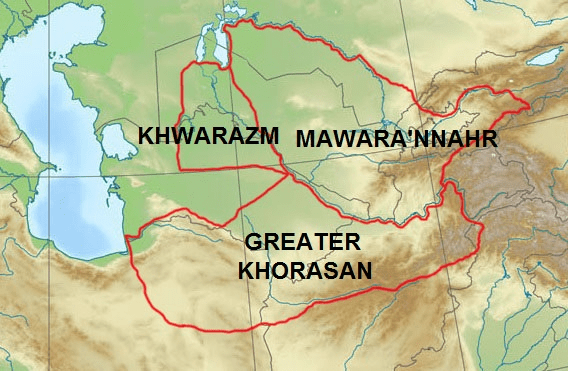
(1) A map illustrating the historic Iranian regions of Māwara’nnahr (Transoxiana), Khwārazm (Chorasmia) and Greater Khorāsān overlying modern political borders (2) Map of Khwārazm and its important settlements during the early Islamic period (3) Location of the main fortresses of the Chorasmian oasis during the Sassanian period, 4th century BC-6th century AD (4) Fortress of Kyzyl-Kala (c. 1st-4th century AD; restored), one of the many fortresses constructed when the region was inhabited by the Iranian Chorasmian people

Throughout antiquity, the fate of the Khwarezmians rested upon the unpredictable currents of the fierce Oxus river (Āmu Daryā). A large oasis region nestled in a fertile river delta where the Oxus meets the historic Aral Sea, Khwarezm’s urban settlements relied on a complex system of man-made canals and irrigation networks for agricultural growth. Its name is most likely a reference to being the lowest region in Central Asia: kh(w)ar ‘low’ and zam ‘land’. But Khwarezm owed both its glory and demise to the Oxus; due to the nearly flat plain, its cities were frequently flooded when the river changed course. This was particularly felt in the early capital city of Kāth on the right bank of the river, which at its zenith in the 10th century CE apparently rivaled the cities of the Iranian plateau. According to Biruni, who eye-witnessed the flooding of his hometown Fir, a suburb (birūn) of Kāth, before his emigration at the age of twenty-five (in 998 CE), Fir “was broken and shattered by the Oxus, and was swept away piece by piece every year, till the last remains of it had disappeared” in the year 1305 of the Seleucid era (994 CE) (Biruni, Āṯār, tr., p. 41).

During the reign of Shapur I, the Sassanian Persian Empire extended its territorial boundaries to encompass Khwarezm. Historical sources, such as Yāqūt al-Ḥamawī, confirm Khwarezm’s status as a regional capital of the Sassanid empire, with references to the pre-Islamic “Khosrau of Khwarezm” (خسرو خوارزم), Islamic “Amir of Khwarezm” (امیر خوارزم), and the Khwarezmid Empire. These sources explicitly indicate that Khwarezm was a part of the Iranian (Persian) empire, and the conquest of significant areas of Khwarezm during the reign of Khosrow II further supports this assertion. Moreover, Al-Biruni and Ibn Khordādbeh, among other sources, attest to the use of Pahlavi script, which was employed by the Persian bureaucracy in conjunction with the local Chorasmian alphabet around the 2nd century AD.
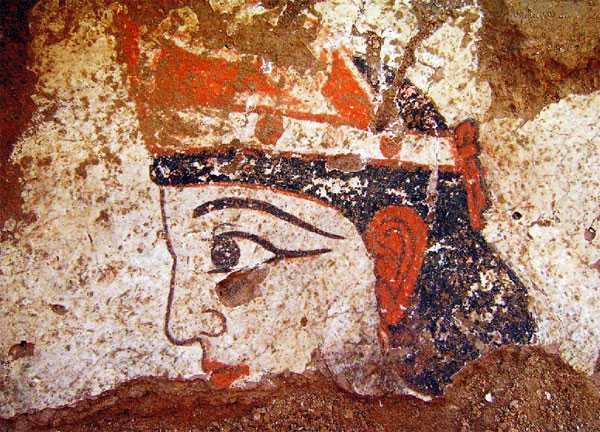
(1) Khwarezmian frescoes from Kazakly-Yatkan fortress (1st century BC-2nd century AD), modern Republic of Karakalpakstan, Uzbekistan. Ancient Iranians in Central Asia made frequent use of cosmetics, as depicted in the figure’s full red ears and lips, thick eyebrows and eyeliner (2) Ruins of the massive Chilpyk Zoroastrian Tower of Silence (daḵma) from the 1st century B.C.- 1st century A.D, Republic of Karakalpakstan, Uzbekistan (3) The native Iranian Chorasmian (Khwarezmian) language was likely spoken at least until the Mongol conquest in 13th century A.D., after which it was definitively supplanted by Persianized Turkic dialects and Persian. The language first employed a script derived from Pahlavi and after Islam, a modified Perso-Arabic script. Both scripts read: zβāk āy xwārazm “Khwarezmian language”

The arrival of Islam in the 8th century A.D. delivered a catastrophic blow to the Iranian Chorasmian language, identity and the native Zoroastrian religion in the oasis. According to al-Biruni, the Arabs systematically annihilated the strongholds of the religion, punished those who retained competency in their language and culture, engaged in massive-scale book burning and massacred the region’s scholars and literati. Speaking to the fate of Khwarezm after the Arab conquest, al-Biruni lamented:

When Qutayba ibn Muslim under the command of Al-Ḥajjāj ibn Yūsuf was sent to Khwarazmia with a military expedition and conquered it for the second time, he swiftly killed whoever wrote in the Khwarazmian native language and knew of the Khwarazmian heritage, history, and culture. He then killed all their Zoroastrian priests and burned and wasted their books, until gradually the illiterate only remained, who knew nothing of writing, and hence the region’s history was mostly forgotten.

Khwarezm became increasingly Turkicized in the centuries after Islam, particularly after 1044, when it came under the Seljuqs (Tolstow, pp. 290-­92). At the same time, however, Persian language was asserting itself in the same area (Spuler, 1966, p. 171), although the indigenous (Middle) Iranian languages Sogdian and Chorasmian were also still spoken (Henning, “Mitteliranisch,” pp. 56-58, 84). With the fall of indigenous Iranian dynasties including the Afrighid and Ma’munid lines, the title of Khwarezmshah was assumed by the Turks, but court life and high culture was conducted in Persian, as confirmed by existing chancery documents authored by a reputable Persian poet Rashid al-din Vatvat who lived at the court in Gurganj. Additionally, the fact that Khwarezmshahs such as ʿAlā al-Dīn Tekish (1172–1200) issued all of their administrative and public orders in Persian further corroborates Al-Biruni’s claims of the status of Persian in the oasis. It appears that the autochthonous Iranian Chorasmian language was still in use in the 13th century A.D., but it disappears from the record following the Mongol invasion of the region. In contrast to the valleys and major oases in Transoxiana such as Bukhara and Samarqand which retained Persian as the dominant language, a deeply Persianized Turkic (Chaghatai) emerged as the dominant language in Khwarezm, while Persian was used as a language of literature, poetry and administration.

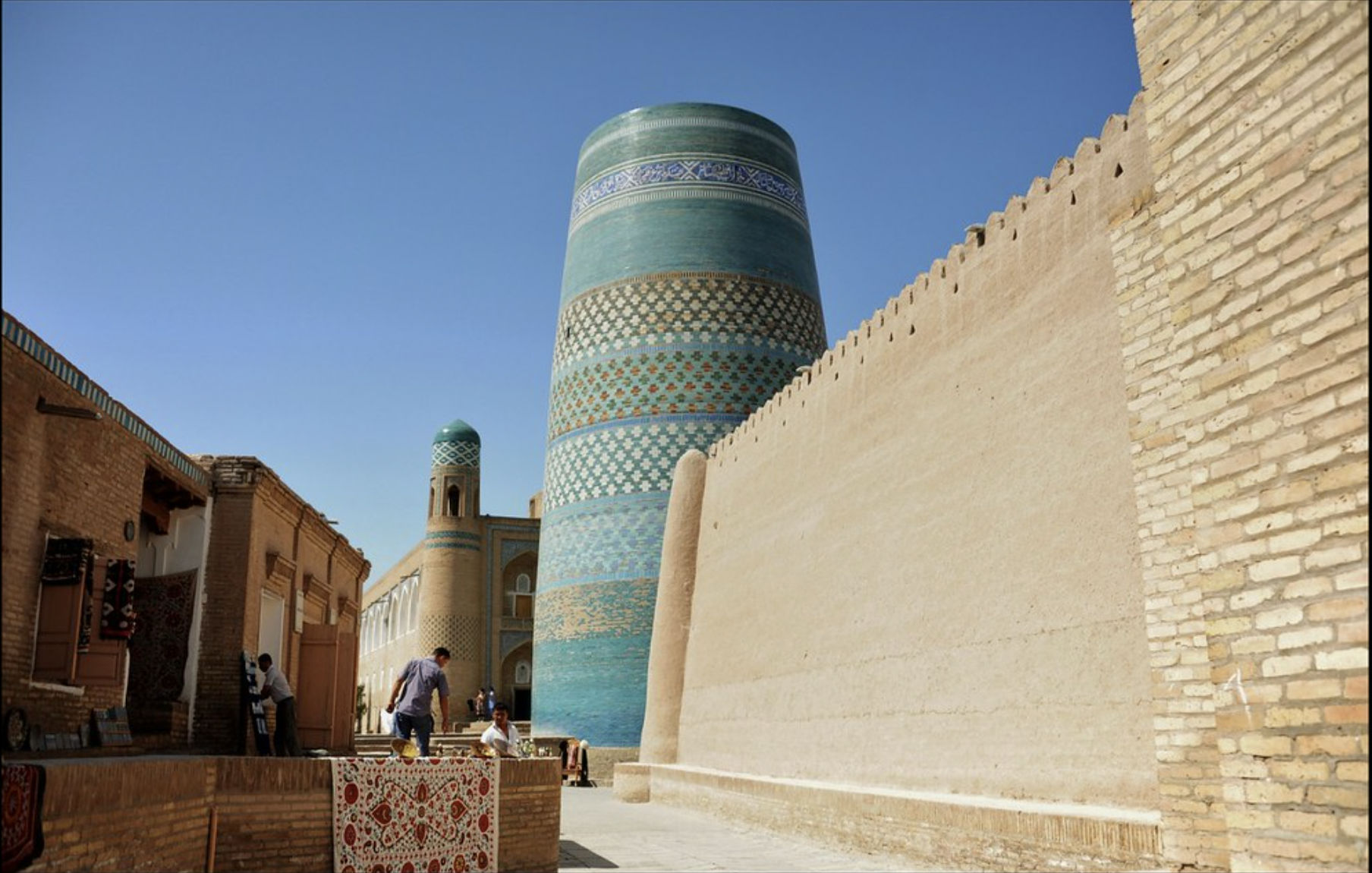
A band of glazed azure majollica tiles with an inscription in Persian in nastaʿlīq script adorns the top of the unfinished Kalta Minor, Khiva, Uzbekistan (c. 1851 AD). The minaret and the madrasa that adjoins it were commissioned by the Uzbek Qongrat ruler, Muhammad Amin Khān, who originally planned to build the highest minaret in the world. The poem reads in Persian:

منار عالی فرخنده بنیاد که مانندش ندیده چشم افلاک
Menār-e āli-ye farḵonde bonyād ke mānandash nadide chashm-e aflāk
عمارت شد بامر شاه عالم ز جمله عیبها و نقص ها پاک
Emārat shod be amr-e Shāh-e ‘ālam, ze jomle ‘aybhā va naqṣhā pāk
بچشم عقل در وقت نمودش شده سرو سهی مانند خاشاک   
Be chashm-e ‘aql dar vaqt-e nemudash shode sarv-e sahi mānand-e ḵāshāk
چو از طوبی آمد دلگشاتر به جنت کرد نادرش عرضه خاک
Cho az ṭubā āmad delgoshātar be jannat kard nāderash ‘arze-ye ḵāk
رسیده چون ستون بر كاخ گردون ز وصفش قاصر آمد عقل و ادراک
Raside chun sotūn bar kāḵ-e gardūn, ze vafash qāṣer āmad ‘aql-o-edrāk
از این در آگهی سال بنایش رقم کرده ستون خاک افلاک
Az in dar āgahi-ye sāl-e banāyash raqam karde sotūn-e ḵāk-e aflāk

Chingis Khan’s conquest of the Khwarezmid empire dealt a fatal blow to the region from which it would never fully recover its former eminence. Its cities, including the imperial capital of Gurganj, were systematically flooded by destruction of the region’s ancient dams, and the majority of Khwarezm’s population was executed by the Mongol horde. Several thousand craftsmen and soldiers who escaped the sword were deported to the China, where they established a thriving diaspora community that persists in present times (for further reading about China’s Hui community, see here). The decimation of the ancient Iranian population of Khwarezm created a vacuum that occasioned the gradual influx of nomadic Turko-Mongol peoples, some of whom maintained their nomadic lifestyle over the centuries, while others came to settle in newly constructed urban centers where they adopted Persian culture. Khwarezm was originally assigned to the Chaghatayid dominion and later–following devastations by the Golden Horde and Timurids– came under the control of a local Jochid-line clan ‘Arabshāhids. Reflecting on the Mongol invasion, the Persian poet Anvari writes:

آخر ای خاک خراسان داد یزدانت نجات
Āḵar ey ḵāk-e Ḵorāsān dād yazdānat nejāt

“Oh land of Khorāsān! God hath saved you,

از بلای غیرت خاک ره گرگانج و کات
Az balā-ye eirat-e ḵāk-e rah-e Gurganj o Kāt

from the disaster that befell the land of Gurganj and Kāth [Khwarezm]”

Divān of Anvari

(1) The inner shell of the dome covering the hexagonal main hall of the Turabek Khānum Mausoleum. The surface is covered in colorful Persian mosaics depicting ornamental patterns of flowers and stars; a visual metaphor for the heavens (2) The partially-restored mausoleum of Turabek Khānum, wife of Qultugh-Temür (ruled between 1321 and 1336). The capital of the Khwarazmshahid dominion, Gurganj (modern Urgench, Turmenistan) was destroyed and its entire population annihilated at the hands of Genghis Khan

Following the demise of the ‘Arabshāhids, various khans were brought from the steppes to Khiva where they held the reins of power, usually as puppets, while the actual authority was wielded by the inaq, or military chief, of the Mongol Qongrat clan. In the 18th century A.D., nomadic Karakalpaks–a Kipchak people closely related to Kazakhs–settled in the lower reaches of the Āmu Daryā and its delta with the Aral Sea, dotted with the ruins of innumerable fortresses, settlements, and Zoroastrian buildings of ancient Khwarezm, while the upper shores of the river and its watershed have been inhabited by Persianized, mixed Oghuz-Karluk-speaking peoples through modern times. The region came under the control of imperial Russia, and the Soviet era saw the creation of the short-lived People’s Republic of Khorezm (Khorezm SSR; Хорезмская Народная Советская Республика Khorezmskaya Narodnaya Sovetskaya Respublika) before it was incorporated into the Uzbek SSR and thence, Uzbekistan.

There appears to be little, if any, Iranian Chorasmian substrate in modern Khorezmian Turkic. A few terms relating to irrigation (arna “large canal” and yab “small canal”), which survived only at Ḵīva and among the Turkmen are supposed by Barthold (1956, p. 15) to be of Chorasmian origin. By coincidence, Iranian Chorasmian had the dental fricatives [ð] and [θ], a unique feature which it shares with the language that at least partially supplanted it, Turkmen. The largest influence on Khorezmian Turkic is Persian (discussed below), and more recently, Russian.

Khorezmian-Uzbek singer Ulug’bek Sobirov performs a song, “Janim” (“my soul”, from Persian), in the Khorezmian Uzbek language:

-Jan al uch erkalik ba süziŋde, yuz miŋ ma’na karashiŋde, güziŋde
“There are three heart-robbing tricks in your words, there are a hundred-thousand hidden meanings in your glance, in your eye”
-Janim, mani janim sani ichiŋde, kachan-g’acha öldurasan iziŋde
“My soul, my soul is within you, until when will you kill all those who cross your path?
-San küŋlim bag’ini rahyan güli, qalbim nazirasi javahir duri
“You are a basil flower in the garden of my soul, you are a pearl worthy of my whole heart”
-Kimlar man dab aysta– aytaversinlar, sani mandin sevolmiydi hich biri
“Whoever tries to woe you like me, let them woe! None of them can ever love you more than me”


Khorezmian-Uzbek singer Feruza Jumaniyozova performs contemporary iteration of a traditional Khorezmian song, “Man bandang bo’lin” (“May I become thy serf”):

Aksham düshümde, bir gül-i ranoni güribman
“In my dreams at night, I am holding a beautiful flower”
-Shul gül-i rano bilen bog’da yuribman
“Holding that beautiful flower, I am standing in a garden”
-Ul bog’ ichinde sorı, kızıl güller tiribmen
“In this garden, I am picking yellow and red flowers”
-Shuni yollara harna bela gelsa turibmon
“If any manner of calamity should cross his path, I shall stand my ground”
-Man bandaŋ bo’lin, ko’lıŋ bo’lin, yor, soŋo banda!
“May I become thy serf, may I be thy slave; a slave to thee, my beloved!”
-Sodog’oŋ bo’lin, sariŋa dünin, ö’rtama shuda. Kıynama beda!
“May I be thy sacrifice, may I rotate about thy head; do not interfere in this!”

Khorezmian Turkic as a mixed Oghuz-Karluk language

The main dialect is spoken in Khiva-Urgench and appears to be a mixed language, consisting of an Oghuz core with a strong admixture of Karluk elements. This language appears to descend from an ancestor close to that of the Chaghatai language. In morphology, some Karluk elements have supplanted the Oghuz elements, while in phonology and lexicon KT can in some respects be seen as closer to Oghuz than to Karluk. There is a Kipchak language spoken in Khwarezm, but it does not seem to have influenced the prestige language in Khiva-Urgench to an appreciable degree.

The largest foreign influence on Khorezmian Turkic has been Persian, a fact that is frequently underestimated when speakers compare the “Turkness” of KT to Standard Uzbek (adabiy til, lit. “literary language”) or Sarti Uzbek dialects, which by comparison are viewed as heavily Persianized. There is some truth to the idea inasmuch as KT has retained Turkic phonological features such as vowel harmony while Persian influence eradicated them from Uzbek. However, Khorezmian Turkic also contains hundreds of Persian words used in daily life, some of which do not exist in Uzbek. Like all Islamized Turkic languages among which Chaghatai, Uyghur, Azeri, Ottoman Turkish and Tatar may be enumerated, both Uzbek and Khorezmian Turkic rely heavily on Persian lexicon and formulas (calques, subordinate clauses, relative clauses) in the literary register.

A selection of distinguishing phonological, morphological and lexical features of Khorezmian is discussed below.

Phonology:

The most striking feature of KT’s phonology is the presence of vowel harmony, whereas Karluk in Transoxiana (Sarti Uzbek) lost vowel harmony under the influence of Persian (Tajik). KT has expected phonological correspondences for an Oghuz language: /d/ for Uzbek /t/ ; /g/ for uzbek /k/, i.e: Uzbek til — KT dil “language, tongue”; Uzbek tish — KT dish “tooth”; Uzbek kel —KT  gal “come”; Uzbek kerak — KT garak “need”.

Khorezmian, unlike Uzbek, retains vowel harmonized modifications to the personal pronouns: i.e. KT män, maŋa “I, to me” and sän, saŋa “you, to you” for Uzbek men, menga and sen, senga, respectively. This feature is shared with Oghuz, where the presence of -g- reflects early Oghuz dative forms prior to being lost it in modern Azeri mana and Turkish bana.

TurkishKhorezmian TurkicUzbekEnglish
Yanıma gelib sırrını söyleYanıma gelib sırıŋnı sölleYonimga kelib siringni aytCome to me and tell me your secret
-Adınız ne?
-Sana söyleceğim
-Adıŋız ne?
-Saŋa sölejekmen
-Ismingiz nima?
-Senga aytaman
-What is your name?-I will tell you (later)

Like Oghuz but in contrast to Karluk, KT has an aversion for the voiceless uvular plosive /q/ which is instead approximated as the voiceless velar plosive /k/. In higher registers, /q/ is sometimes realized in an attempt to emulate Standard Uzbek phonology. When followed by rounded /a/, /q/ becomes /g’/.

TurkishKhorezmian TurkicUzbekEnglish
Kapkara kaşına bak, efendimKap-kara kashına bak, og’ojonQop-qora qoshiga boq, akajonLook at her darkest black eyebrows, mister
Akkan suAkkan suwOqqan suvRunning water

/X/ is usually realized as /h/, like in nearby Turkmen and western varieties of Anatolian Turkish. Frequently speakers pronounce /v/ as /w/. Additionally, the Uzbek ablative suffix -dan “from”  is vowel harmonized -nan/-nen in KT:

Khorezmian TurkicUzbekEnglish
Harezmıŋ hanları hiwanan kachdılaXorazmning xonlari xivadan qochdilar“The Khans of Khwarezm fled Khiva”

Morphology:

Speakers of KT are frequently socially conscious of linkages between Khorezmian Turkic and Oghuz Turkic languages, particularly Anatolian Turkish. Khorezmian is confederate with Oghuz in use of -n- in third person genitive constructions while Uzbek lacks it. Indeed, it is possible to construct phrases which reveal the affinity of Khorezmian to Anatolian Turkish:

TurkishKhorezmian TurkicUzbekEnglish
Gözlerinde büyü var, elinde bal varGüzlerinde efsun ba, elinde bal baKo’zlarida afsun bor, qo’lida asal borThere is sorcery in his/her eyes, there is honey in his/her hands
çiçeklerin içindechicheklerıŋ ichinda gullarning ichidainside the flowers

Contrarily, verb endings and morphological paradigms in KT are definitively Karluk in character, with only literary use of the Oghuz styles such as -mish:

TurkishKhorezmian TurkicUzbekEnglish
Yediğim yemekYegen yemegimYegan ovqatimThe food I have eaten
Yaprağlar çok güzelmişYaprag’la dım xushro’y ekenBarglar juda chiroyli ekanThe leaves are very beautiful

Khorezmian Turkic and Standard Uzbek have variably inherited morphological features that existed in Chaghatai. For example, Khorezmian more frequently uses the focal present marker -yotir- while Uzbek favors -yap-. Of note, -yatir was consciously introduced into Uzbek in the 1920s, but its use remains confined to the literary register

Khorezmian TurkicUzbekEnglish
Og’o galyotıAka kelyapti“The man is coming”

KT makes more use of definitive future -ajak/ejek which it shares with Oghuz Turkic, while Uzbek uses the present-future -a(y)-, presumptive future -ar and intentional -moqchi with higher frequency to indicate actions in the future

Khorezmian TurkicUzbekEnglish
Opojon galajakmı?
Hawa, galajak
Onajon keladimi?
Ha, keladi
-“Will mother come?”
-“Yes, she will come”
Et satajakmanGo’sht sotmoqchiman“I want to/will sell meat”

KT has the optative singular ending –in for Uzbek -ay/-ayin and the vowel harmonized optative plural –eli/alı for invariable Uzbek –aylik 

Khorezmian Turkic UzbekEnglish
Bu aksham degirmana baralı, chürek yapalıBu oqshom tegirmonga boraylik, non yapaylik“Let’s go to the mill at tonight, let’s make bread”
Kara güzinnen aynanin Qora ko’zidan aylanay “I’ll ritually circulate around her black eyes to ward off harm from them” (aylanmoq is calqued from the Persian دور گشتن, گرد گشتن)
Nich etinNima qilay“What should I do?”

Like Oghuz, origin is expressed with -li/lı instead of Uzbek and Uyghur (Karluk) -lik, –liq respectively.

Khorezmian TurkicUzbekEnglish
Hiwakizla bashkachaXivalik qizlar boshqacha“Girls from Khiva are wonderful”

Vocabulary:

In general Khorezmian Turkic lexicon is close to Karluk Uzbek, but contains three classes of distinct vocabulary from it: (1) Oghuz words (2) Native words of unclear origin, and (3) Persian words (including Persianized Arabic) which are present in one language but not the other.

Some examples of Khorezmian vocabulary and comparison with Uzbek are listed here: el “hand” (Uz. qol) , bol “honey” (Uz. asal) , et “meat” (Uz. gosht), ne, novvi “what” (Uz. nima), nerda “where” (Uz. qayerda), nichik (Uz. qanaqa/qanday), eshik “door” (Uz. qopi), chechak “flower” (Uz. gul), yapraq “leaf” (Uz. barg), ad “name” (Uz. ism), salma “burn” (Uz. soy), taka “pillow” (Uz. yostiq), karvuch “brick” (Uz. g’isht), etmek “to do” (Uz. qilmoq), söllemek “to say” (Uz. aytmoq), dali “crazy” (Uz. devona), pitta “a little” (Uz. biroz), kadi “gourd” (Uz. qovoq), ina’ “here it is; right here; voila” (Uz. mana), mazali “beautiful” (Uz. go’zal), dim “very, a lot” (Uz. juda), xushro’y “beautiful” (Uz. chiroyli), zangi “ladder” (Uz. narvon), yimirta “egg” (Uz. tuxum), brinj “rice” (Uz. guruch).

Khorezmian-Uzbek artist Murod Qilichev performs “Qiliqlari”, a song in the Khorezmian Uzbek language:

-Kılıkları kurmag’ay, sho’xlıkları durmag’ay
“Don’t do these delightful behaviors, don’t let your naughtiness stop”
-Wakh shu kiznı azabları hichkima buyurmag’ay
“Oh goodness, do not direct this woman’s wrath at anyone else”
-Koymin sıra sho’xlıkıŋ, bılmin özda yoklıkıŋ
“May I never stop your contentment, may I never know your absence”
-Shu kiz bilen ekansin, yanib turg’an otlıkıŋ
“When you’re with this girl, your embers burst into flames”
The Persian Vernacular of Samarkand and Bukhara: A Primer

Written by Afsheen Sharifzadeh, a graduate of Tufts University focusing on Iran and the Caucasus. The goal of this article is to introduce the reader to the history, language and culture of the autochthonous Tajik Persian-speaking population of Uzbekistan.

day 3 uzbekistan bukhara miriarab st
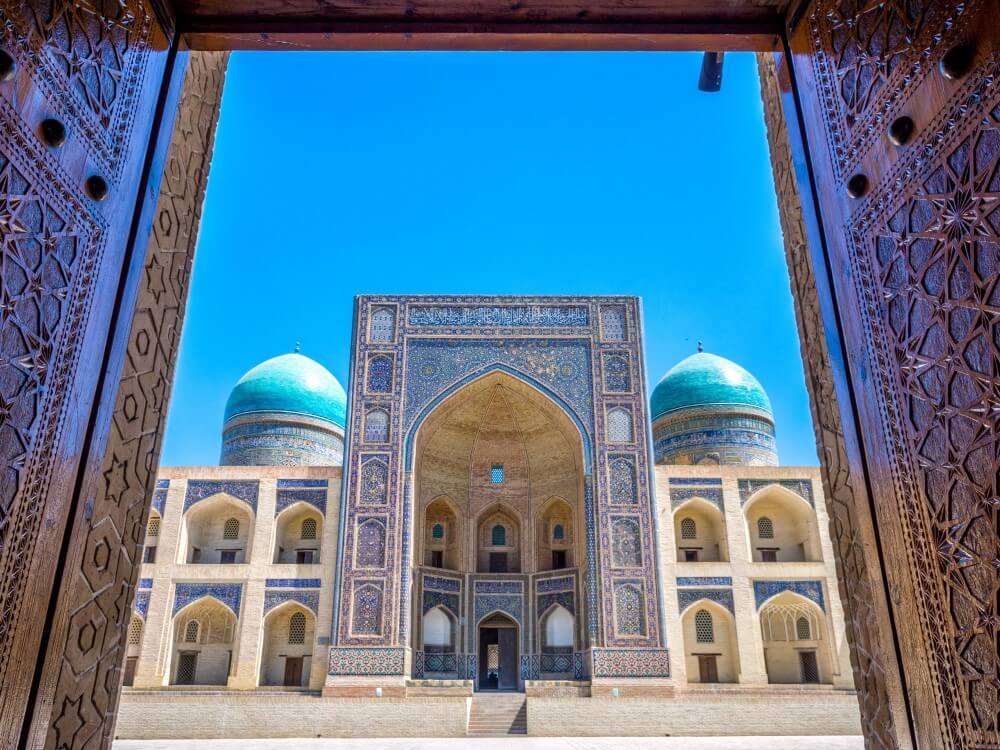
The anterior façade of Madrasa-i Mīr-i ‘Arab (c. 1535 A.D.) from the vantage point of the portal to Masjid-i Kalon, together part of the Po-i Kalon complex; Bukhara, Uzbekistan.

اگر آن ترک شيرازى بدست آرد دل ما را، به خال هندويش بخشم سمرقند و بخارارا
“If only that Shirâzian maiden would deign to take my heart within her hand,
I’ll donate Samarkand and Bukhara, for her Hindu beauty mole”
-Ḥāfeẓ-e Shīrāzī, Ghazaliāt

Background
Northern Tajik, a dialect of Persian, is the mother tongue of the majority of people born in the Samarqand and Bukhara oases located in the modern-day Republic of Uzbekistan. Multiple experts, international commentators, as well as Tajiks within and outside of the republic suggest that there may be between nine and ten million Tajiks in Uzbekistan, constituting 30% of the republic’s 33 million population, rather than the government’s official figure of 5%. Mainstream English sources, however, are mute on this matter.

Astonishingly, until quite recently many reputed web-based sources and encyclopedias erroneously reported that Persian had functionally vanished from those oases several centuries ago–the equivalent of disseminating the idea that Catalan and its dialects have not been spoken along the eastern shoreline of the Iberian Peninsula since the reign of House of Aragón. On the contrary, Bahodir, a local 52-year-old Uzbek man from Hokimullomir who learned to speak in Tajik in Bukhara, reports:

In Bukhara you have to speak Tajik. If you want anything to be done, it is far better. Everything gets done quicker if you speak Tajik with them. Like I told you, we lived in Bukhara for many years. Back then, at home, we spoke Uzbek, but outside we spoke Tajik. ( Peter Finke, “Variations on Uzbek Identity”. Pg 82)

Another informant, manager at a popular Samarqandian restaurant in Brooklyn, NY, told this author (translated from Persian):

Samarqand and Bukhara are Tajik-speaking cities. The majority of Uzbeks in New York City hail from Samarqand and Bukhara, and have been labeled as “Uzbeks” in our nationality, but we are in fact Tajiks.

The reasons for this perplexing discrepancy are manifold. On the one hand, official census statistics released by the Uzbek government reflect the continuation of a well-documented Soviet-era effort to trivialize the Tajik population of Central Asia. Indeed, it is hard to deny that there is some truth in this, in light of the rather arbitrary territories assigned respectively to Uzbekistan and Tajikistan S.S.R.’s in the 1920s. Those assigned to the latter were primarily mountainous hinterlands; sparsely inhabited by speakers of various Eastern Iranian languages rather than Persian dialects. Fueled by fears of the more sedentary and more literate Tajik population posing potential resistance to Soviet rule, as well as the possible geopolitical linkage with Iran, in 1929 the areas of modern-day Tajikistan were split off to form the Tajik SSR, but the Uzbek SSR retained the traditionally Tajik-speaking regions of Samarkand, Bukhara, and parts of the Ferghana Valley. In order to make the borders look plausible, authorities forced the majority of Persian speakers in cities such as Bukhara and Samarkand to register as Uzbeks (Allworth 1990; Subtelny 1994). Many Tajik intellectuals continue to assert that the cities of Bukhara and Samarkand, which were (and are) predominantly Tajik-speaking, should have been assigned to Tajikistan (Atkin 1994; Foltz 1996). Of note, in 2009, Tajik President Emomali Rahmon reportedly told journalists that he had threatened Uzbek President Islam Karimov that he would “take Samarkand and Bukhara back.”

Second, and closely connected with the ideas about ethnogensis, is the fate of the concept of Uzbekness during the period of national delimitation. The process of creating the Uzbek natsional’nost’ (националъностъ “nationality”) in early Soviet times has been regarded as the most artificial in the region and as a deliberate act on the part of the authorities with little justification in pre-existing patterns of identity (although the name “Uzbek” had existed before to refer to the 16th century Qipchaq-speaking tribal confederation led by Shaybani Khan, it had been used for self-designation by only a fraction of the ancestors of the present day population, who instead used terms such as “Turki” and “Sart”, yet more commonly identified with their city rather than language).

On the other hand, in most contexts Tajik-speakers in Uzbekistan prefer not to differentiate themselves from the so-called Uzbeks, and consequently lump themselves together with them as a distinct entity from the citizens of neighboring Tajikistan who are– secondary to decades of strained relations and economic instability–the subject of negative public opinion. As nearly all Tajik-speakers in Uzbekistan are functionally bilingual in both Tajik Persian and Uzbek, identification with the titular nationality affords Tajik-speaking citizens social prestige and heightened prospects for social and economic mobility. Cases where brothers ended up with different ethnicities have been reported for Bukhara in particular (Naby 1993). Despite their decided indifference in matters of national identity, the Tajik-speakers of Uzbekistan continue to safeguard their distinct language which is often referred to colloquially as Forscha (“Persian”), Tojikcha (“Tajik”), Bukhorocha and Samarqandcha, and several informants recall the scorn of their elders imploring them as children to “not speak Turki.” As such, Northern Tajik will likely survive in Uzbekistan, however with governmental pressure its domain of use is becoming increasingly restricted to the domestic sphere. Of note there are, however, a minority of Tajiks in Uzbekistan who identify foremost as Tajiks and are active in local spheres of television broadcast, music, and other cultural activities.

Samarqand-based television program “Shomi Samarqand” is one of several regional programs that are broadcasted in the Tajik-Persian language within Uzbekistan

By law, Uzbek is Uzbekistan’s exclusive nation-wide state language. Government policy requires the use of Uzbek in all dealings with officials, in street signage, and in business and education. Russian is still spoken widely and boasts widespread prestige, however, and as in other post-Soviet states enjoys ambiguous legal status as “the language of interethnic communication.”

Paradoxically, in the autonomous Republic of Karakalpakstan (Qoraqalpogʻiston Respublikasi) located in ancient Khwarezm, Karakalpak (a Kipchak Turkic language closely related to Kazakh, brought by nomadic migrants to that region in the 18th century) enjoys official status alongside Uzbek, even though numerically there are estimated to be at least twelve times as many Tajiks as there are Karakalpaks within Uzbekistan.

Bukhara Oasis
In linguistic and ethnic terms, the city of Bukhara is still renowned for its Tajikness, and outside the region sometimes everyone originating from there is depicted as Tajik. Foltz believes 90 percent of the population of Bukhara city to be Tajiks (1996:213). According to Finke, the ubiquity of Tajik is obvious to the most casual observer. Even in social situations among strangers, such as on buses or talking on the phone, Tajik is spoken. Many Uzbeks report learning or improving their Tajik after moving to town.  In addition, in contrast to many official reports, Tajik is also spoken in many of the rural areas, particularly in the north and west of the Bukhara oasis. It may also be worth noting that Bukharan Tajik enjoys some prestige in Bukhara province as the language of city dwellers. Not surprisingly, the oft-quoted aphorism associated with the city is a Tajik-language quote originating with the Naqshbandi Sufi order which was founded in Bukhara: “Дил ба ёр у даст ба кор” dil ba yor u dast ba kor “One should devote their heart to God and their hands to the production of crafts.”

Khorezmian-Uzbek pop artist Feruza Jumaniyozova performs a folk medley in the local Bukharian Tajik language in Bukhara. Many Uzbek national singers perform songs in Tajik Persian which they devote to their fans in Samarqand and Bukhara regions

Virtually every Bukharan Tajik speaker is bilingual in Tajik Persian and Uzbek, the heavily Persianized Turkic language with which Tajik has been in intensive contact for centuries. Within Bukhara, the Uzbek language is spoken with a decidedly Tajik character (i.e. pronunciation of man, san instead of standard men, sen for the 1st and 2nd person singular pronouns; preferences for Persian-style subordinate clauses using the Persian article ki ). Language mixing, i.e. code switching and code mixing, takes place even in households where every member is a native speaker of Bukharan Tajik. However, Tajik–Uzbek bilingualism is not limited to those who have Bukharan Tajik as their first language – native Uzbek speakers who grow up in the city of Bukhara usually acquire some command of Bukharan Tajik, which they utilize either passively or actively. Among Uzbeks, Tajik (Persian) is often idealized as shirin or “sweet”, and proficiency in Tajik language, music and literature remains, much like centuries in the past, a desirable skill.

The autochthonous people of the Bukhara oasis are Tajik-speaking, including the once sizable Jewish community that still boasts several hundred souls within the city today. Despite popularization of Bukhoric as a distinctively “Jewish language” by migrants to the West, there exist few if any tangible differences between the Tajik vernacular of the Jews and Muslims in Uzbekistan, save terminology for Jewish religious concepts and rites which are borrowed from Hebrew and Aramaic. The language of Bukharian Jews therefore does not constitute a true sociolect, and is better understood simply as Northern Tajik.

Performance of “Mavrigi” in Bukhara, part of the local musical traditions of Bukhara and designated by UNESCO as part of the “Intangible Cultural Heritage of Uzbekistan.” Mavrigi is a cycle of local  Bukharian folk songs in couplet form in the Tajik Persian language, alternating between the songful-lyrical and improvisatory-recitative nature, often with doira accompaniment
Interview with local Bukharian musician Nishon Otamurodov, broadcasted locally on “Payomi Ruz” program on Bukhara TV, Uzbekistan

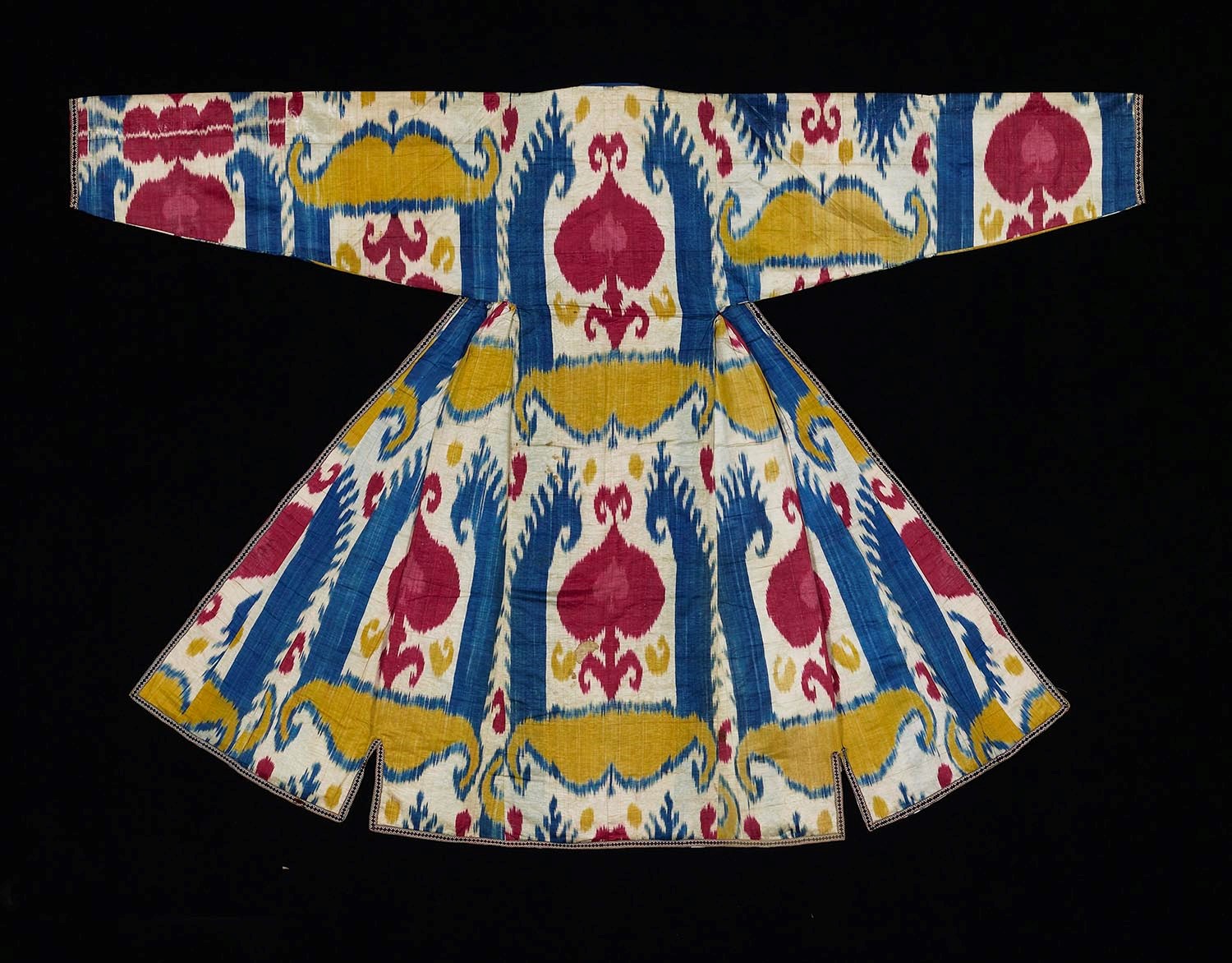
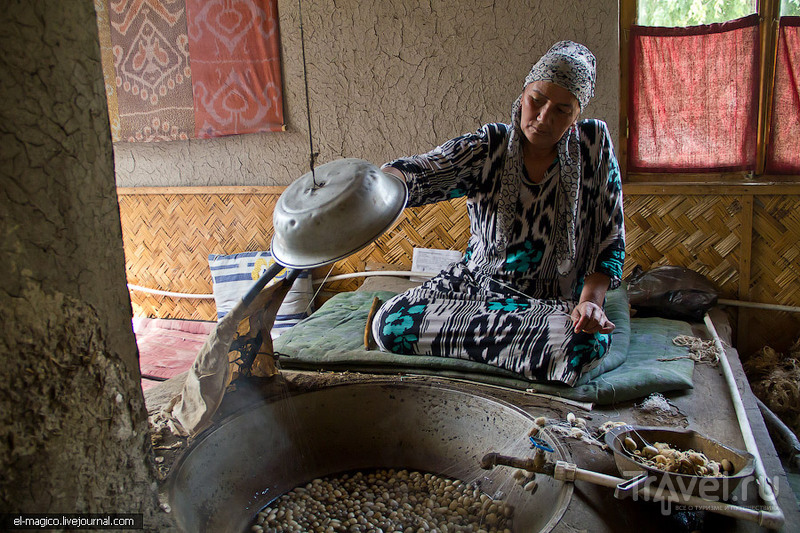
The city of Bukhara is renowned as a historic center of silk and cotton textile production (atlas and adras), a craft that has its origin in the material culture of the autochthonous Tajik population. Known in the West as “ikat”, abrabandi is the art of resist-dyed warped silk, rendering bold, abstract motifs that is often used in garments and upholstery. In abrabandi (literally “binding of clouds” in Persian, referring to the fuzzy appearance of the patterns), the master pattern of the atlas textile is determined by the nishonzan (“one who sets the marks” in Persian), and the silkworms cocoons are carefully processed in the pillakashkhona (Persian for “workshop where cocoon is pulled”). Following the charcoal marks of nishonzan, the abraband (“binder of clouds”) carefully prepares the warps for the next skillful master, the rangrēz, or “dyer.” In Bukhara, the blue and indigo rangrēz were traditionally Jews. The warps are then carefully placed on a wooden loom and hand-woven into a finished textile. Evidently, despite becoming popularized throughout the country and the world as a quintessentially “Uzbek” craft, this complex art and its technical terminology has its roots in the indigenous Tajik-speaking Muslim and Jewish urban population of Transoxiana rather than the more recent Turkic migrants.

002_2713088_original3img_0141
Abrabandi, or “binding of clouds” in Persian, is a magnificent resist-dyed silk textile produced in Bukhara. 

ikat 2005.36.118
A traditional abrabandi kaftan from Bukhara, early 20th century. 

04653v
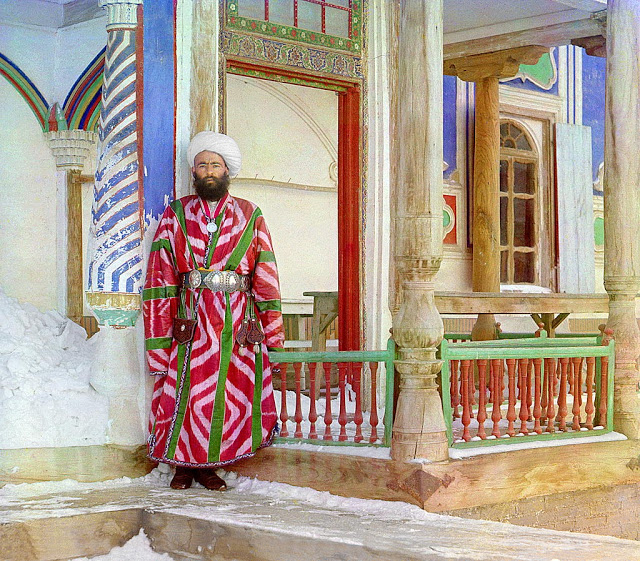
“Bukharan Bureaucrat” (c. 1905) by the Russian photographer Sergei Mikhailovich Prokudin-Gorskii, who used a special color photography process to create a visual record of the Russian Empire in the early 20th century. The bureaucrat is pictured vested in a splendid abrabandi kaftan of local production.

Samarqand Oasis
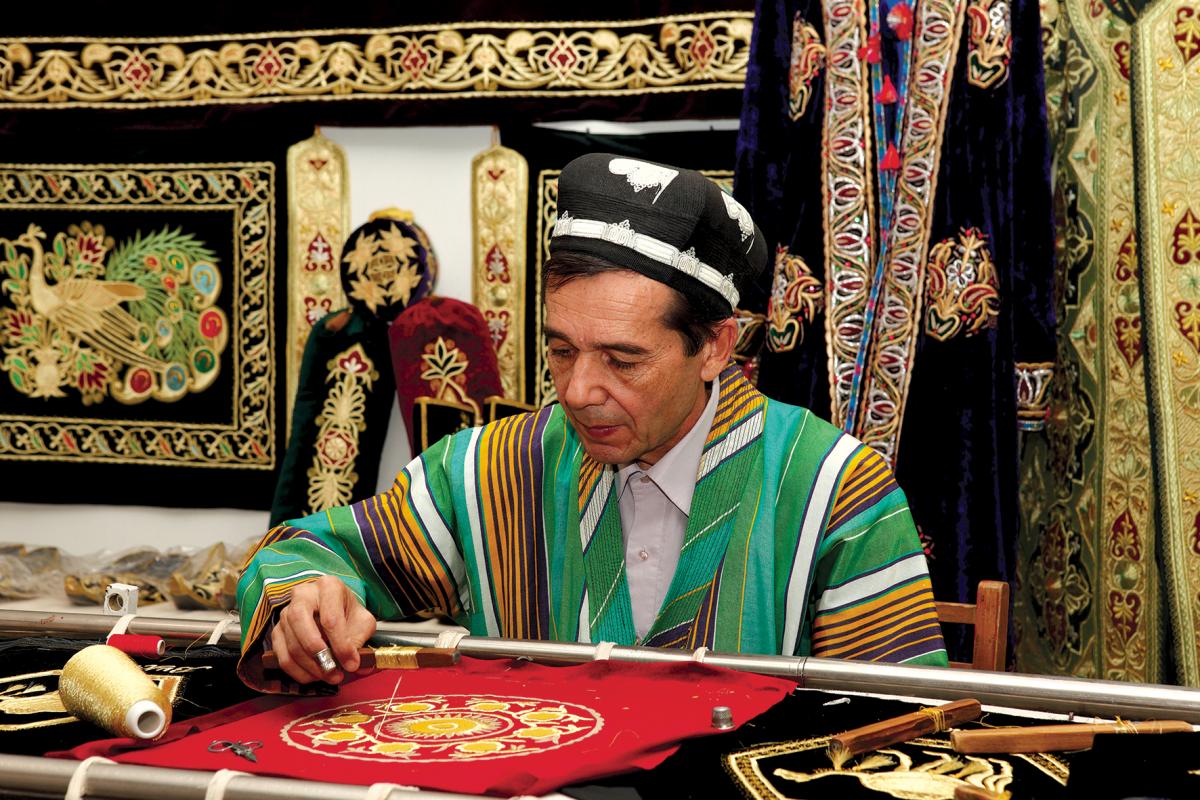
The prominence of Tajik in Samarqand, located just 30 kilometers from the border of the neighboring post-Soviet Republic of Tajikistan, is not dissimilar to the situation in Bukhara. According to Richard Foltz, Tajiks account for perhaps 70 percent of the population of Samarqand. Much like in Bukhara, Northern Tajik (Persian) is the primary vernacular heard in the streets, markets, and domestic sphere, and the city is home to many renowned local Tajik-language singers such as Daler Xonzoda, Sherzod Uzoqov, Rohila Olmasova, Ruslan Raxmonov, and Baxtiyor Mavlonov, among others. Local crafts for which Samarkand is famed, such as the Samarqand style of zarduzi or golden-thread embroidery, take their technical terminology from Tajik Persian. As a famous epithet uttered by locals goes,

Tajik Persian: Самарқанд сайқали рўйи замин аст, Бухоро қуввати ислом дин аст
Persian (Iran): سمرقند صیقل روی زمین است، بخارا قوت اسلام و دین است
English: “Samarkand is the gem of the earth, Bukhara is the powerhouse of faith”

There exist a number of local radio and television broadcasts in Tajik Persian, such as the Shomi Samarqand television program which covers local festivals, arts, crafts and other civil activities. The local Tajik Persian newspaper Ovozi Samarkand (“Voice of Samarkand”) publishes twice weekly, but it appears to be absent in other parts of the country. Traditional Tajik maqom ensemble pieces abound in the local music culture, including the renowned Ushoqi Samarqand:

Performance of the famous Ushoqi Samarqand (refrain lyrics below), part of the local Tajik-language maqom repertoire, by Samarqandian vocalist Bakhtiyor Mavlonov

Tajik Persian: Биё ки зулфи каҷу, чашми сурмасо инҷост; Нигоҳи гарм у адоҳои дилрабо инҷост (biyo ki zulfi kaj u čašmi surmaso injost; nigohi garm u adohoi dilrabo injost)
English:Come! The lover’s curly locks of hair and kohl adorned-eyes are here; her warm gaze and her enchanting coquetry is here.”

Local Samarqandian pop singer Rohila Olmasova performs “Samarqand” in Tajik (Persian)

While Tajik remained the language of choice for many Samarqand residents during the Soviet era, migration and state policy are steadily changing the city’s linguistic landscape. These days, there are hardly any signs written in Tajik, and there are limited opportunities for residents to educate their children or access media in their mother tongue, local Tajiks complain. Official figures for Tajik-language education in Samarqand and the surrounding region are not available, but an overall countrywide trend shows that the number of schools in minority languages is declining: There were 282 Tajik and mixed Tajik-Uzbek schools in Uzbekistan in 2004, down from 318 in 2001, according to the Moscow-based Federal Center for Educational Legislation.

gold-embroidery3vyshevka_04
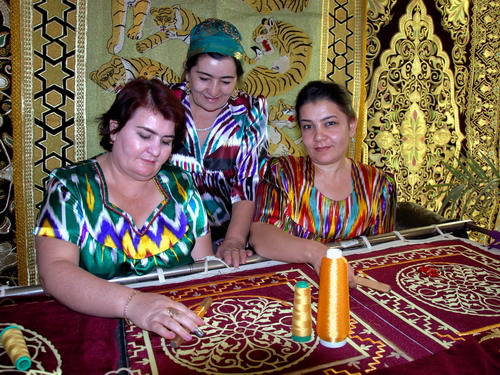
Zarduzi or gold-thread embroidery is a delicate craft passed down from masters to apprentices in guilds throughout Samarkand.

photo0jpg-1
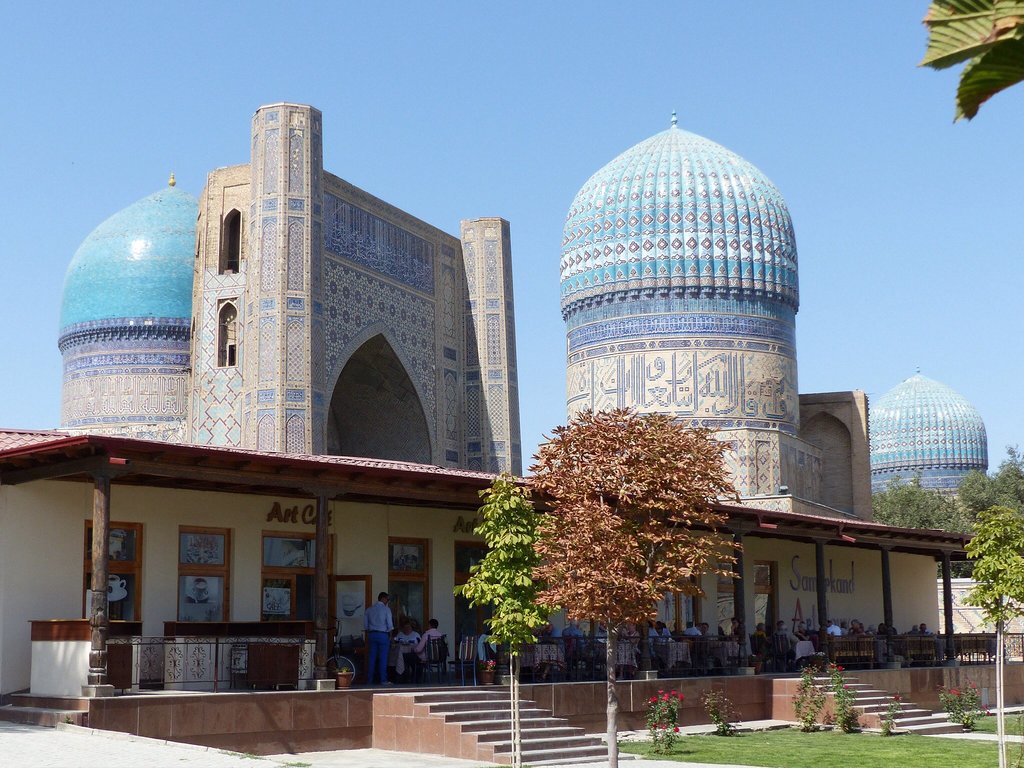
According to local lore, Masjid-i Bibi Khanym (c. 1404 A.D.) in Samarqand was commissioned by Timur’s favorite wife, Bibi Khanym, in honor of his return from a campaign in India. The two lateral sanctuaries flanking the main iwan each feature an elegant melon-shaped, longitudinally ribbed cupola whose outer shell is adorned with polychrome glazed ceramic tiles. Stalactite cornices form the articulation between each dome and a high cylindrical drum ornamented with belts of thuluth inscriptions 

LANGUAGE

Today, mutual intelligibility between the Persian vernacular spoken in Uzbekistan and those in Iran, Afghanistan and Tajikistan is limited without training. Beyond obvious differences in core lexicon and phonology which would otherwise constitute surmountable dialectical variation, easy intelligibility is hindered by pervasive Uzbekisms that are otherwise alien to Persian grammatical canons. These influences include a greater tendency towards agglutination, such as in the form of prepositional suffixes, as well as a complex system of conjunct auxiliary verbs which furnish participles with metaphorical ‘modes of action’, among others. Some of the salient features of the Samarqand and Bukhara dialects vis-à-vis Western Persian are outlined here.

*note: The future of the official orthography for the Uzbek language–that is, Cyrillic vs. Latin script–is currently the subject of heated debate. The Latin script (Lotini) will be used in this article. In contrast, the Standard Tajik language is written in a modified Cyrillic script, and official Tajik-language newspapers published in Uzbekistan also use this orthography.

GRAMMAR AND MORPHOLOGY
The Persian directional preposition به /be/ “to, towards” is a suffix in Samarkand Tajik (-ба /ba/), and its function is more versatile, occupying a variety of semantic fields corresponding to the diversified Uzbek use of -da, -ga. This constitutes a departure from both Standard Tajik and Western Persian vernaculars–wherein prepositional suffixes are absent–and a convergence with Uzbek Turkic agglutinative structure:

UzbekSamarkand TajikWestern PersianEnglish
Qozonda tuz tushdilarДегба намак рехтан
Degba namak reḵtan
 نمک توى ديگ ريختن
Namak tūye dīg ritan
They poured salt into the pot
Bizlarga non beringlarМоҳонба нон детон
Mohon
ba non deton
به ما نان بديد
Be
mâ nân bedid
Give us bread (“to us”)
Bolalar uchun yangi maktab ochdilarБачаҳонба мактаби нав гушодан
Bačahon
ba maktabi nav gušodan
مدرسه جديدى براى بچهها باز كردن
Madreseye jadidi barâye baččehâ bâz kardan
They opened a new school for the children
Shungaҳаминба
Hamin
ba
به خاطر همين
Be âtere
hamin
For this reason
Toshkentga kelganimdaТошкентба омадамба
Toškent
ba omadamba
وقتى كه به تاشكند آمدم
Vaghti ke
be Tâškand âmadam…
When I came to Tashkent…
Onam bu mavzu haqida gapirib qoldiМодарам ин мавзуба суҳбат карда монд
Modaram in mavzuba suhbat karda mond
مادرم شروع كرد راجع به اين موضوع صحبت كردن
Mâdaram shoru’ kard
râje’ be in mowzu’ sohbat kardan
My mother suddenly began to talk about this subject
Tepada turganТаппаба истода
Tappa
ba istoda
روى تپه ايستاده
Rūye
tappe istâde
Standing on top of the hill

As such, the prepositional suffix -ба /-ba/ is very powerful indeed in that it is encountered in a remarkable number of semantic fields corresponding to Western Persian توى tūye “in, into”, به be “to”, براى barâye “for”, به خاطر be ḵâtere “for [a reason], وقتى كه vaghti ke “when”, راجع به râje’ be “about”, بر روى bar, rūye “on, atop.” In formal speech, the more specified prepositions are used. Finally in the ablative and locative constructions, /-ba/ may occur in fields in which it would be considered redundant in Western Persian: haminjaba “right here” (literally “in right here”), a feature which is shared with dialects in northern Afghanistan (da inja).

Note: The dialect of Bukhara uses a unique ablative case suffix -бан /-ban/ “from”: Наманганбан Фаргонаба рафтем Namanganban Farġonaba raftē“We went from Namangan to Ferghana.”

Northern Tajik has developed numerous prepositional suffixes such as кати -kati or truncated ки –ki “with” (also found in Afghan dialects, as a prepositional prefix قت qat-e), барин -barīn “like”, and баъд /-ba’d/, пас /-pas/, апушта a’ pušta “after”. For example, dadem-kati Khuqandba raftēm (Uzbek: otam bilan Qo’qonga ketdik) “I went to Kokand together with my father”; man ham kalon šavam bobom-barīn tariḵčī šudanī (Uzbek: men ham katta bo’lganimda, otam kabi tarikhchi bo’laylik) “When I grow up, I want to become a historian like my father”; in suruda navistan-ba’d (Uzbek: bu qo’shiqni yozishidan keyin) “after writing this song…”, whereas enclitics are absent in Western Persian: ba’d az neveštan-e in âhang. These examples are represented in table form below:

UzbekSamarkand TajikEnglish
otam bilan Qo’qonga ketdikдадем кати Хуқандба рафтем
dadem
-kati Khuqandba raftēm
I went to Kokand together with my father
men ham katta bo’lganimda, otam kabi tarikhchi bo’laylikман ҳам калон шавам бобом барин тарихчӣ шуданӣ
man ham kalon šavam bobom-
barīn tariḵčī šudanī
When I grow up, I want to become a historian like my father
bu qo’shiqni yozishidan keyinин суруда навистан баъд
in suruda navistan
-ba’d
After writing this song

The superlative construction uses an Uzbek loan eng in place of Standard Persian ترين –tarīn: eng baland “the tallest” (Western Persian: بلندترين boland-tarīn).

In addition, a number of native Persian constructions have evolved to mirror Uzbek. These include:
1) anī construction, parallel to Uzbek –moqchi signifying will or intent (discussed below), and all of its derived uses with + bo’lmoq“to be, become”
2) onda construction, parallel to Uzbek -yotgan signifying a continuous action

UzbekSamarkand TajikWestern PersianEnglish
Agar dasturda qatnashmoqchi bo’lsangizАгар барномаба ширкат карданӣ
бошетон…
Agar barnomaba širkat kardanī bošeton
اگر بخواهيد در برنامه شركت كنيد…
Agar beḵwâhid dar barnâme
šerkat konid…
“If you would like to participate in the program…”
Olov uyni yondirmoqchi bo’lardi, lekigin ko’klamgi yomg’ir uni bartaraf etganАлов хоная сухтанӣ мушуд, аммо борони баҳорӣ вая хомуш кард
Alov xonaya suxtanī mušud, ammo boroni bahori vaya xomuš kard
آتش ميخواست خانه را بسوزد، ولى باران بهارى آتش را خاموش كرد
Ataš miḵwâst ḵâna râ besuzad, vali bârâne bahâri âtaš râ ḵâmuš kard
“The fire was about to burn the house, but the spring rains extinguished it”

Communal commands follow the Uzbek pattern using the past tense of the 1st person pl.: рафтем raftēm “let’s go” (literally: “we went”, often preceded by набошад nabošad; compare Uzbek ketdik bo’lmasa) as opposed to Western Persian which uses the subjunctive prefix /be-/: برويم beravīm. The second person plural enclitic is -етон -eton (Western Persian: يد-īd):

Northern Tajik

Western Persian

English

дастатонба гиретон
dastatonba gireton

تو دستتان بگيريد
tu dastetân begirīd

“Hold [it] in your hands”

гуетон
gūyeton

بگويد
begūīd

“Say!” (pl., command)

09-Bukhara-2013
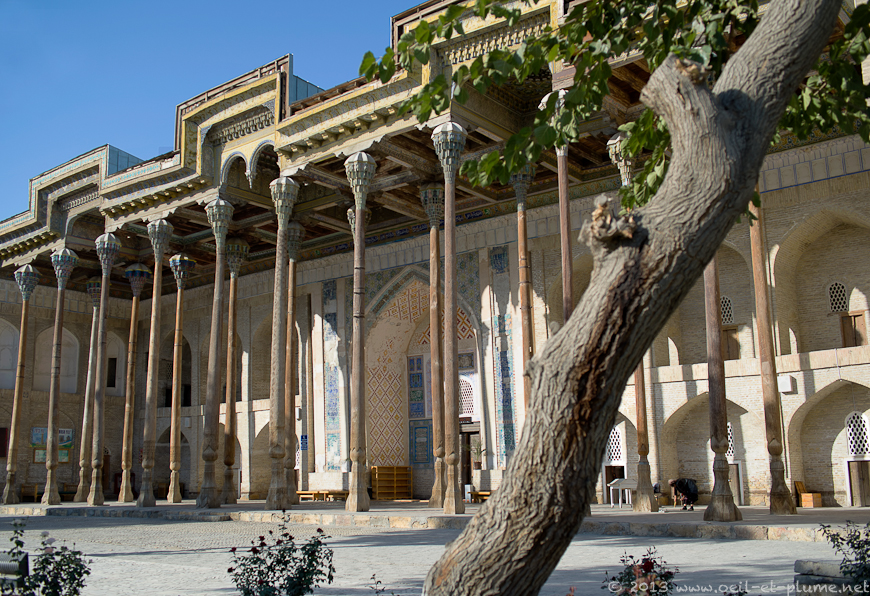
Masjid-i Bolo Hauz (c. 1712 A.D.) Bukhara, Uzbekistan. The most striking feature of this mosque are the twenty slender wooden columns, each comprised of two trunks bound together by metal rings, and crowned with painted stalactite capitals. The mosque takes inspiration from Safavid pavilion forms, such as the Chehel Sotun Palace in Isfahan, Persia.

Tajik-Uzbek artist Munira Mukhammedova, a native of Bukhara, performs the Persian song “Ey Nigori Nozanin” in the Khan’s palace in Bukhara

The Uzbek emphatic/intensifying modal particle -ku or a Tajik equivalent -da is used when there is doubt whether the interlocutor is aware/sure about the information, or in order to intensify the sentiment: xама ҷоиба ҳамту-ку! hama joyba hamtu-ku! “It’s like this everywhere!” (cf. Uzbek hamma joyda shunday-ku!); мушудаст-ку mušudast-da! “Bravo!” (calqued from Uzbek bo’lardi-ku; note alternative expressions are also used: Standard Tajik офарин ofarin and Russian молодец/молодцы molodets’/molodts’y.)

Another peculiarity of Northern Tajik is the present continuous tense of the verb. In contrast to Western Persian, the formal register of the language employs a construction consisting of the past participle followed by a conjugated form of the desemanticized verb истодан istodan (originally meaning “to stand”) in lieu of Western Persian داشتن dâštan (“to have”). This feature is shared with Standard Tajik. However, the informal register of the language employs a contracted reflex of this past participle + istodan form, resembling the Uzbek focal present form –yap-, whereby -[i]s- in Samarkand and -ašt- in Bukhara:

Samarqand Tajik (colloquial)Standard Tajik Western Persian
(colloquial)
English
mehnat kaisemмеҳнат карда истодам
mehnat karda istodam
دارم زحمت مى كشم
dâram zahmat mikešam
I am working hard [currently]
davom daisemдавом дода истодам
davom doda istodam
دارم ادامه ميدم
dâram edâme midam
I am continuing
omaisas омада истода
omada istoda
داره مياد
dâre miyâd
S/he/it is coming
varaq zaisemварақ зада истодам
varaq zada istodam
دارم ورق ميزنم
dâram varaġ mizanam
I am turning the page
kalon šusenкалон шуда истодан
kalon šuda istodan
دارن بزرگ ميشن
dâran bozorg mišan
They are getting bigger
chi puxseton?чӣ пухта истодаед?
chi puḵta istodaed?
چي داريد ميپزيد؟
chi dârid mipazid?
What are you(pl.) cooking?

An alternate use of desemanticized гаштан gaštan (originally meaning “to roam, wander”) for the auxiliary usually gives a perfect progressive sense: kor karda gašta-ast “he has been working.”

Characteristic of Northern Tajik spoken in Uzbekistan are conjunct (or serial) verbs, of which the progressive tenses (see above) are grammaticalized instances. There are some eighteen lexically established conjunct auxiliaries corresponding to models in Uzbek, which in regularly conjugated tenses furnish adverbial ‘modes of action’ for the non-finite participle—which is, semantically speaking, the main verb. Some are fairly literal in sense:  kitob-mitob ḵarida mebarad “he buys (up) books and stationery (and takes them away with him),” to highly metaphorical: in adrasa pūšida bin “try on this resist-dyed tunic” (дидан/бин didan/bin- ‘to see,’ tentative mode; cf. Eng. “see if it fits”). Other typical conjunct auxiliaries are гирифтан giriftan ‘to take’ (self-benefactive): dars-i nav-ro navišta giriftem “we copied down the new lesson”; додан dodan “to give” (other-benefactive): nom-i ḵud-ro navišta mēdiham “I shall jot down my name (for you)”; партофтан partoftan “to throw (away)” (complete or thorough action): berunho-ya toza karda rūfta parto! “sweep all the outside nice and clean!” This last illustrates a double conjunct construction, the auxiliary governing both of the non-finite forms of руфтан rūftan “to sweep” and тоза кардан toza kardan “to clean” (a typical Persian-type composite verb).

Colloquially, the copula is omitted: вай номашон Дилбар vay nomashon Dilbar “Her name [is] Dilbar.” Non-finite verb forms are used much like in Uzbek: шумо озмойш карданӣми? šumo ozmoiš kardani-mi? “Are you going to give it a try?”; ин маҳаллаба моҳон чил у панҷ сол яша кадагӣ; In mahallaba mohon chil u panj sol yaša kadagi “We have lived in this neighborhood for forty-five years”; ман дар бораи чашмаҳо китоб навистагӣ man dar borayi čašmaho kitob navistagi “I have written a book about fresh water springs”.

photo0jpgdecorations-on-the-entrance.jpg
palast-ak-saray
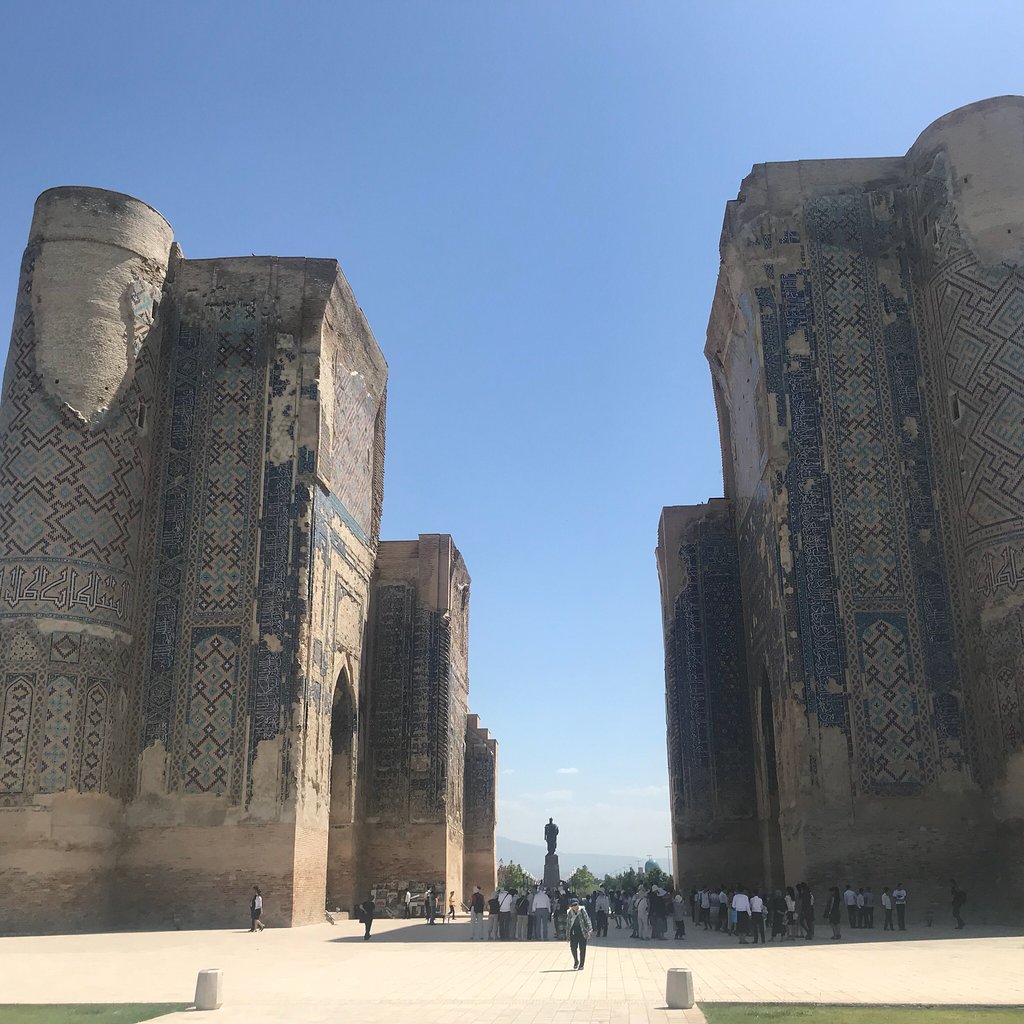
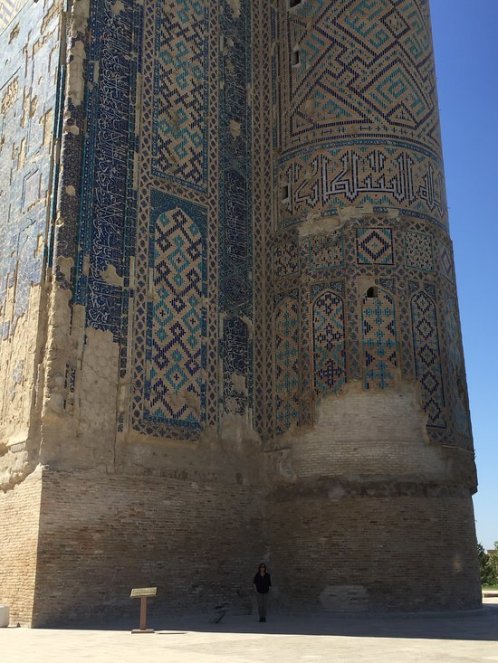
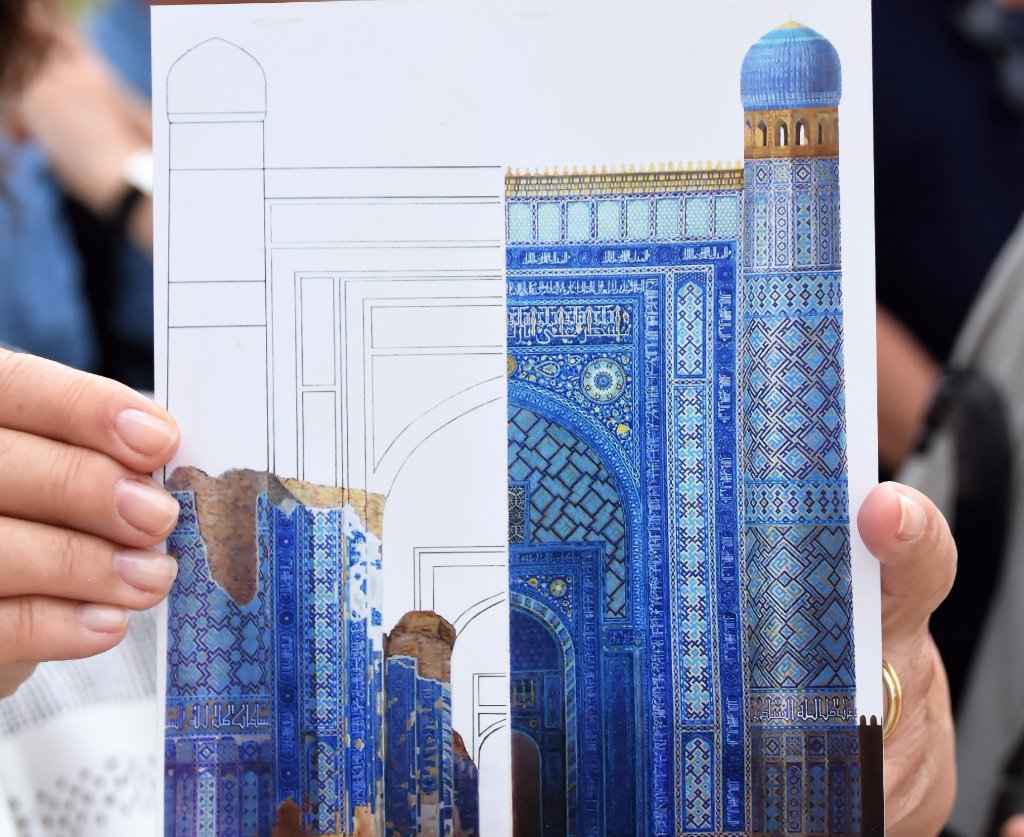
Remains of the entrance portal to Timur’s royal palace “Oq Saroy” at Shahrisabz, Uzbekistan. The Spanish ambassador, Ruy Gonzalez de Clavijo, who passed through Shahrisabz in 1404, was astounded by the structure’s enormous scale and elaborate ornamentation using dark blue- and turquoise-colored glazed ceramic tiles. Brick mosaic work, forming large geometrical and epigraphic designs on a background of polished building brick, affords the portal a special softness of color and an air of grand mystery. Calculation of the proportions of the surviving elements of the site makes it fairly certain that the height of the main portal reached 70 m (230 ft). It was topped by arched pinnacles (ko’ngra), while corner towers on a multifaceted pedestal were at least 80 m high. Today, only the lower segment of the pillars and part of the arch remain.

Occasionally the contracted enclitic form of the 1st person copula is substituted wholesale from Uzbek. This occurs particularly at the end of the -anī construction, which is based on Uzbek –moqchi signifying will or intent, whereby -man instead of Persian -[hast]am: Man bukhorocha usluba yod giftaniman “I intend to learn the Bukharian style [of embroidery]”; man unjaba raftaniman “I want to/will go there” (Uzbek: men uyerga ketmoqchiman).

*Note: in the first example above, the Uzbek construction bukhorocha uslub is used instead of Persian uslūbi bukhoroi, which is considered canonical.

Representing another radical departure from Persian syntax and morphology, colloquial Northern Tajik displays synthetic relative constructions in lieu of post-nominal subordinate or relative clauses (e.g. constructs using Persian ke که “that”; although, these do exist in the formal register and Uzbek through Tajik influence). It instead mimics Turkic nominalized clauses:

UzbekSamarkand TajikWestern Persian English
U aslida menga do’st emasligini tushundim Vay aslašba manba do’st nabudageša famidamFahmidam ke u dar haqiqat dust-e man nistI realized that he/she is not really my friend
Sizlarga ham kattakon raxmat o’yinimizda qatnashganingiz uchunŠumohonbayam raxmati kalon bozemonba qati šudagetonbaAz shomâ ham kheyli mamnun ke dar bâziye mâ sherkat kardidThank you very much too for partaking in our game
Chunki u hayotda baxt nimaligini bilmagan odam, shuning uchun sevgiga ishonmaydiChunki u xayotba baxt chi budageša namedonistagi odam, azbaroi hamin naġz didanba bovar namukunadChon u âdami ast ke tâ hâlâ nadâneste khoshbakhti dar zendegi chist, be hamin dalil be eshgh bâvar nadâradBecause he is a person who has not known what happiness is in life, that’s why he doesn’t believe in love

Northern Tajik makes extensive use of the verbs баромадан baromadan (coll. buromdan) “to come out” and баровардан barovardan (coll. burovardan) “to bring out”, which are parallel to the versatile Uzbek verbs chiqmoq and chiqarmoq, respectively. For example: Зўр буромадаст zōr buromdast “It came out great/wonderfully” (cf. Uzbek zo’r chiqibdi). Notably, these verbs are conjugated with the affix bar- treated as part of the verb stem. Баровардан barovardan is sometimes used in lieu of the Western Persian verbs بردن، آوردن bordan, âvardan “to take”, “to bring.” For example: писар хиёнат кунад агар, духтар кечири мукунад лекин ҳеч вақт а есаш намубурорад pisar iyonat kunad agar, dutar kečiri mukunad lekin heč vaġt a’ esaš namuburorad “If a guy cheats, the girl will forgive him but she will never forget it” (cf. Western Persian: از یادش نمى برد az yâdaš nemibarad; cf. Uzbek: yigit xiyonat qilsa agar, qiz kechiradi lekin hech qachon esidan chiqarmaydi.)

The Turkic interrogative particle -ми –mi is used in final position, or as an enclitic on the component questioned. In Western Persian, a construction using آيا âyâ is optionally used:

UzbekBukhara/Samarkand TajikWestern PersianEnglish
Siz Buxoro shahrini yaxshi ko’rasizmi?Шумо шаҳри Бухороя нағз мебинедми?
Šumo šahri Buoroya naġz mebined-
mi?
آيا شما شهر بخارا را دوست داريد؟
Âyâ
šomâ šahre boârâ râ dust dârid?
Do you like the city of Bukhara?
Otasi bilan tanishdingmi?Падараш кати шинос шудими?
Padaraš-kati šinos šudi-mi?
با پدرش آشنا شدى؟
Bâ pedaraš âšenâ šodi?
Did you meet his father?

Occasionally, a construction signifying ownership is calqued from the Uzbek nominal predicate bor, whereby: pronominal enclitic + ҳact hast (“to exist”) instead of the Persian verb داشتن dâštan (“to have”): Tuya eng naġz mididagi aktriset hast-mi? Ha, hast (Uzbek: Senda eng yaxshi ko’radigan aktrising bormi? Ha, bor.) “Do you have a favorite actress? Yes, I do.” The corresponding optional construction for “to not have” is based on Uzbek yo’q, whereby: pronominal enclitic + нест nēst (“to not exist”) instead of the Persian verb نداشتن nadâštan (“to not have”): хабаромо нест abaromo nēst (Uzbek: xabarimiz yo’q) “I don’t have knowledge [of that].”

The Western Persian deontic modality using بايد bâyad is not encountered colloquially, but is used infrequently in the literary register. Instead, the auxiliary даркор darkor is placed following the clause. This construction mirrors the Uzbek form using kerak:

UzbekSamarqand TajikWestern PersianEnglish
Kelajakda shundan ham ko’proq harakat qilishimiz kerakОяндаба аз ин ҳам зиёда ҳаракат кардагомон даркор
Oyandaba az in ham ziyoda harakat kadagomon darkor
در آينده بايد از اين هم بيشتر تلاش كنيم
Dar
âyande bâyad az in ham bištar talâš konim
In the future, we have to try even harder than this

In contrast to Western Persian, the reporting of speech centers on гуфта gufta (occasionally гуйон gūyon), a non-finite form of гуфтан guftan “to say” with the speech string preceding, forming a sort of idealized quotation to explain the cause or purpose of the action in the main clause. It also the proceeds the statement of an opinion. This form has evolved on the analogy of a typically Turkic construction, using deb/degan “saying” in Uzbek:

UzbekBukhara/Samarkand TajikEnglish
Onamiz doimo yaxshi xizmat qilinglar, hech qachon boshqa odamlarga yomon gaplar aytmanglar deb bizlarga o’rgatib kelganOčamon hameša naġz xizmat kuneton, hečvaght hečkasba gapi ganda nazaneton gufta mohonba yod doda omadagiOur mother has always taught us to work hard, and to never speak disrespectfully to others.
Agar ota-onam topgan bol’salar demak yaxshi bola deb o’ylayman Agar xonangom yoftagi boshan demak naġz bachcha gufta o’yla mukunamIf my parents found him, then I think he is a good guy

022_Klub_puteshestviy_Pavla_Aksenova_Uzbekistan_Samarkand_Registan_Medrese_Sherdor_Foto_efesenko_-_Depositphotos-1024x623
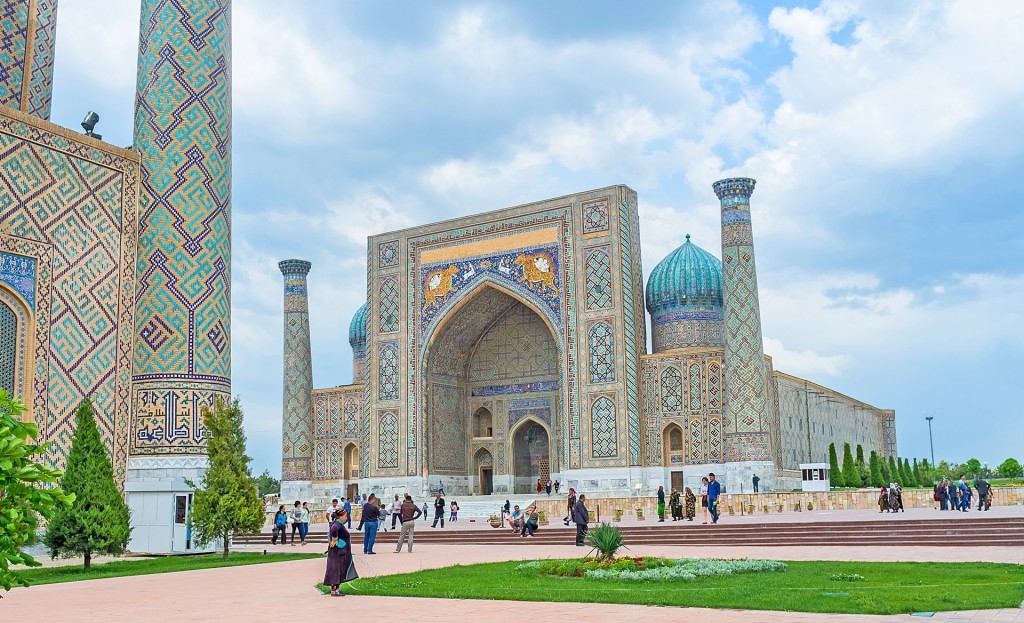
Madrasa-i Sherdor (c. 1636 A.D.) in Registan square, Samarkand, Uzbekistan. “Sherdor” translates to “baring lions” in Persian.

LEXICON

Northern Tajik features numerous archaisms, as well as neologisms and loanwords from Uzbek and Russian. In some instances, alternative native forms vis-à-vis Western Persian have developed or been differentially favored over time: such as the suffix –kati or simply -ki for Western Persian “with” (also found in Afghan dialects as a preposition qat-e); ganda for Western Persian bad “bad”; kalon for bozorg “big”; xursand for xošhâl “happy”; pagah for fardâ “tomorrow”; mayda, xurd for kučak “small, little, young”; šifokor for pezešk “doctor”; san’atkor for honarmand “artist; singer”; tayyor for âmâde, hâzer “ready”; anakun, akun for al’ân, aknun “now”; iflos for kasīf “dirty”; pēš, soni for qabl, ba’d “before, after”; –barin for mesle “like”; o’īd ba for râje’ be “about, concerning”; pazandagi for âšpazi “cooking”; harakat kardan for sayy’ kardan, talâš kardan “to try”; sar šudan for šoru’ šodan “to start”; daromadan for vâred šodan “to enter”; bevaqt for dir “late”; monda, halok for xaste “tired”; šištan for nešastan “to sit”; partoftan for raftan “to leave”; xezedan for pâ šodan “to rise, get up”; mondan for gozâštan “to place, to lie (object onto a surface)”; fursondan for ferestâdan “to send”; foridan, whence foram “pleasing”, for oš âmadan “to please”; allondan for farib dâdan “to cheat, delude”; koftan/kobedan for jostojū kardan “to look for, search”; mazmun for ma’ni “meaning”; jindi for divâne “crazy”; mehnat for zahmat “exertion; duty to another according to prevalent Iranian social ideals”; yoftan for peydâ kardan “to find”; dastgiri for komak “help”; chuva for cherâ “why”; yakjoya for bâ hamdigar “together”; sonitar for ba’dan “then, after”; apušti for donbâl-e “follow, pursuit”; azbaroi or postposition baroš for barâye, vâse “for; for the purpose of”; darkor for lâzem, bâyad “need”; minnatdor for mamnūn “thankful”; xunuk for zešt “ugly”; naġz (Samarkand) and sara (Bukhara) for Western Persian ūb “good; nēk for qašang “beautiful, nice”; ušrő and dősrő for zibâ “beautiful”, among others.

There are a few verbs which function differently from Western Persian, such as буровардан burovardan for درست كردن dorost kardan “to make, to produce”. In this case, the adjunct bar- is treated as part of the radical: hence, present tense mebarorand instead of bar meyorand “they produce.” Additionally, the verb омадан omadan “to come” in the present tense uses the stem biyo- instead of â-mebiyod instead of miâyad.

Common loanwords from Uzbek include qiziq for jâleb “interesting”; qiyin for saxt, moškel “difficult”; ovqat for ġazâ “food”; omad for xošbaxti ‘”good fortune, luck”; yigit for mard “boy, young man”; yordam for komak “help”; juda for xeyli “very”; yaša kardan for zendegi kardan “to live”; őyla kardan for fekr kardan “to think”; qišloq for deh “village”; turmuš, tōy for ezdevâj, arusi “wedding”; kelin for arus “bride; yošagi for bačegi “childhood”; qiziqi kardan for alâghe dâštan “to take interest in”; es for yâd “memory”; butun for kâmelan “completely”; rivojlani for pišraft “development, progress”. As discussed above, the majority of Persian speakers in Uzbekistan are bilingual in both Persian and Uzbek.

In some cases, phraseology has been calqued from Uzbek, such as Tajik naġz didan for Uzbek yaxshi ko’rmoq “to like; love” (but literally “to see as good”).

Russian loans dating to the Soviet period are more numerous than those found in Standard Tajik, which has replaced most Soviet-era loans with native forms. The lexemes are usually technical terminology pertaining to science, transport, technology and government administration: вокзал vokzal “train station”, аеропорт aeroport “airport”, операция operatsiya “operation”, композитор kompozitor “musical composer”, реконструкция rekonstruktsiya “reconstruction”, ассоциация assotsiatsiya “association”, рестоврация restovratsiya “restoration”. Some Russian loanwords have been assimilated to the native phonology, such as корейс Koreiis “A member of the Soviet Korean community in Uzbekistan” (Russian has корейц Koreiits’).

po-i-kalyan_mosque_with_kalyan_minaret86d6c18da36588b50670e621f1870b1e
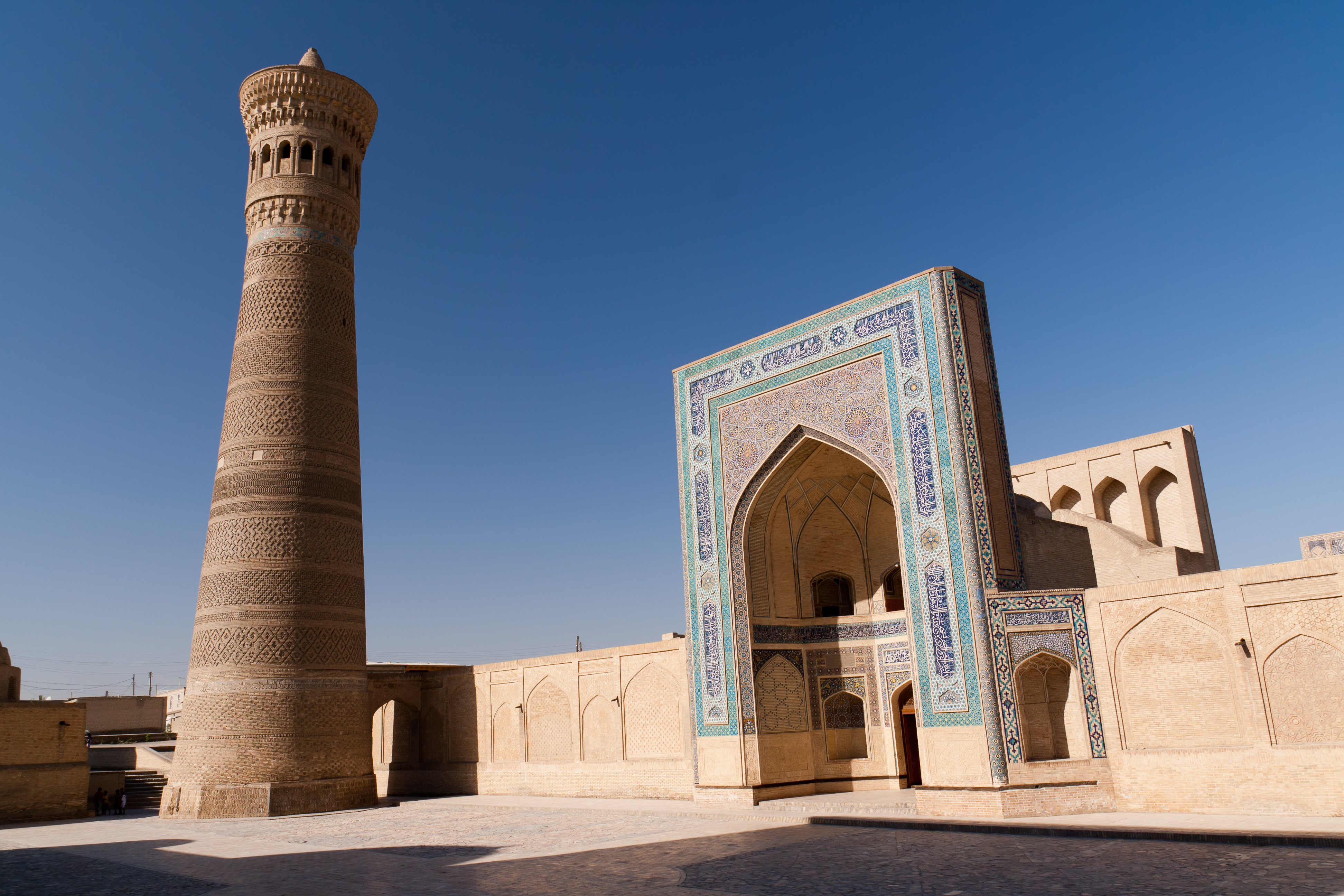
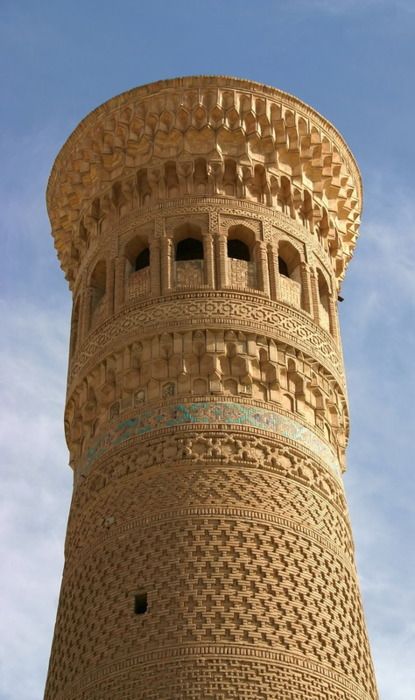
The Kalon Minaret (Минораи Калон “Great minaret”), designed by “Bako” according to the frieze, was commissioned by the Qarakhanid ruler Mohammad Arslan Khan in 1127 A.D. and stands at 48 m (157 ft). Proving the versatility of sun-baked brick, each band is composed of either circular, square or rectangular bricks arranged in differing patterns to give an extraordinary texture. The body of the minaret is topped by a rotunda with 16 arched fenestrations forming a gallery, which is in turn is crowned by a magnificent cornice adorned with muqarnas (stalactites) and a pointed conical stump.

The pronouns are similar to those in Southern Tajik, including вай vay and вайхо vayho for the 3rd person singular and plural. This has been elaborated colloquially to mean “he”, “she”, “it”, and “that”. In Western Persian, its equivalent وى vey is only encountered in the meaning of “he, she” and its use is restricted to the literary register, particularly in media and news broadcast, while it is never encountered colloquially.

The Persian 1st person pl. pronoun ما mâ “we” is used with a plural suffix forming an ‘explicit plural’, which may also refer deprecatingly or deferentially to a singular person: моҳон mo-hon “I/We” (often heard as мон mon); while mo without a plural suffix is heard in compounds: mo-yam gɵsh metemda “we are listening [right now] too“, otherwise its use is restricted to the literary register. Similarly, šumo ‘you’ (sg. or pl.) becomes šumo-yon, šumo-ho ‘you (pl.)’. 

The deferential pronoun ešon for 3rd person plural (“he, she,” lit. “they;” cf. Pers. ايشان išān) evolved into an honorific title for religious notables, and has been replaced in Northern Tajik by ин кас in kas or ун кас un kas (lit. “this person”, “that person”). 

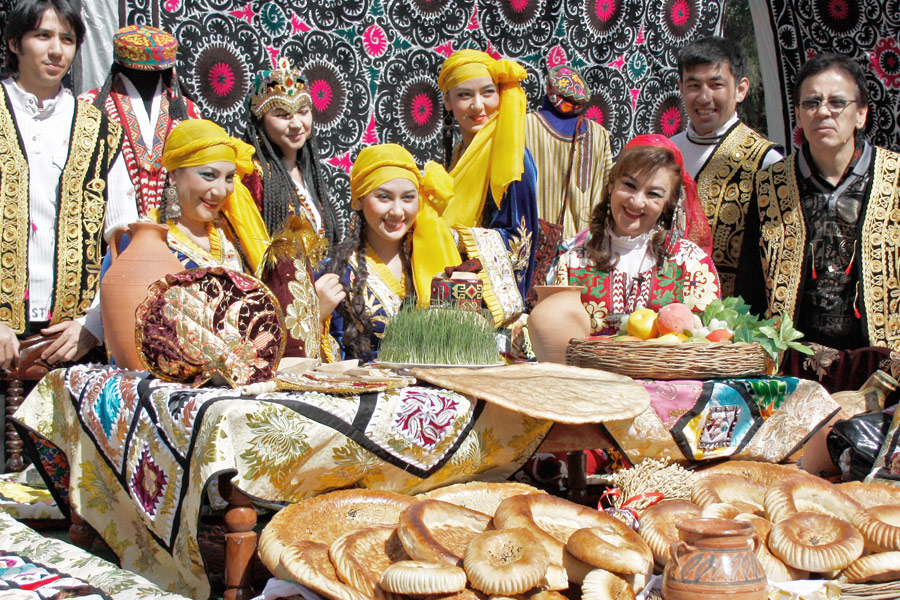
navruz3
Tajik-Uzbek artist Munira Mukhammedova (right) at Navruz (Persian New Year) celebration in Tashkent, Uzbekistan.

Tajik artist Sitora Karomatullo performs traditional Samarqandian maqom piece “Ranjidi Az Man” in the local Tajik Persian language in Samarqand (refrain lyrics below, translation by the author)

Tajik Persian: Чи кардам, ин ки ту дил канди аз мано; Зи роҳи ваъдаи худ рафта берун (či kardam inki tu dil kandi az mano, zi rohi va’dai ud rafta berun)
English: What did I do, that you have torn your heart away from me? That you have transgressed from the path of your own promises?

PHONOLOGY
Bukharan Tajik and the dialect of Samarkand belong to the Northern dialects, which share basically the same phoneme inventory.

There are differences in pronunciation between Northern Tajik spoken in Uzbekistan and the dialects of Tajikistan. Colloquially, certain words are transformed rather radically, following a pattern whereby medial consonant clusters are truncated or omitted entirely, such as giftan or gitan for гирифтан giriftan “to take; to get”; kadan for кардан kardan “to do” (the latter also found in Afghan dialects).

Additionally, Northern Tajik–as opposed to Standard Tajik–has the phoneme /ő/, but the close-mid central vowel is pronounced /ū/ in Standard Tajik:

Samarkand TajikStandard TajikEnglish
mőgőt, mőgőftanmēga, mēguftanS/he says, they were saying
mukunatmēkunaS/he does
namőšődnamēšudIt couldn’t happen
dőstidūstiFriendship
gőštgūštMeat
őzbegūzbakUzbek

There are slight variations in pronunciation between the Tajik varieties in Bukhara and Samarkand cities:

Bukharan TajikSamarkand TajikEnglish
mēgőmmőgőmI say
dilom dard mēkunatdilam dard mukunatIt pains me (lit. “my heart hurts”)
Da bozor namērőmBozorba namőrőmI won’t go to the bazaar
Uno kadaštenVayon kaisenThey are doing it

Tajik direct object marker -ra becomes -a after consonants and -ya following vowels

Northern TajikStandard TajikEnglish
man tuya naġz mebinamman turo dūst medoramI love you


Sources:

Bhatia, Tej K. “Societal Bilingualism/Multilingualism and Its Effects.” The Handbook of Bilingualism and Multilingualism, 2012, pp. 439–442., doi:10.1002/9781118332382.part3.

Encyclopaedia Iranica

Finke, Peter. Variations on Uzbek Identity: Strategic Choices, Cognitive Schemas and Political Constraints in Identification Processes. 1st ed., Berghahn Books, 2014. JSTOR, http://www.jstor.org/stable/j.ctt9qck24.

Foltz, Richard. “The Tajiks of Uzbekistan.” Central Asian Survey, vol. 15, no. 2, 1996, pp. 213–216., doi:10.1080/02634939608400946.

Ido, Shinji. “Bukharan Tajik.” Journal of the International Phonetic Association, vol. 44, no. 1, 2014, pp. 87–102., doi:10.1017/s002510031300011x.